


Quantitative pediatric vision screening in primary care settings in Alabama
- PMID: 18772721
- PMCID: PMC2766866
- DOI: 10.1097/OPX.0b013e318185282a
Quantitative pediatric vision screening in primary care settings in Alabama
Abstract
Purpose: Alabama Medicaid reimburses "objective" vision screening (VS), i.e., by acuity or similar quantitative method, and well child checks (WCCs) separately. We analyzed the frequency of each service obtained.
Methods: Claims for WCC and VS provided between October 1, 2002 and September 30, 2003 for children aged 3 to 18 years, and summary data for all enrolled children, were obtained from Alabama Medicaid. We used univariate analysis followed by logistic regression to explore the potential influence of factors (patient age, provider type, and provider's volume of WCCs) on the receipt of VS at pre-school ages.
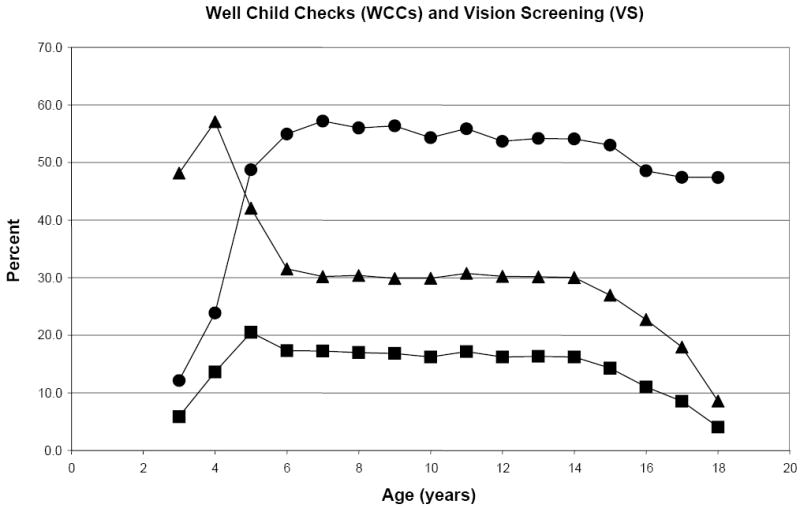
Results: Children receiving WCCs were 55% black, 40% white, and 5% other. Percentages of children with WCC claims were highest at 4 years (57%) and thereafter declined to 30% at 6 to 14 years and to <10% at 18 years. Nearly all VS (>98% at each age) occurred the same day as the WCC. Pediatricians provided 68% of all WCCs. Multivariate analysis, after adjusting for nesting of pre-school patients within provider, showed the odds ratios (ORs) of VS were increased by patient age (5 years vs. 3 years, OR = 3.57, p < 0.0001), nonphysician provider type (nonphysician vs. pediatrician, OR = 1.80, p = 0.0004) and high WCC volume (at or above vs. below the median number (n = 8) of WCC per provider per year (OR = 7.11, p < 0.0001)). Because VS rates were high when attendance to WCC visits was low, few enrolled children received VS at any age (6% at the age of 3, 13% at the age of 4, and a maximum of 20% at the age of 5).
Conclusions: National efforts to reduce preventable vision loss from amblyopia are hampered because children are not available for screening and because providers miss many opportunities to screen vision at pre-school age. Efforts to improve VS should target pediatrician-led practices, because these serve greater numbers of children.
Figures
References
-
- Committee on Practice and Ambulatory Medicine. Recommendations for preventive pediatric health care. Pediatrics. 1995;96:373–4. - PubMed
-
- Committee on Practice and Ambulatory Medicine and Section on Ophthalmology. Eye examination in infants, children, and young adults by pediatricians. Pediatrics. 2003;111:902–7. - PubMed
-
- Kvarnstrom G, Jakobsson P, Lennerstrand G. Visual screening of Swedish children: an ophthalmological evaluation. Acta Ophthalmol Scand. 2001;79:240–4. - PubMed
-
- Kvarnstrom G, Jakobsson P, Lennerstrand G. Screening for visual and ocular disorders in children, evaluation of the system in Sweden. Acta Paediatr. 1998;87:1173–9. - PubMed
-
- U. S. Department of Health and Human Services. Centers for Medicare and Medicaid Services. Overview. [January 3, 2008]. Available at: http://www.cms.hhs.gov/MedicaidGenInfo/
