


Review
doi: 10.1016/j.exer.2008.08.002.
Epub 2008 Aug 16.
The lens capsule
Affiliations
- PMID: 18773892
- PMCID: PMC2674021
- DOI: 10.1016/j.exer.2008.08.002
Item in Clipboard
Review
The lens capsule
Exp Eye Res.
2009 Feb.
Abstract
The lens capsule is a modified basement membrane that completely surrounds the ocular lens. It is known that this extracellular matrix is important for both the structure and biomechanics of the lens in addition to providing informational cues to maintain lens cell phenotype. This review covers the development and structure of the lens capsule, lens diseases associated with mutations in extracellular matrix genes and the role of the capsule in lens function including those proposed for visual accommodation, selective permeability to infectious agents, and cell signaling.
Figures
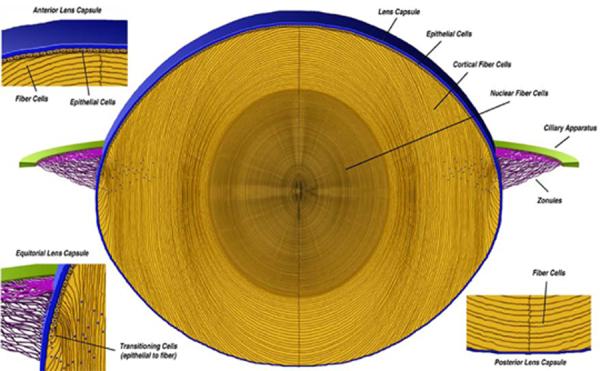
A cross section of an adult mouse lens showing the lens capsule (blue) surrounding the cellular lens (yellow). The anterior and posterior lens capsules are the basement membranes for the lens epithelial cells and the lens cortical fiber cells, respectively. In the equatorial region the lens capsule serves as the basement membrane for the epithelial cells differentiating into fiber cells and is also the site of zonule (purple) integration.
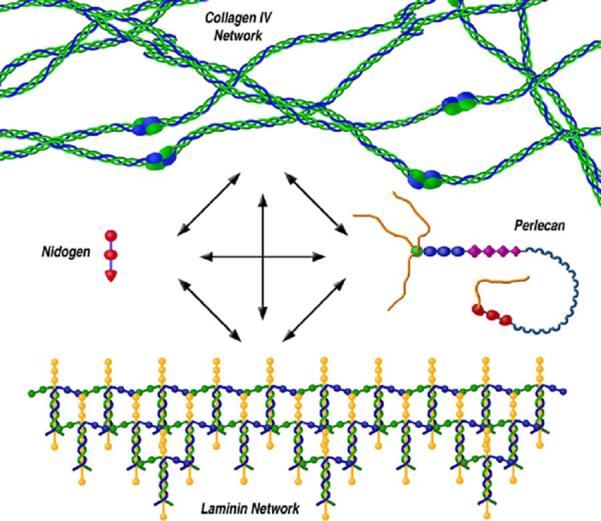
The lens capsule is a matrix of molecules consisting primarily of interacting collagen IV and laminin networks which are further bound together by nidogen and perlecan. The interactions between all four molecules and water create a viscoelastic membrane capable of withstanding and transmitting the forces of accommodation. Other molecules important for lens biology are also capable of binding to this scaffolding such as collagen XVIII and a variety of growth factors.
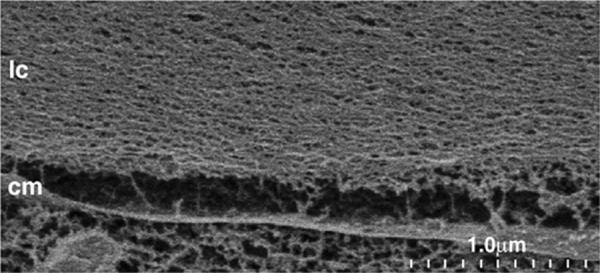
A cryo-SEM image (35,000X) showing lens capsule (lc) slightly separated from an epithelial cell membrane (cm). The meshwork structure of the capsule is apparent.
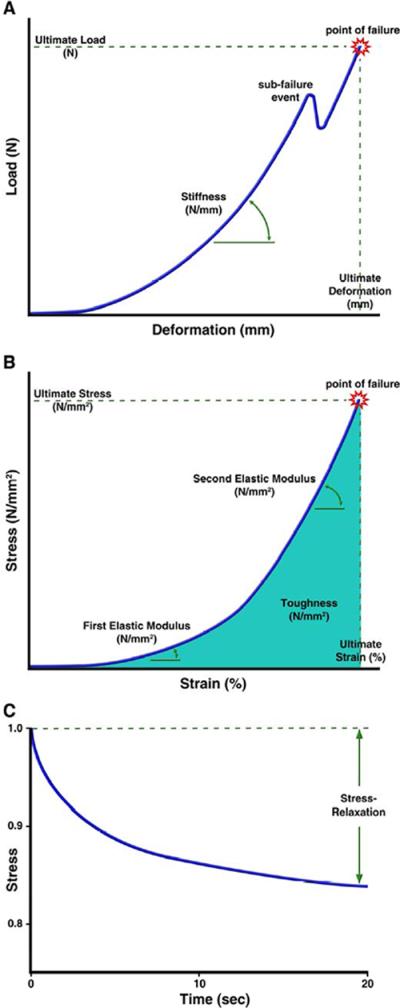
a) A load-deformation curve represents the capsule's structural parameters as a function of the capsule's geometry when an increasing uniaxial or biaxial load or deformation is applied. Stiffness is determined from a linear slope fit to this curve while ultimate load and deformation is the point of complete lens capsule failure. Sub-failure events represent the breaking of individual matrix bonds or tissue layers prior to complete failure. b) The load-deformation relationship is normalized into a stress-strain curve to account for differences in the dimensions of the capsule. This relationship represents the intrinsic properties of the lens capsule material. Elastic moduli are determined by fitting linear slopes to regions of the curve. The area under the stress-strain curve represents the toughness of the capsule while the ultimate stress and strains are determined at the point of lens capsule failure. c) Stress-relaxation is the responding change in stress over time after a constant strain is applied to a viscoelastic material. After the initial strain is applied (time zero) to the lens capsule, the matrix relaxes over time resulting in a reduction in stress. The stress-relaxation is reported as the percent stress relief after a given time as a result of the constant applied strain.
References
-
- Ammash NM, Sundt TM, Connolly HM. Marfan syndrome-diagnosis and management. Curr Probl Cardiol. 2008;33:7–39. - PubMed
Publication types
MeSH terms
Substances
Grants and funding
LinkOut - more resources
Full Text Sources
Other Literature Sources
