


Prevalence and risk factors of obesity in an urban population of healthy cats
- PMID: 18774325
- PMCID: PMC10832791
- DOI: 10.1016/j.jfms.2008.07.002
Prevalence and risk factors of obesity in an urban population of healthy cats
Abstract
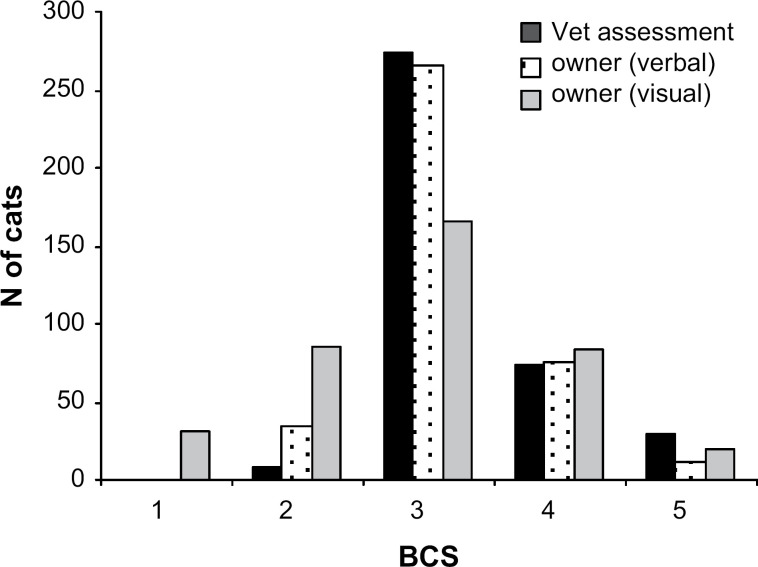
The incidence of overweight in cats has been reported in various studies to range between 6 and 52% depending on such factors as gender, neutering, age, being cross-bred, living in a single or two-cat household, no dog living in the household, inactivity, feeding fresh meat or fish, eating a premium or therapeutic food, distribution of food on a free choice basis and owner underestimation of their cat's body weight or body condition (BC). The purpose of this study was to assess the prevalence of overweight and to determine the risk factors associated with excess body weight, including owners' perception of their cat's BC in the studied population. Between March and June 2006, all owners presenting healthy cats for vaccination at the National Veterinary School of Alfort were questioned by a veterinarian using a standardised and validated questionnaire. Owners and veterinarians gave an oral evaluation of the cat's BC first verbally and then by comparison with a legend free visual scale. Univariate analysis was performed for all variables. Multivariate logistic regression analysis was applied to variables strongly associated with overweight or regarded as major risk factors. On a total population of 385 cats, 19.0% were found to be overweight and 7.8% to be obese. The evaluation of overweight cats' BC by their owner was better with the visual scale than with the verbal description. This study confirmed earlier reports identifying being male, neutering, and underestimation of the cat's BC by the owner, as risk factors for being overweight.
Figures
References
-
- Crane S.W. Occurrence and management of obesity in companion animals, J Small Anim Pract 32, 2002, 275–282.
-
- Lewis S.D. Obesity. Lewis L.D., Morris M., Hand M.S. Small Animal Clinical Nutrition III, 1987, Kansas: Topeka, 6.1–6.39.
-
- Mason E. Obesity in pet dogs, Vet Rec 86, 1970, 612–616. - PubMed
-
- Anderson R.S. Obesity in the dog and cat, Vet Ann 14, 1973, 182–186.
-
- Steininger E. Die adipositas und ihre diabetische behandlung, Weiner Tierarztliche Monatsschrift 68, 1981, 122–130.
MeSH terms
LinkOut - more resources
Full Text Sources
Miscellaneous
