. 2008 Dec 1;178(11):1123-9.
doi: 10.1164/rccm.200804-579OC. Epub 2008 Sep 5.

Evidence of a causal role of winter virus infection during infancy in early childhood asthma

Affiliations

Evidence of a causal role of winter virus infection during infancy in early childhood asthma

Pingsheng Wu et al. Am J Respir Crit Care Med. .

Abstract

Rationale: Bronchiolitis during infancy is associated with an increased risk of childhood asthma. Whether winter viral infections cause asthma or are a manifestation of a predisposition to asthma development is unknown.

Objectives: To study the relationship of winter virus infection during infancy and the development of childhood asthma.

Methods: We studied over 95,000 infants born between 1995 and 2000 and followed through 2005 who were enrolled in the Tennessee Medicaid program from birth through early childhood to determine whether infant birth in relationship to the winter virus peak alters the risk of developing early childhood asthma.

Measurements and main results: Among 95,310 children studied during five winter virus seasons from birth through early childhood, the risk of developing asthma tracked with the timing of infant birth in relationship to the winter virus peak. Infant birth approximately 4 months before the winter virus peak carried the highest risk, with a 29% increase in odds of developing asthma compared with birth 12 months before the peak (adjusted odds ratio, 1.29; 95% confidence interval, 1.19-1.40). Infant age at the winter virus peak was comparable to or greater than other known risk factors for asthma.

Conclusions: Timing of birth in relationship to winter virus season confers a differential and definable risk of developing early childhood asthma, establishing winter virus seasonality as a causal factor in asthma development. Delay of exposure or prevention of winter viral infection during early infancy could prevent asthma.


Figures
<b>Figure 1.</b>
Figure 1.
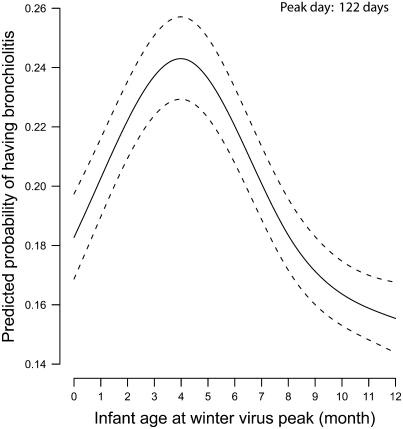
Predicted probability and 95% confidence intervals of bronchiolitis requiring a health care visit during infancy (hospitalization, emergency department visit, or outpatient visit) by infant age in months at the winter virus peak (formula image = 345.52; P < 0·001). Results were obtained from a multivariable logistic regression model. Effect was adjusted for gender, infant race, birth weight, gestational age, number of living siblings, region of residence, maternal smoking, marital status, maternal education, and season.
<b>Figure 2.</b>
Figure 2.
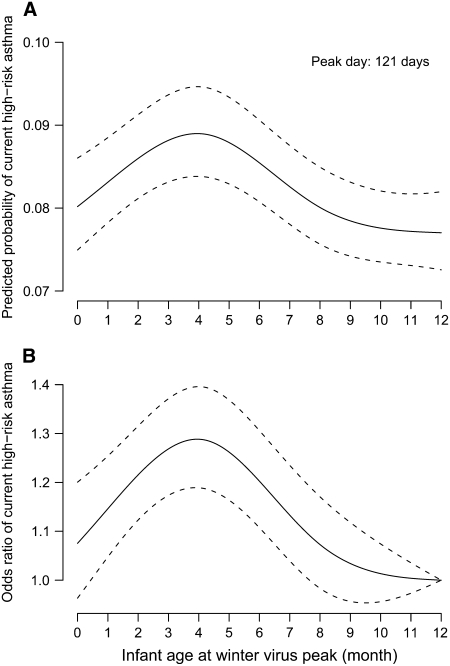
Differential risk of developing current high-risk childhood asthma in relationship to infant age at the winter virus peak. Results were obtained from a multivariable logistic regression model adjusted for gender, infant race, birth weight, gestational age, number of living siblings, region of residence, maternal smoking, marital status, maternal education, and season. (A) Predicted probability and 95% confidence intervals (CI) of developing current high-risk childhood asthma by infant age in months at the winter virus peak (formula image = 49.05; P < 0·001). The area under the curve is equal to the asthma prevalence of the population. (B) Adjusted odds ratio and 95% CI of developing current high-risk childhood asthma relative to children who were 12 months of age at the winter virus peak. Infants who were 1 year of age at the winter virus peak served as the reference group.
<b>Figure 3.</b>
Figure 3.
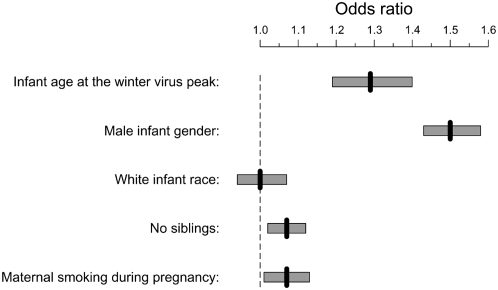
Adjusted maximum relative odds ratio and 95% confidence intervals (CI) of developing high-risk childhood asthma by infant age at the winter virus peak compared with other recognized asthma risk factors. Adjusted odds ratios (AOR) were obtained from a multivariable logistic regression model that adjusted for gender, infant race, birth weight, gestational age, number of living siblings, region of residence, maternal smoking, marital status, maternal education, and season. The comparison groups for the variables were infant age 121 days versus 365 days at winter virus peak, male versus female, white versus black, no siblings versus at least one living sibling, and smoking versus no smoking during pregnancy. Among the subgroup of infants in whom maternal history was available (n = 54,235), the AOR of developing high-risk childhood asthma by maternal asthma was 1.82 (95% CI, 1.64–2.03).
<b>Figure 4.</b>
Figure 4.
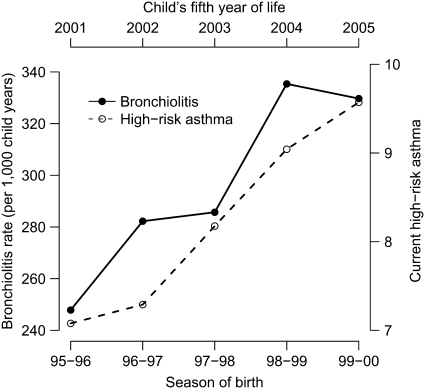
Bronchiolitis rate (per 1,000 child-years) of each study season (solid line) and current high-risk childhood asthma (dashed line) from 1995 to 2000. The childhood asthma curve is offset by 5 years from that of the bronchiolitis curve to represent the same group of infants who were later 5.5-year-old children.
<b>Figure 5.</b>
Figure 5.
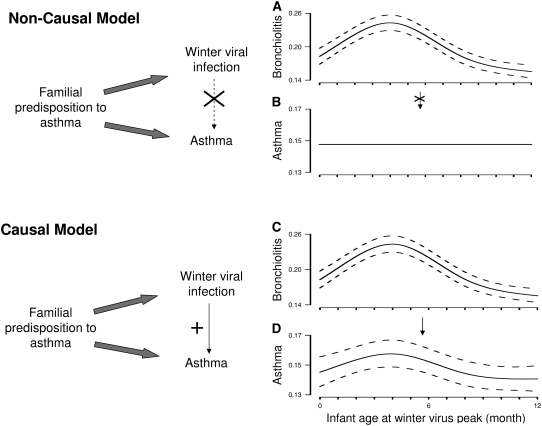
Noncausal and causal models of the relationship between winter viral infection and early childhood asthma. In the noncausal model, a common familial predisposition to asthma is associated with winter viral infection and asthma and is a confounder of the association between winter viral infection and asthma. Thus, timing of infant birth in relationship to winter virus peak has a seasonal effect on (A) infection but not on (B) asthma. In the causal model, although familial predisposition to asthma relates to winter viral infection and asthma, winter viral infection is in the causal pathway of development of asthma. Timing of infant birth in relationship to winter virus season relates to (C) bronchiolitis and (D) asthma risk in an identical way.

Comment in

References

    1. Asthma Facts from WHO Statistical Information System WHOSIS [accessed June 22, 2008]. Available from: http://www.who.int/respiratory/asthma/en
    1. Robertson SE, Roca A, Alonso P, Simoes EA, Kartasasmita CB, Olaleye DO, Odaibo GN, Collinson M, Venter M, Zhu Y, et al. Respiratory syncytial virus infection: denominator-based studies in Indonesia, Mozambique, Nigeria and South Africa. Bull World Health Organ 2004;82:914–922. - PMC - PubMed
    1. Sigurs N, Bjarnason R, Sigurbergsson F, Kjellman B. Respiratory syncytial virus bronchiolitis in infancy is an important risk factor for asthma and allergy at age 7. Am J Respir Crit Care Med 2000;161:1501–1507. - PubMed
    1. Sigurs N, Gustafsson PM, Bjarnason R, Lundberg F, Schmidt S, Sigurbergsson F, Kjellman B. Severe respiratory syncytial virus bronchiolitis in infancy and asthma and allergy at age 13. Am J Respir Crit Care Med 2005;171:137–141. - PubMed
    1. Henderson J, Hilliard TN, Sherriff A, Stalker D, Al Shammari N, Thomas HM. Hospitalization for RSV bronchiolitis before 12 months of age and subsequent asthma, atopy and wheeze: a longitudinal birth cohort study. Pediatr Allergy Immunol 2005;16:386–392. - PubMed

Publication types