


Review
doi: 10.1093/cvr/cvn243.
Epub 2008 Sep 8.
Apoptotic and non-apoptotic programmed cardiomyocyte death in ventricular remodelling
Affiliations
- PMID: 18779231
- PMCID: PMC2721651
- DOI: 10.1093/cvr/cvn243
Item in Clipboard
Review
Apoptotic and non-apoptotic programmed cardiomyocyte death in ventricular remodelling
Cardiovasc Res.
.
Abstract
A defining cellular event in the transition from compensated hypertrophy to dilated cardiomyopathy is cardiomyocyte drop-out due to apoptosis, programmed necrosis, and autophagy. The importance of apoptosis in heart failure has been recognized for over a decade, while other forms of programmed cell death have more recently been appreciated, and their pathophysiological roles continue to be defined in experimental and clinical heart failure. The major focus of this review is on apoptosis in heart failure, with a discussion of molecular cross-talk between apoptosis, autophagy, and programmed necrosis.
Figures
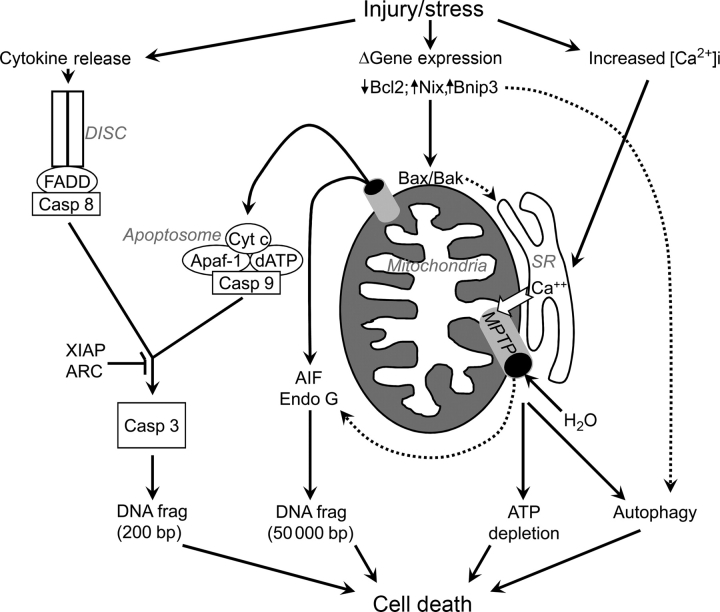
Schematic depiction of pathways leading to programmed cardiomyocyte death, as described in the text. Mechanisms of cell death (bottom) are, from left to right, caspase-dependent apoptosis, caspase-independent apoptosis, programmed necrosis, and authophagy. Solid lines show primary effects; interrupted lines depict cross-talk between pathways.
References
-
- Opie LH, Commerford PJ, Gersh BJ, Pfeffer MA. Controversies in ventricular remodelling. Lancet. 2006;367:356–367. - PubMed
-
- Blom AS, Mukherjee R, Pilla JJ, Lowry AS, Yarbrough WM, Mingoia JT, et al. Cardiac support device modifies left ventricular geometry and myocardial structure after myocardial infarction. Circulation. 2005;112:1274–1283. - PubMed
-
- Cheng A, Nguyen TC, Malinowski M, Langer F, Liang D, Daughters GT, et al. Passive ventricular constraint prevents transmural shear strain progression in left ventricle remodeling. Circulation. 2006;114:I79–I86. - PubMed
-
- Kass DA, Baughman KL, Pak PH, Cho PW, Levin HR, Gardner TJ, et al. Reverse remodeling from cardiomyoplasty in human heart failure. External constraint versus active assist. Circulation. 1995;91:2314–2318. - PubMed
Publication types
MeSH terms
Substances
Grants and funding
LinkOut - more resources
Full Text Sources
Other Literature Sources
Medical
