. 2008 Nov;76(11):5402-11.
doi: 10.1128/IAI.00626-08. Epub 2008 Sep 8.

Burkholderia thailandensis as a model system for the study of the virulence-associated type III secretion system of Burkholderia pseudomallei

Affiliations

Burkholderia thailandensis as a model system for the study of the virulence-associated type III secretion system of Burkholderia pseudomallei

Andrea Haraga et al. Infect Immun. 2008 Nov.

Abstract

Burkholderia pseudomallei is a bacterial pathogen that causes a broad spectrum of clinical symptoms collectively known as melioidosis. Since it can be acquired by inhalation and is difficult to eradicate due to its resistance to a wide group of antibiotics and capacity for latency, work with B. pseudomallei requires a biosafety level 3 (BSL-3) containment facility. The bsa (Burkholderia secretion apparatus)-encoded type III secretion system (TTSS) has been shown to be required for its full virulence in a number of animal models. TTSSs are export devices found in a variety of gram-negative bacteria that translocate bacterial effector proteins across host cell membranes into the cytoplasm of host cells. Although the Bsa TTSS has been shown to play an important role in the ability of B. pseudomallei to survive and replicate in mammalian cells, escape from the endocytic vacuole, and spread from cell to cell, little is known about its effectors mediating these functions. Using bioinformatics, we identified homologs of several known TTSS effectors from other bacteria in the B. pseudomallei genome. In addition, we show that orthologs of these putative effectors exist in the genome of B. thailandensis, a closely related bacterium that is rarely pathogenic to humans. By generating a Bsa TTSS mutant B. thailandensis strain, we also demonstrated that the Bsa TTSS has similar functions in the two species. Therefore, we propose B. thailandensis as a useful BSL-1 model system to study the role of the Bsa TTSS during Burkholderia infection of mammalian cells and animals.


Figures

FIG. 1.
FIG. 1.
The Bsa TTSS is required for replication of B. thailandensis in HeLa cells. (A to C) HeLa cells were infected with wild-type (700388), bsaZ mutant (AH174), or trans-complemented bsaZ mutant (AH186) B. thailandensis. After 2 h, the infected cells were washed to remove extracellular bacteria and were lysed (A) or the infection was allowed to continue in the presence of IMP for a total of 4 (B) or 20 (C) h. (D) Alternatively, HeLa cells were infected for 2 h, after which the infected cells were washed and the infection was allowed to continue in the presence of ceftazidime (CAZ) for a total of 20 h. To quantify intracellular bacteria, the infected cells were washed and lysed and serial dilutions of the lysates were plated onto LB agar. CFU were counted after 24 to 48 h at 37°C. Data are representative of the results of one of at least three independent experiments and are presented as the means ± standard deviations of the results obtained with triplicate samples. Statistical significance was evaluated by the Welch two-sample t test or analysis of variance and the Tukey posttest of log base 10-transformed data. *, P = 0.7804; **, P = 0.0327; ***, P < 0.0001; #, P = 0.0001; ##, P = 0.8249; ###, P = 0.0021.
FIG. 2.
FIG. 2.
bsaZ mutant B. thailandensis does not escape from the endocytic vacuole and form actin tails in the cytoplasm of HeLa cells. HeLa cells were infected with GFP-expressing wild-type (AH183) or bsaZ mutant (AH181) B. thailandensis for a total of 20 h by using IMP. Then the infected cells were fixed and stained with DAPI and anti-LAMP-1 antibody (A) or phalloidin (B) and were examined by immunofluorescent microscopy. Data are representative of the results of one of at least two independent experiments.
FIG. 3.
FIG. 3.
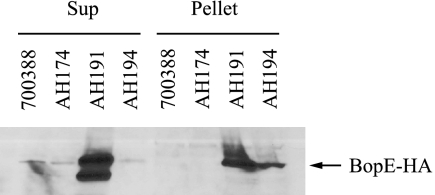
HA-tagged BopE is secreted by wild-type but not bsaZ mutant B. thailandensis. Wild-type (700388), bsaZ mutant (AH174), and BopE-HA-expressing wild-type (AH191) and bsaZ mutant (AH194) B. thailandensis bacteria were grown to mid-logarithmic phase in LB broth at pH 4.5, and the proteins from the supernatants were precipitated with trichloroacetic acid. BopE-HA from the precipitates (Sup) and the cell lysates (Pellet) was detected by immunoblotting with anti-HA antibody. Data are representative of the results of one of two independent experiments.
FIG. 4.
FIG. 4.
Blocking vacuolar acidification inhibits intracellular replication of B. thailandensis and its ability to escape from the endocytic vacuole. (A and B) HeLa cells were pretreated with increasing concentrations of NH4Cl (A) or bafilomycin A1 (B) and were infected with wild-type B. thailandensis for a total of 20 h by using IMP, while NH4Cl or bafilomycin A1 was maintained in the culture medium. Data are representative of the results of one of at least two experiments. (C) Alternatively, HeLa cells were pretreated with 10 mM bafilomycin A1 or DMSO and were infected with wild-type (700388), bsaZ mutant (AH174), or trans-complemented bsaZ mutant (AH186) B. thailandensis for a total of 20 h by using IMP, while bafilomycin A1 or DMSO was maintained in the culture medium. Then the cells were washed and lysed, and intracellular bacteria were quantified. Data are representative of the results of one of at least two independent experiments and are presented as the means ± standard deviations of the results obtained with triplicate samples. Statistical significance was evaluated by the Welch two-sample t test of log base 10-transformed data. *, P = 0.0012; **, P = 0.2328; ***, P = 0.0114 (versus corresponding DMSO-treated control results). (D) HeLa cells were pretreated with 10 mM bafilomycin A1 or DMSO and were infected with GFP-expressing wild-type B. thailandensis for a total of 20 h using IMP. The infected cells were then fixed, stained with anti-LAMP-1 antibody and DAPI, and examined by immunofluorescent microscopy. Data are representative of the results of one of two independent experiments.
FIG. 5.
FIG. 5.
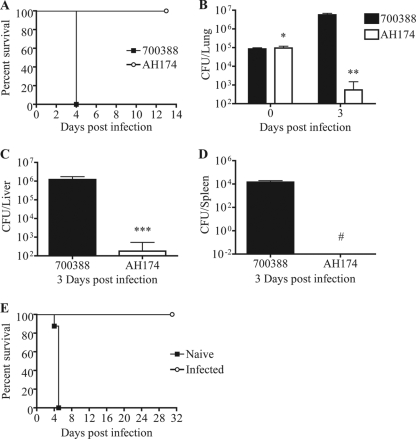
bsaZ mutant B. thailandensis is avirulent in mice and protective against challenge with lethal doses of wild-type B. thailandensis. A total of 105 CFU/lung of wild-type (700388) or bsaZ mutant (AH174) B. thailandensis was deposited by aerosol in the lungs of C57BL/6 mice in paired experiments. The deposition doses were determined by quantitative culture of the left lung of sentinel mice immediately following infection. (A) Survival was monitored over 13 days (n = 4 per group). Statistical significance was evaluated by the log rank test (P = 0.0082). (B to D) In separate groups of mice, levels of bacterial replication in the left lung were compared at 0 and 3 days postinfection (B) and dissemination to the median hepatic lobe (C) or the spleen (D) was determined by quantitative culture at 3 days postinfection (n = 4 per group). Data are presented as means ± standard deviations. Statistical significance was evaluated by the Welch two-sample t test of log base 10-transformed data. *, P = 0.5229; **, P = 0.0017; ***, P = 0.0020; #, P < 0.0001 (versus corresponding strain 700388 results). (E) C57BL/6 mice were infected with 105 CFU/lung of aerosolized AH174. One month later, infected and naïve control mice (n = 8 per group) were challenged with 4 × 10⁴ CFU/lung of aerosolized strain 700388 and their survival was monitored over 4 weeks. Statistical significance was evaluated by the log rank test (P = 0.0001). Both survival and bacterial burden data represent the results of one of two similar experiments performed independently.

References

    1. Attree, O., and I. Attree. 2001. A second type III secretion system in Burkholderia pseudomallei: who is the real culprit? Microbiology 1473197-3199. - PubMed
    1. Blocker, A., P. Gounon, E. Larquet, K. Niebuhr, V. Cabiaux, C. Parsot, and P. Sansonetti. 1999. The tripartite type III secreton of Shigella flexneri inserts IpaB and IpaC into host membranes. J. Cell Biol. 147683-693. - PMC - PubMed
    1. Brett, P. J., D. DeShazer, and D. E. Woods. 1998. Burkholderia thailandensis sp. nov., a Burkholderia pseudomallei-like species. Int. J. Syst. Bacteriol. 48(Pt. 1)317-320. - PubMed
    1. Brett, P. J., D. Deshazer, and D. E. Woods. 1997. Characterization of Burkholderia pseudomallei and Burkholderia pseudomallei-like strains. Epidemiol. Infect. 118137-148. - PMC - PubMed
    1. Chakravortty, D., M. Rohde, L. Jager, J. Deiwick, and M. Hensel. 2005. Formation of a novel surface structure encoded by Salmonella Pathogenicity Island 2. EMBO J. 242043-2052. - PMC - PubMed

Publication types

Substances

LinkOut - more resources