Role of the neuropathology of Alzheimer disease in dementia in the oldest-old
- PMID: 18779425
- PMCID: PMC3071251
- DOI: 10.1001/archneur.65.9.1211
Role of the neuropathology of Alzheimer disease in dementia in the oldest-old
Abstract
Background: Neuritic plaques (NPs) and neurofibrillary tangles (NFTs) in the brain, especially in the hippocampus, entorhinal cortex, and isocortex, are hallmark lesions of Alzheimer disease and dementia in the elderly. However, this association has not been extensively studied in the rapidly growing population of the very old.
Objective: To assess the relationship between estimates of cognitive function and NP and NFT pathologic conditions in 317 autopsied persons aged 60 to 107 years.
Design: We studied the relationship between severity of dementia and the density of these characteristic lesions of Alzheimer disease in young-old, middle-old, and oldest-old persons. The relationship of the severity of dementia as measured by the Clinical Dementia Rating scale to the density of NPs and NFTs was then assessed in each age group.
Participants: Three hundred seventeen brains of persons aged 60 years and older were selected to have either no remarkable neuropathological lesions or only NP and NFT lesions. Brains with any other neuropathological conditions, either alone or in addition to Alzheimer disease findings, were excluded. The study cohort was then stratified into the youngest quartile (aged 60-80 years), middle 2 quartiles (aged 81-89 years), and oldest quartile (aged 90-107 years).
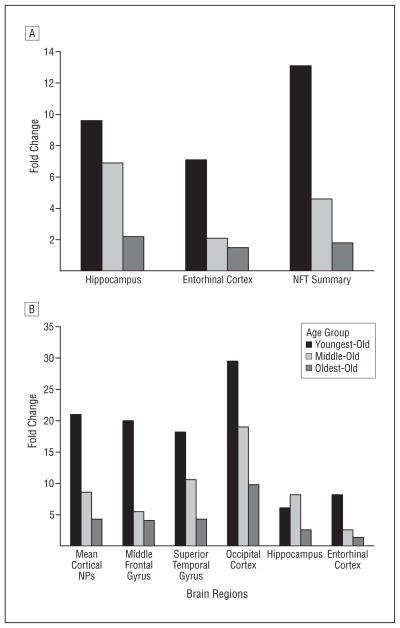
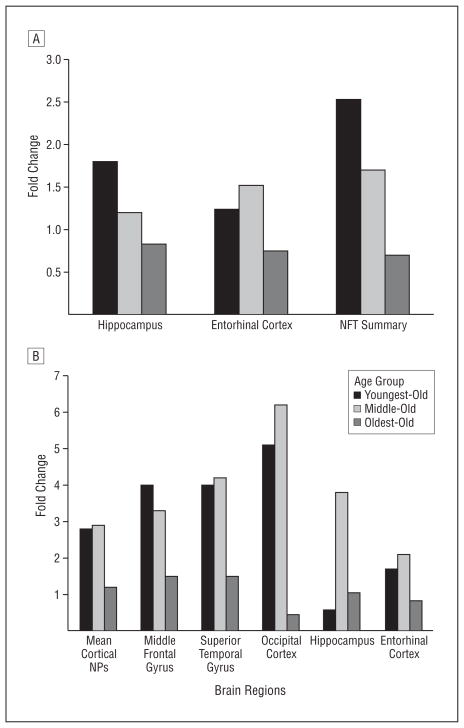
Results: While the density of NPs and NFTs rose significantly by more than 10-fold as a function of the severity of dementia in the youngest-old group, significant increases in the densities of NPs and NFTs were absent in the brains of the oldest-old. This lack of difference in the densities of NPs and NFTs was due to reduced lesion densities in the brains of oldest-old persons with dementia rather than to increased density of these lesions in the brains of nondemented oldest-old persons.
Conclusions: These findings suggest that the neuropathological features of dementia in the oldest-old are not the same as those of cognitively impaired younger-old persons and compel a vigorous search for neuropathological indices of dementia in this most rapidly growing segment of the elderly population.
Figures
References
-
- Haroutunian V, Davies P, Vianna C, Buxbaum JD, Purohit DP. Tau protein abnormalities associated with the progression of Alzheimer disease type dementia. Neurobiol Aging. 2007;28(1):1–7. - PubMed
-
- Morris JC, Storandt M, Miller JP, et al. Mild cognitive impairment represents early-stage Alzheimer disease. Arch Neurol. 2001;58(3):397–405. - PubMed
-
- Haroutunian V, Purohit DP, Perl DP, et al. Neurofibrillary tangles in nondemented elderly subjects and mild Alzheimer disease. Arch Neurol. 1999;56 (6):713–718. - PubMed
-
- Haroutunian V, Perl DP, Purohit DP, et al. Regional distribution of neuritic plaques in the nondemented elderly and subjects with very mild Alzheimer disease. Arch Neurol. 1998;55(9):1185–1191. - PubMed
Publication types
MeSH terms
Grants and funding
LinkOut - more resources
Full Text Sources
Medical
Miscellaneous