Myasthenia gravis: presentation and outcome in 104 patients managed in a single institution
- PMID: 18779641
- PMCID: PMC6074486
- DOI: 10.5144/0256-4947.2008.341
Myasthenia gravis: presentation and outcome in 104 patients managed in a single institution
Abstract
Background and objectives: Few studies have attempted to delineate the clinical profile of myasthenia gravis (MG) among people of Arab ancestry. Therefore, we sought to clarify the clinical profile, the outcome of treatment and the role of thymectomy in non-thymomatous MG in Saudi Arabia.
Patients and methods: We retrospectively studied 104 patients followed over a mean period of 7.2 years (range, 1 to 22 years) at the King Khaled University Hospital, Riyadh, Saudi Arabia. Disease outcomes were compared among thymectomized and non-thymectomized patients according to the post-intervention status criteria of the Myasthenia Gravis Foundation of America (MGFA).
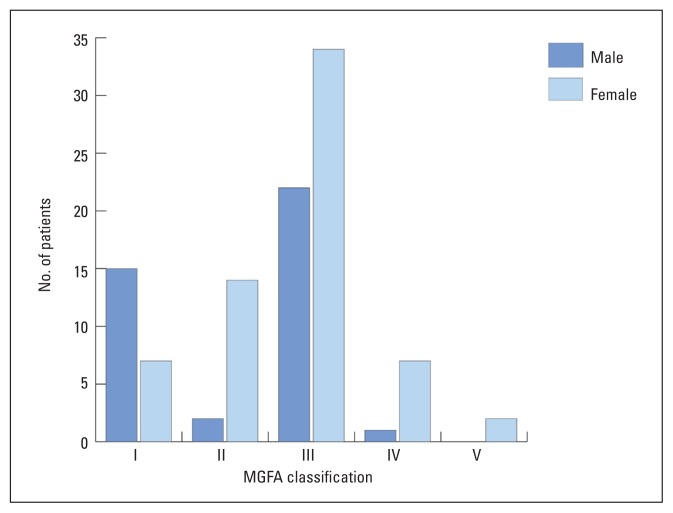
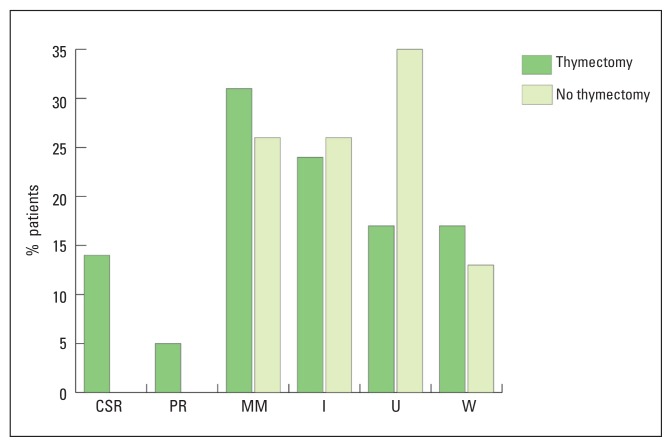
Results: Age of onset was 22.5+/-9.3 years (meanA+/-SD) in females and 28.2+/-15.9 years in males, with peaks in the second and third decades among females and the third and fourth decades among males. At diagnosis, a majority of patients had moderate generalized weakness, equivalent to MGFA class III severity. After medical treatment with or without thymectomy, 9.6% of all patients had achieved complete stable remission, 3.8% had pharmacological remission, 27.9% had minimal manifestations, 23.1% were improved, 20.2% were unchanged and 15.4% were worse. Only thymectomized patients without a thymoma achieved remission, a significant benefit over those who had no thymectomy (P=.02).
Conclusion: MG presents at a younger age among Saudi Arabs compared to other racial groups. Thymectomy conferred significant benefits towards achievement of remission.
Figures
References
-
- Mantegazza R, Baggi F, Antozzi C, et al. Myasthenia gravis (MG): Epidemiological data and prognostic factors. Ann N Y Acad Sci. 2003;998:413–423. - PubMed
-
- Grob D, Brunner NG, Namba T. The natural course of myasthenia gravis and effects of therapeutic measures. Ann N Y Acad Sci. 1981;377:652–669. - PubMed
-
- Drachman DB. Myasthenia gravis. N Eng J Med. 1994;330(25):1797–1810. - PubMed
-
- Gronseth GS, Barohn R. Practice parameter: thymectomy for autoimmune myasthenia gravis (an evidence-based review). Report from the Quality Standards Subcommittee of the American Academy of Neurology. Neurol. 2000;55:7–15. - PubMed
-
- Chui H-C, Vincent J, Newsom-Davis, et al. Myasthenia gravis: population differences in disease expression and acetylcholine receptor antibody titers between Chinese and Caucasians. Neurol. 1987;37:1854–1857. - PubMed
MeSH terms
LinkOut - more resources
Full Text Sources
Other Literature Sources
Medical