. 2006 Dec;1(2):71-7.
doi: 10.1007/s11552-006-9004-4.

Posterior approach for double nerve transfer for restoration of shoulder function in upper brachial plexus palsy

Affiliations

Posterior approach for double nerve transfer for restoration of shoulder function in upper brachial plexus palsy

Stephen H Colbert et al. Hand (N Y). 2006 Dec.

Abstract

Restoration of shoulder function is one of the most critical goals of treatment of brachial plexus injuries. Primary repair or nerve grafting of avulsion injuries of the upper brachial plexus in adults often leads to poor recovery. Nerve transfers have provided an alternative treatment with great potential for improved return of function. Many different nerves have been utilized as donor nerves for transfer to the suprascapular nerve and axillary nerve for return of shoulder function with variable results. As our knowledge of shoulder neuromuscular anatomy and physiology improves and our experience with nerve transfers increases, so evolve the specific transfer procedures. This article presents a technique and rationale for reconstructing shoulder function by transferring the distal spinal accessory nerve to the suprascapular nerve and the nerve branch to the medial head of the triceps to the axillary nerve, both through a posterior approach.


Figures
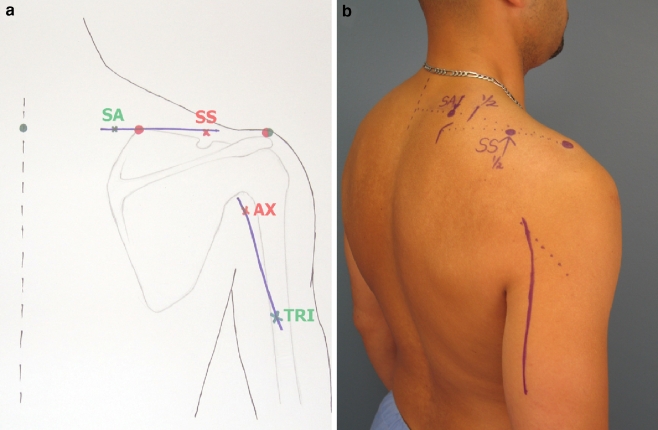
Figure 1
Figure 1
(a) Posterior approach, double nerve transfer for shoulder function surgical markings. The midline spinous process is marked (green dot) as is the acromion (red/green dot). The location of the spinal accessory nerve is marked (SA) at a distance 40% from the dorsal midline to the acromion parallel to a line along the superior border of the scapula. The superior angle of the scapula is marked (red dot), and the location of the suprascapular notch containing the suprascapular nerve is identified and marked (SS) at the midpoint between the superior angle of the scapula and the acromion along the superior border of the scapula. The surgical incision is planned in a transverse fashion to expose both nerves. The posterior approach to the quadrangular space containing the axillary nerve (AX) is marked at the posterior border of the deltoid muscle just inferior to the scapular neck and infraglenoid tubercle. The surgical incision is planned from this point distally along the posterior border of the arm in line with the interval between the long and lateral heads of the triceps muscle, approximately 10–12 cm in length. At the distal aspect of this approach, the nerve branch to the medial head of the triceps muscle (TRI) is located. (b) Preoperative markings on human subject. SA, spinal accessory; SS, suprascapular. Note that SA is marked medial to the halfway point from midline to the acromion, and that SS is marked halfway from the superomedial border of the scapula to the acromion. The surgical incision connects these two points. The incision for the triceps branch-to-axillary nerve transfer is also marked at the posterior arm. The dotted line at the superior aspect of this incision mark identifies the posterior border of the deltoid muscle.
Figure 2
Figure 2
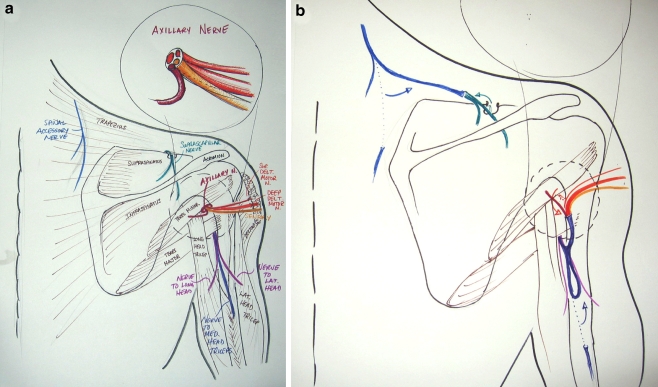
(a) Posterior approach for double nerve transfer for shoulder function; posterior shoulder anatomy. Note that the posterior approach allows access to the more distal aspect of the spinal accessory nerve. The suprascapular nerve passes over the suprascapular notch beneath the superior transverse scapular ligament. The inset shows the components of the axillary nerve at the level of the quadrangular space. Note that the larger motor branch to the deltoid comprises the deep aspect of the nerve, whereas the other smaller components, including the nerve to teres minor and the sensory component (superior brachial cutaneous), comprise the superficial aspect of the nerve. The nerve branch to the medial head of the triceps is found along with the radial nerve deep to the interval between the long and lateral heads of the triceps muscle overlying the humerus. (b) Posterior approach for double nerve transfer for shoulder function, following nerve transfer. The distal spinal accessory nerve has been transected as distally as possible and the proximal segment transferred to the distal segment of the suprascapular nerve, which has been transected just proximal to the suprascapular notch. The branch to the medial head of the triceps has been transected distally and the proximal segment transferred to the distal segment of the axillary nerve. The axillary nerve has been transected as proximally as possible in the quadrangular space. The nerve to teres major is included as a recipient in the transfer and no special effort is made to exclude the sensory branch of the axillary nerve (superior brachial cutaneous nerve).
Figure 3
Figure 3
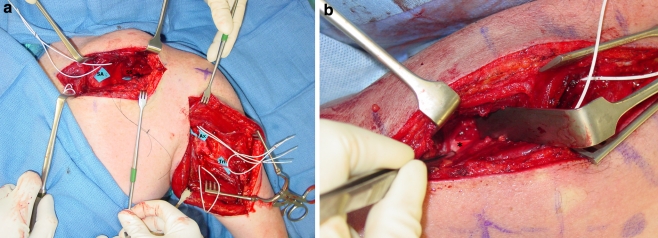
(a) Intraoperative exposure. All nerves have been identified and marked with blue backgrounds. SA, spinal accessory nerve; SS, suprascapular nerve; Ax, axillary nerve; Tri, nerve branch to medial head of triceps. Note that the suprascapular nerve is deep within the operative site. It and the axillary nerve have been divided. The donor nerves have not yet been divided. (b) Intraoperative exposure; a closer view of the suprascapular dissection. The trapezius muscle has been divided and is being retracted. The superior transverse scapular ligament (asterisk) has been identified. The ligament is glistening white. Note that the superior border forms a sharp edge. The forceps are resting in the hollow of the notch below the ligament.

References

    1. {'text': '', 'ref_index': 1, 'ids': [{'type': 'PubMed', 'value': '15622257', 'is_inner': True, 'url': 'https://pubmed.ncbi.nlm.nih.gov/15622257/'}]}
    2. Bahm J, Naoman H, Becker M. The dorsal approach to the suprascapular nerve in neuromuscular reanimation for obstetric brachial plexus lesions. Plast Reconstr Surg 2005;115:240–4. - PubMed
    1. {'text': '', 'ref_index': 1, 'ids': [{'type': 'PubMed', 'value': '14751116', 'is_inner': True, 'url': 'https://pubmed.ncbi.nlm.nih.gov/14751116/'}]}
    2. Bertelli JA, Ghizoni MF. Reconstruction of C5 and C6 brachial plexus avulsion injury by multiple nerve transfers: spinal accessory to suprascapular, ulnar fascicles to biceps branch, and triceps long or lateral head branch to axillary nerve. J Hand Surg 2004;29A:131–9. - PubMed
    1. {'text': '', 'ref_index': 1, 'ids': [{'type': 'PubMed', 'value': '16582662', 'is_inner': True, 'url': 'https://pubmed.ncbi.nlm.nih.gov/16582662/'}]}
    2. Bertelli JA, Ghizoni MF. Improved technique for harvesting the accessory nerve for transfer in brachial plexus injuries. Neurosurgery 2006;58(4) Suppl 2:ONS-366-70; discussion ONS-370. - PubMed
    1. {'text': '', 'ref_index': 1, 'ids': [{'type': 'PMC', 'value': 'PMC6569224', 'is_inner': False, 'url': 'https://pmc.ncbi.nlm.nih.gov/articles/PMC6569224/'}, {'type': 'PubMed', 'value': '3346713', 'is_inner': True, 'url': 'https://pubmed.ncbi.nlm.nih.gov/3346713/'}]}
    2. Brushart TME. Preferential reinnervation of motor nerves by regenerating motor axons. J Neurosci 1988;8:1026–31. - PMC - PubMed
    1. None
    2. Celli L, Rovesta C, Balli A. Neurotization of brachial plexus avulsion with intercostal nerves (personal techniques). In: Brunelli G, editor. Textbook of microsurgery. Milano: Masson; 1988. p. 789–95.