


Intraoperative electrophysiological studies to predict the efficacy of neurolysis after nerve injury-experiment in rats
- PMID: 18780106
- PMCID: PMC2525873
- DOI: 10.1007/s11552-008-9094-2
Intraoperative electrophysiological studies to predict the efficacy of neurolysis after nerve injury-experiment in rats
Abstract
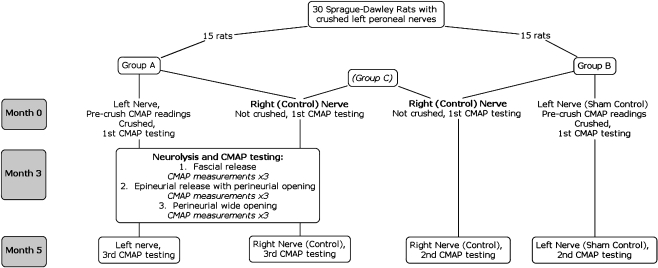
Compound muscle action potentials (CMAPs) can be used to analyze injury and recovery of nerve. This standardized study evaluates the value of CMAP analysis in predicting the long-term efficacy of neurolysis. CMAP amplitude is also used to determine the optimal extent of neurolysis. The left peroneal nerves of 30 rats were crushed. CMAPs were recorded for both crushed (left) and control (right) nerves. Fifteen rats underwent neurolysis 3 months post crush injury; the remaining 15 were sham controls and did not undergo neurolysis. CMAP measurements were taken after: (1) release of the nerve from the fascia, (2) opening the epineurium, and (3) opening the perineurium. At 3 months post crush injury, opening the epineurium resulted in a statistically significant increase in CMAP. CMAP increase with perineurial neurolysis was greater than with fascial release of the nerve but was not statistically different from that of epineurial release. At 5 months post crush injury, recovery of crushed nerves that underwent neurolysis was 90% and significantly less at 70.5% in rats not treated with neurolysis, according to CMAP analysis. Two conclusions can be made from this study. First, intraoperative neurophysiologic studies can monitor the immediate results of neurolysis and predict long-term results in the injured nerve. Second, epineurotomy is important in neurolysis, improves the function of the nerve, less invasive, and a slightly more effective technique than perineurotomy.
References
-
- None
- Babcock WW. A standard technique for operations on peripheral nerves with especial reference to the closure of large gaps. Surg Gynecol Obstet 1927;45:364–78.
-
- {'text': '', 'ref_index': 1, 'ids': [{'type': 'DOI', 'value': '10.1007/BF01402047', 'is_inner': False, 'url': 'https://doi.org/10.1007/bf01402047'}, {'type': 'PubMed', 'value': '1882718', 'is_inner': True, 'url': 'https://pubmed.ncbi.nlm.nih.gov/1882718/'}]}
- Barrios C, Ganoza C, de Pablos J, et al. Posttraumatic ulnar neuropathy versus non-traumatic cubital tunnel syndrome: clinical features and response to surgery. Acta Neurochir (Wien) 1991;110:44–8. - PubMed
-
- None
- Birch R, Bonney GWL, Wynn Parry CB. Surgical disorders of the peripheral nerves. New York: Churchill Livingstone; 1998, p. 539.
-
- {'text': '', 'ref_index': 1, 'ids': [{'type': 'DOI', 'value': '10.1002/mus.880140307', 'is_inner': False, 'url': 'https://doi.org/10.1002/mus.880140307'}, {'type': 'PubMed', 'value': '1645845', 'is_inner': True, 'url': 'https://pubmed.ncbi.nlm.nih.gov/1645845/'}]}
- Brown WF, Watson BV. Quantitation of axon loss and conduction block in peroneal nerve palsies. Muscle Nerve 1991;14:237–44. - PubMed
-
- {'text': '', 'ref_index': 1, 'ids': [{'type': 'PubMed', 'value': '1139370', 'is_inner': True, 'url': 'https://pubmed.ncbi.nlm.nih.gov/1139370/'}]}
- Cameron MG, Stewart OJ. Ulnar nerve injury associated with anaesthesia. Can Anaesth Soc J 1975;22:253–64. - PubMed
LinkOut - more resources
Full Text Sources
