. 2008 Oct;180(2):797-810.
doi: 10.1534/genetics.108.091090. Epub 2008 Sep 9.

Pnc1p-mediated nicotinamide clearance modifies the epigenetic properties of rDNA silencing in Saccharomyces cerevisiae

Affiliations

Pnc1p-mediated nicotinamide clearance modifies the epigenetic properties of rDNA silencing in Saccharomyces cerevisiae

Julie M McClure et al. Genetics. 2008 Oct.

Abstract

The histone deacetylase activity of Sir2p is dependent on NAD(+) and inhibited by nicotinamide (NAM). As a result, Sir2p-regulated processes in Saccharomyces cerevisiae such as silencing and replicative aging are susceptible to alterations in cellular NAD(+) and NAM levels. We have determined that high concentrations of NAM in the growth medium elevate the intracellular NAD(+) concentration through a mechanism that is partially dependent on NPT1, an important gene in the Preiss-Handler NAD(+) salvage pathway. Overexpression of the nicotinamidase, Pnc1p, prevents inhibition of Sir2p by the excess NAM while maintaining the elevated NAD(+) concentration. This growth condition alters the epigenetics of rDNA silencing, such that repression of a URA3 reporter gene located at the rDNA induces growth on media that either lacks uracil or contains 5-fluoroorotic acid (5-FOA), an unusual dual phenotype that is reminiscent of telomeric silencing (TPE) of URA3. Despite the similarities to TPE, the modified rDNA silencing phenotype does not require the SIR complex. Instead, it retains key characteristics of typical rDNA silencing, including RENT and Pol I dependence, as well as a requirement for the Preiss-Handler NAD(+) salvage pathway. Exogenous nicotinamide can therefore have negative or positive impacts on rDNA silencing, depending on the PNC1 expression level.


Figures
F<sc>igure</sc> 1.—
Figure 1.—
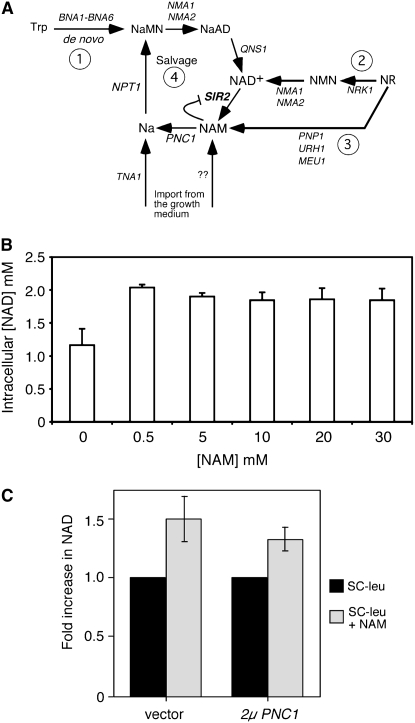
Exogenous nicotinamide raises the intracellular NAD+ concentration. (A) Schematic of known NAD+ biosynthesis pathways in S. cerevisiae. (1) The de novo NAD+ synthesis pathway begins with tryptophan (Trp) and ends with the conversion of nicotinic acid adenine dinucleotide (NaAD) into NAD+ by the NAD synthetase, QNS1. (2) The nicotinamide riboside (NR) pathway begins with the import of exogenous NR and its phosphorylation by Nrk1p into nicotinamide mononucleotide (NMN). (3) NR can also be broken down into NAM by Pnp1p, Urh1p, and Meu1p. (4) The NAD+ salvage pathway begins with NAM produced by sirtuins or imported from the growth media and merges with the de novo pathway through the production of nicotinic acid mononucleotide (NaMN) by NPT1. Na, nicotinic acid. (B) Increase in cellular NAD+ concentrations caused by various concentrations of exogenous NAM in the growth medium with a WT strain (YSB348). (C) PNC1 overexpression does not elevate the NAD+ level, even when clearing a high concentration of exogenous NAM (10 mm). The NAD+ level in the absence of nicotinamide was normalized to a value of 1.0 for each strain. Error bars represent the standard deviation from six independent experiments.
F<sc>igure</sc> 2.—
Figure 2.—
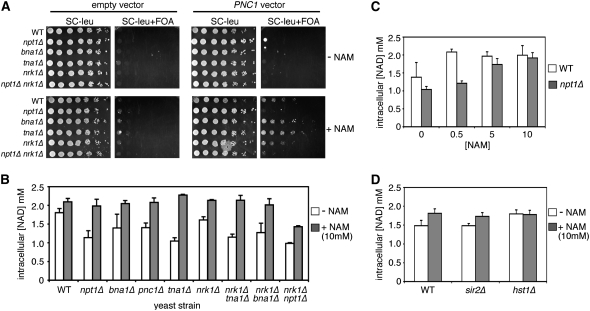
Nicotinamide clearance alters the epigenetic properties of rDNA silencing. (A) Schematic of the centromere-proximal rDNA repeat on chromosome XII. The mURA3-HIS3 silencing reporter cassette is integrated in unique sequence, 50 bp left (50L) of the rDNA NTS1 region. The directions of Pol I and Pol II transcription are indicated by horizontal black arrows. (B) rDNA silencing assay in which the 50L∷mURA3-HIS3 silencing reporter strain (YSB348) was transformed with an empty LEU2 vector (pRS425) or a 2μ PNC1 vector (pJOE31). The concentration of NAM in the plates is indicated. (C) rDNA silencing assay showing the FOAR phenotype in the presence of 0, 10, or 20 mm NAM. YSB348 was transformed with pRS425, pJOE31, an empty ADH1-promoter vector (pAAH5), or the same ADH vector expressing PNC1 (pJSS95-3), or E. coli pncA (pFR1). (D) Requirement of modified rDNA silencing for RNA Pol I transcription. A control strain (PRO+; YSB505) and a strain deleted for the leftmost Pol I promoter (proΔ; YSB509) were transformed with the pRS425 vector or pJOE31 PNC1 vector. The mURA3-HIS3 reporter was located 61 bp left of the tandem array. An X in the schematic indicates the location of the promoter deletion. The addition of 10 mm nicotinamide is indicated as +NAM.
F<sc>igure</sc> 3.—
Figure 3.—
Spreading of modified rDNA silencing. (A) rDNA silencing in which the mURA3-HIS3 cassette was positioned 50 bp (50L), 300 bp (300L), or 600 bp (600L) away from the rDNA array or at the nonsilenced TRP1 locus on chromosome IV. Plates contained 0 or 10 mm NAM, and the strains harbored either the empty pRS425 vector or the 2μ PNC1 vector (pJOE31). (B) Effects of SIR2 overexpression on rDNA silencing at the 50L, 300L, 600L, and TRP1 locations. NAM was not added. (C) Effect of overexpressing SIR2 (pSB766) and PNC1 (pJOE30) at the same time on rDNA silencing in the absence or presence of 10 mm NAM. The mURA3-HIS3 reporter was positioned at the 50L position.
F<sc>igure</sc> 4.—
Figure 4.—
Modified rDNA silencing does not disturb HM and telomeric silencing, but requires SIR2. (A and B) Telomeric and HM silencing are not significantly weakened or strengthened by 10 mm NAM coupled with PNC1 overexpression. (A) Fivefold serial dilutions of WT and sir2Δ strains containing pRS425 or pJOE31. The URA3 gene is silenced by an artificial telomere formed at the ADH4 locus. Silencing is indicated by growth on 5-FOA. (B) Fivefold serial dilutions of strain YLS59 (WT) and MC119 (sir2Δ) containing either pRS425 vector or pJOE31 (PNC1). The TRP1 gene is silenced at the HMR locus. Silencing is indicated by lack of growth on SC −leu −trp plates. (C) Effects of deleting SIR2, SIR3, or SIR4 on rDNA silencing in the presence of 10 mm nicotinamide. The empty vector (pRS425) or PNC1 overexpression vector (pJOE31) was transformed into rDNA reporter strains that were deleted for SIR2 (YSB408), SIR3 (CGY135), or SIR4 (CGY152). Fivefold serial dilutions were spotted.
F<sc>igure</sc> 5.—
Figure 5.—
Modified rDNA silencing is dependent on the RENT, but not the SIR complex. The effects of expressing a telomere/HM silencing-defective sir2 mutation (sir2-424, class I) and rDNA silencing-defective mutation (sir2-81, class II) on rDNA silencing in the presence of 10 mm NAM and PNC1 overexpression. The strain background was JS1041, which lacks the endogenous SIR2 gene and has the 50L∷mURA3-HIS3 reporter gene.
F<sc>igure</sc> 6.—
Figure 6.—
Effects of NAD+ salvage and biosynthesis mutants on modified rDNA silencing and intracellular NAD+ concentrations. (A) Modified rDNA silencing in WT (YSB348), npt1Δ (CGY145), bna1Δ (CGY153), tna1Δ (JS932), nrk1Δ (JS944), and npt1Δ nrk1Δ (JM236) mutants. The reporter gene is RDN1(50L)∷mURA3-HIS3. (B) NAD+ concentrations in the various NAD+ biosynthesis and salvage mutants when grown in the presence or absence of 10 mm NAM. (C) NPT1 is required for increasing NAD+ levels when cells are grown in low concentrations (0.5 mm) of NAM. (D) Intracellular NAD+ concentrations in WT (JS1011), sir2Δ (JS1041), and hst1Δ (JM98) strains in the presence or absence of 10 mm NAM.

References

    1. Ammerer, G., 1983. Expression of genes in yeast using the ADC1 promoter. Methods Enzymol. 101 192–201. - PubMed
    1. Anderson, R. M., K. J. Bitterman, J. G. Wood, O. Medvedik, H. Cohen et al., 2002. Manipulation of a nuclear NAD+ salvage pathway delays aging without altering steady-state NAD+ levels. J. Biol. Chem. 277 18881–18890. - PubMed
    1. Anderson, R. M., K. J. Bitterman, J. G. Wood, O. Medvedik and D. A. Sinclair, 2003. a Nicotinamide and PNC1 govern lifespan extension by calorie restriction in Saccharomyces cerevisiae. Nature 423 181–185. - PMC - PubMed
    1. Anderson, R. M., M. Latorre-Esteves, A. R. Neves, S. Lavu, O. Medvedik et al., 2003. b Yeast life-span extension by calorie restriction is independent of NAD fluctuation. Science 302 2124–2126. - PMC - PubMed
    1. Aparicio, O. M., B. L. Billington and D. E. Gottschling, 1991. Modifiers of position effect are shared between telomeric and silent mating-type loci in S. cerevisiae. Cell 66 1279–1287. - PubMed

Publication types

MeSH terms