


Optimizing peptide matrices for identifying T-cell antigens
- PMID: 18781655
- PMCID: PMC2586828
- DOI: 10.1002/cyto.a.20646
Optimizing peptide matrices for identifying T-cell antigens
Abstract
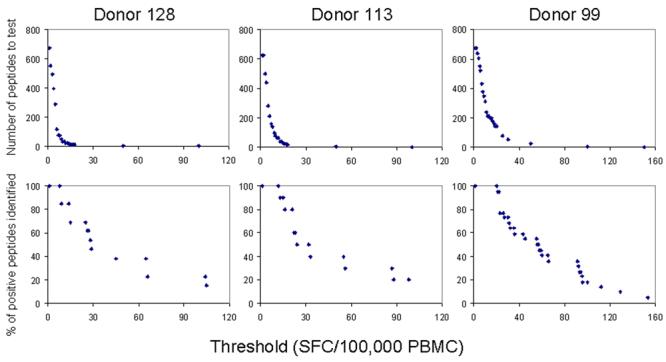
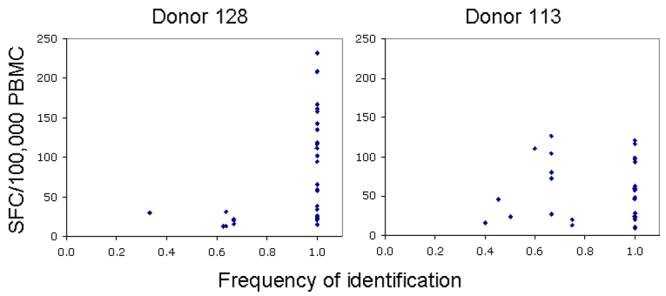
Mapping T-cell epitopes for a pathogen or vaccine requires a complex method for screening hundreds to thousands of peptides with a limited amount of donor sample. We describe an optimized deconvolution process by which peptides are pooled in a matrix format to minimize the number of tests required to identify peptide epitopes. Four peptide pool matrices were constructed to deconvolute the HIV-specific T-cell response in three HIV-infected individuals. ELISpot assays were used to map peptide antigens. Many HIV peptides were mapped in all three individuals. However, there were several challenges and limitations associated with the deconvolution process. Peptides that induced low-frequency responses or were masked by peptide competition within a given pool were not identified, because they did not meet the threshold criteria for a positive response. Also, amino acid sequence variation limited the ability of this method to map autologous HIV peptides. Alternative analysis strategies and revisions to the original matrix optimizations are presented that address ways to increase peptide identification. This optimized deconvolution method allows for efficient mapping of T-cell peptide epitopes. It is rapid, powerful, efficient, and unrestricted by HLA type.
Figures
References
-
- Anthony DD, Lehmann PV. T-cell epitope mapping using the ELISPOT approach. Methods. 2003;29(3):260–9. - PubMed
-
- Hoffmeister B, Kiecker F, Tesfa L, Volk HD, Picker LJ, Kern F. Mapping T cell epitopes by flow cytometry. Methods. 2003;29(3):270–81. - PubMed
-
- Maecker HT, Dunn HS, Suni MA, Khatamzas E, Pitcher CJ, Bunde T, Persaud N, Trigona W, Fu TM, Sinclair E. and others. Use of overlapping peptide mixtures as antigens for cytokine flow cytometry J Immunol Methods 20012551-227–40. - PubMed
-
- Addo MM, Altfeld M, Rosenberg ES, Eldridge RL, Philips MN, Habeeb K, Khatri A, Brander C, Robbins GK, Mazzara GP. and others. The HIV-1 regulatory proteins Tat and Rev are frequently targeted by cytotoxic T lymphocytes derived from HIV-1-infected individuals Proc Natl Acad Sci USA 20019841781–6. - PMC - PubMed
-
- Altfeld M, Addo MM, Eldridge RL, Yu XG, Thomas S, Khatri A, Strick D, Phillips MN, Cohen GB, Islam SA. and others. Vpr is preferentially targeted by CTL during HIV-1 infection J Immunol 200116752743–52. - PubMed
Publication types
MeSH terms
Substances
Grants and funding
LinkOut - more resources
Full Text Sources
Research Materials
