


Accidental traumatic head injury in infants and young children
- PMID: 18782170
- PMCID: PMC8095612
- DOI: 10.1111/j.1750-3639.2008.00203.x
Accidental traumatic head injury in infants and young children
Abstract
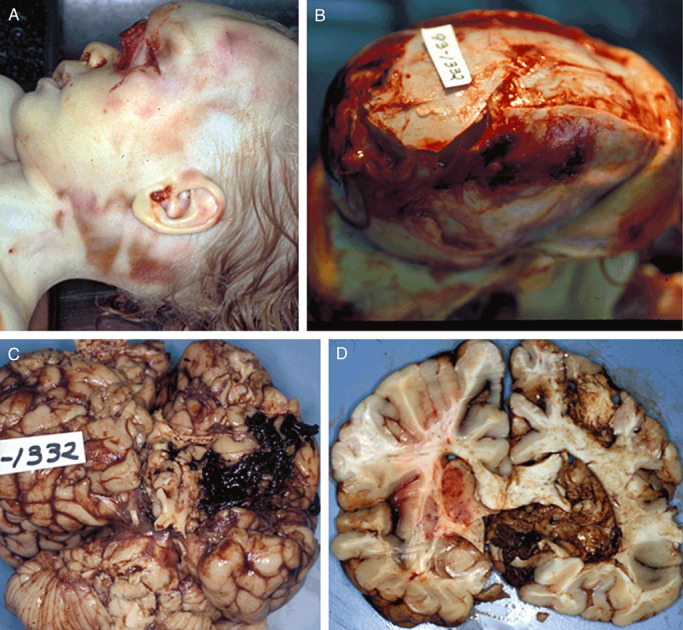
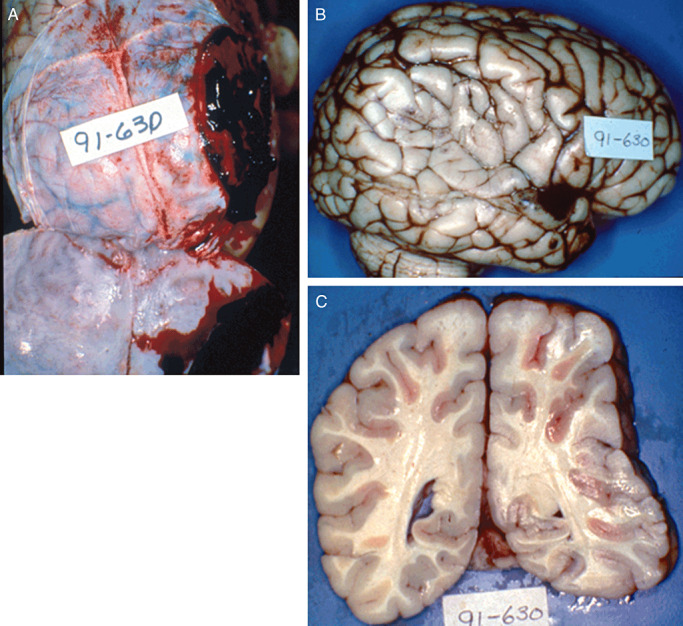
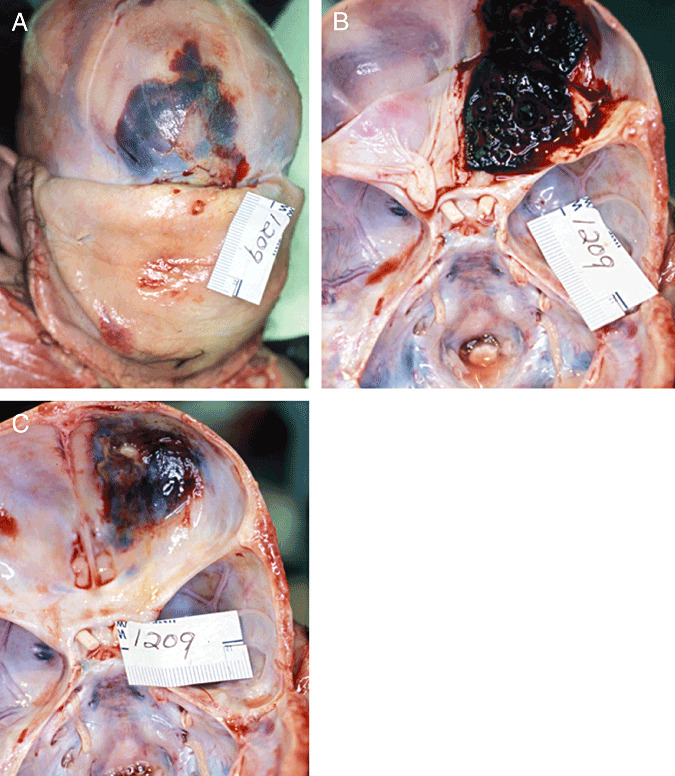
This article will discuss accidental head injuries in infants and young children. The first category of injury is the crushing head injury. Static forces applied slowly to the head result in multiple fractures of the skull and contusions and lacerations of the brain resulting from the bone fragments striking the brain. This article will discuss the subject of short falls in young children and the resulting head injuries. Because falls are frequent events in early life, many cases have been collected and many papers written on the subject. Study of these cases is informative about the injuries likely to occur in these falls. Most often, only a minor contact injury such as scalp bruise or laceration results. In a 2 to 3% of falls, a simple linear skull fracture occurs and the majority of these are uneventful in terms of neurological deficit or intracranial bleeding. In about 1% of the fractures, an epidural or subdural hemorrhage occurs. Each of these forms of contact hemorrhages will be discussed and illustrated. While these are relatively rare injuries, it is essential that they can be identified as consistent with an accidental mechanism so that an erroneous diagnosis of inflicted injury is not made.
Figures
References
-
- Barlow B, Niemirska M, Rajindar P, Gandi RP, Leblanc W (1983) Ten years pf experience with falls from a height in children. J Pediatr Surg 18:509–511. - PubMed
-
- Baykaner K, Alp H, Ceviker N, Keskil S, Seckin Z (1988) Observation of 95 patients with extradural hematoma and review of the literature. Surg Neurol 30:339–341. - PubMed
-
- Bertocci GE, Pierce MC, Deemer E, Aguel F, Janosky JE, Vogeley E (2003) Using test dummy experiments to investigate pediatric injury risk in simulated short‐distance falls. Arch Pediatr Adolesc Med 157:480–486. - PubMed
-
- Case MES (1994) Head injury in child abuse. Chapter 5. In: Child Maltreatment. Broduer AE, Monteleone JA (eds), pp. 75–87. GW Medical: St. Louis, MO.
-
- Chadwick DL, Salerno C (1993) Likelihood of the death of an infant or young child in a short fall of less than 6 vertical feet. J Trauma 35:968. - PubMed
Publication types
MeSH terms
LinkOut - more resources
Full Text Sources
Medical
