Misperceptions and misuse of Bear Brand coffee creamer as infant food: national cross sectional survey of consumers and paediatricians in Laos
- PMID: 18782843
- PMCID: PMC2533525
- DOI: 10.1136/bmj.a1379
Misperceptions and misuse of Bear Brand coffee creamer as infant food: national cross sectional survey of consumers and paediatricians in Laos
Abstract
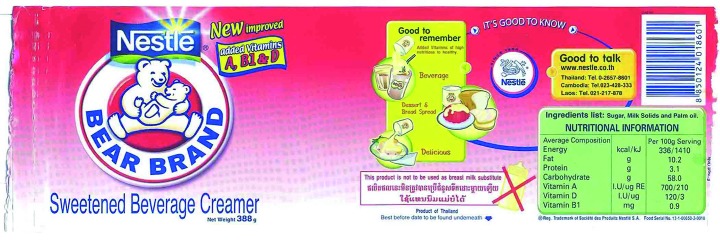
Objective: To investigate the use of Bear Brand coffee creamer as a food for infants and the impact on consumers of the logo of a cartoon baby bear held by its mother in the breastfeeding position.
Design: Interviews with paediatricians throughout the country and a national survey of potential consumers regarding their perceptions and use of the Bear Brand coffee creamer.
Setting: 84 randomised villages in south, central, and northern Laos.
Participants: 26 Lao paediatricians and 1098 adults in households in a cluster sampling.
Results: Of the 26 paediatricians, 24 said that parents "often" or "sometimes" fed this product to infants as a substitute for breast milk. In the capital city, paediatricians said that mothers used the product when they returned to work. In the countryside, they reported that poor families used it when the mother was ill or died. Of 1098 adults surveyed, 96% believed that the can contains milk; 46% believed the Bear Brand logo indicates that the product is formulated for feeding to infants or to replace breast milk; 80% had not read the written warning on the can; and over 18% reported giving the product to their infant at a mean age of 4.7 months (95% confidence interval 4.1 to 5.3).
Conclusion: The Bear Brand coffee creamer is used as a breast milk substitute in Laos. The cartoon logo influences people's perception of the product that belies the written warning "This product is not to be used as a breast milk substitute." Use of this logo on coffee creamer is misleading to the local population and places the health of infants at risk.
Conflict of interest statement
Competing interests: None declared.
Comment in
-
Coffee creamer as infant food. Nestle's works to ensure appropriate use of milk products.BMJ. 2009 Jan 21;338:b196; author reply b198. doi: 10.1136/bmj.b196. BMJ. 2009. PMID: 19158171 No abstract available.
References
-
- Caballero B. A nutrition paradox—underweight and obesity in developing countries. N Engl J Med 2005;352:1514-6. - PubMed
-
- Delpeuch F, Maire B. Obesity and developing countries of the south. Med Trop (Mars) 1997;57:380-8. - PubMed
-
- Nestle M. Food marketing and childhood obesity—a matter of policy. N Engl J Med 2006;354:2527-9. - PubMed
-
- Parrilla-Rodriguez AM, Gorrin-Peralta JJ. Formula labeling violations to the WHO code: a quantitative and qualitative analysis. P R Health Sci J 2008;27:49-54. - PubMed
Publication types
MeSH terms
LinkOut - more resources
Full Text Sources
Medical