. 2008 Oct 9;51(19):6034-43.
doi: 10.1021/jm800510m. Epub 2008 Sep 11.

Synthesis and evaluation of [N-methyl-11C]N-desmethyl-loperamide as a new and improved PET radiotracer for imaging P-gp function

Affiliations

Synthesis and evaluation of [N-methyl-11C]N-desmethyl-loperamide as a new and improved PET radiotracer for imaging P-gp function

Neva Lazarova et al. J Med Chem. .

Abstract

[(11)C]Loperamide has been proposed for imaging P-glycoprotein (P-gp) function with positron emission tomography (PET), but its metabolism to [N-methyl-(11)C] N-desmethyl-loperamide ([(11)C]dLop; [(11)C]3) precludes quantification. We considered that [(11)C]3 might itself be a superior radiotracer for imaging brain P-gp function and therefore aimed to prepare [(11)C]3 and characterize its efficacy. An amide precursor (2) was synthesized and methylated with [(11)C]iodomethane to give [(11)C]3. After administration of [(11)C]3 to wild-type mice, brain radioactivity uptake was very low. In P-gp (mdr-1a(-/-)) knockout mice, brain uptake of radioactivity at 30 min increased about 3.5-fold by PET measures, and over 7-fold by ex vivo measures. In knockout mice, brain radioactivity was predominantly (90%) unchanged radiotracer. In monkey PET experiments, brain radioactivity uptake was also very low but after P-gp blockade increased more than 7-fold. [(11)C]3 is an effective new radiotracer for imaging brain P-gp function and, in favor of future successful quantification, appears free of extensive brain-penetrant radiometabolites.


Figures
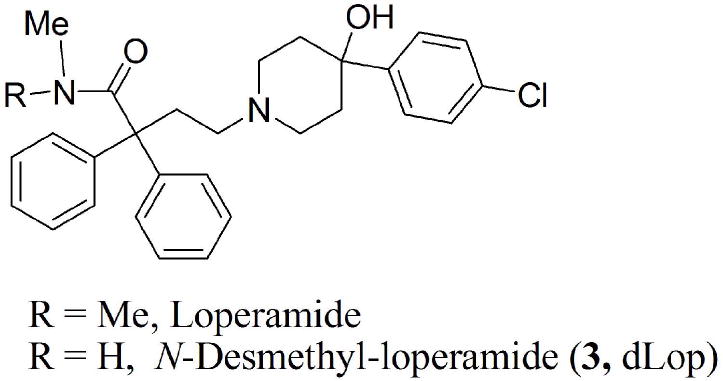
Figure 1
Figure 1
Structures of loperamide and N-desmethyl-loperamide (dLop; 3).
Figure 2
Figure 2
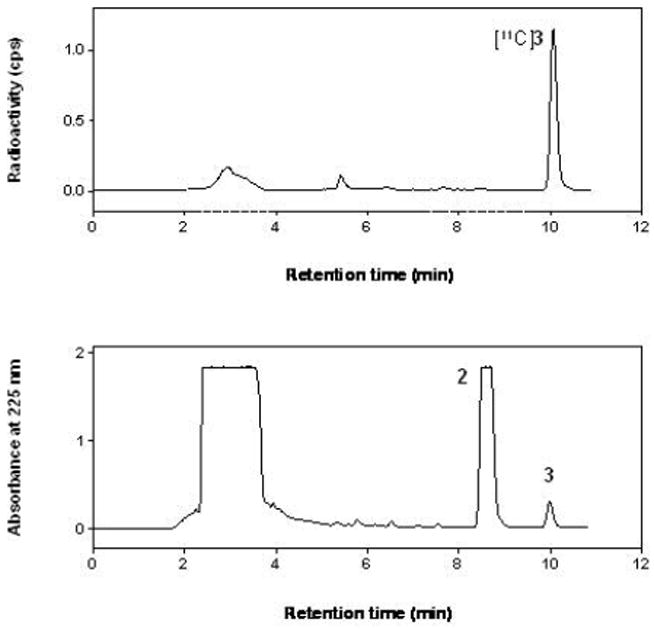
Chromatograms from the HPLC separation used in the radiosynthesis of [11C]3. See Experimental for chromatographic conditions.
Figure 3
Figure 3
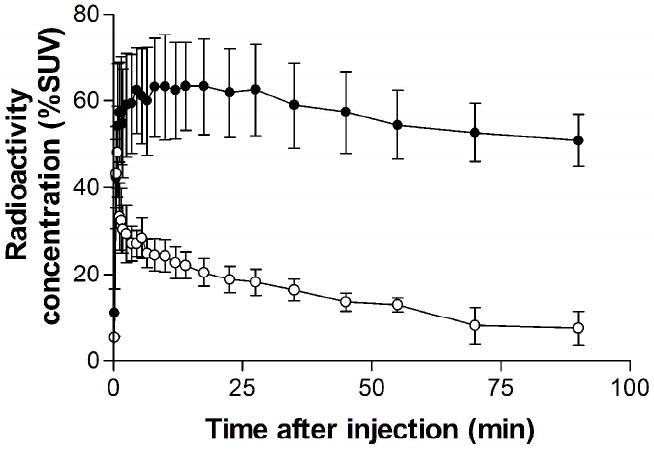
Average time-activity curves in forebrain of three wild type and three P-gp knockout mice determined with PET after the intravenous administration of [11C]3. Key: wild type mice (○); knockout mice (●). Error bars indicate SD.
Figure 4
Figure 4
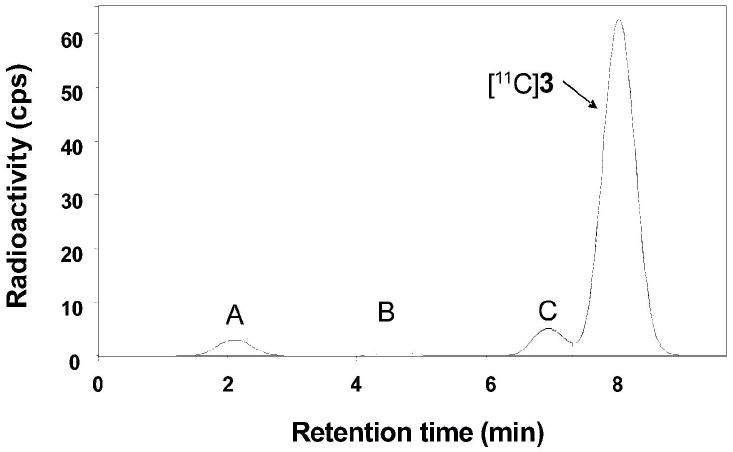
Radiochromatogram of radioactive species in P-gp knockout mouse forebrain at 30 min after the intravenous administration of [11C]3. See Experimental for chromatographic conditions.
Figure 5
Figure 5
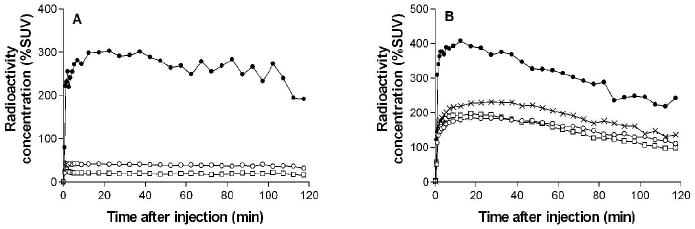
Regional uptake of radioactivity in monkey brain after the administration of [11C]3 under baseline conditions (Panel A), and at 30 min after the intravenous administration of DCPQ (8 mg/kg, i.v.) (Panel B). Key: temporal cortex (○), cerebellum (□), putamen (×) and pituitary (●). In Panel A, data for putamen lie between those of temporal cortex and cerebellum (not shown for Figure clarity). Frontal and parietal cortical regions gave curves similar to those of temporal cortex under each condition.
Figure 6
Figure 6
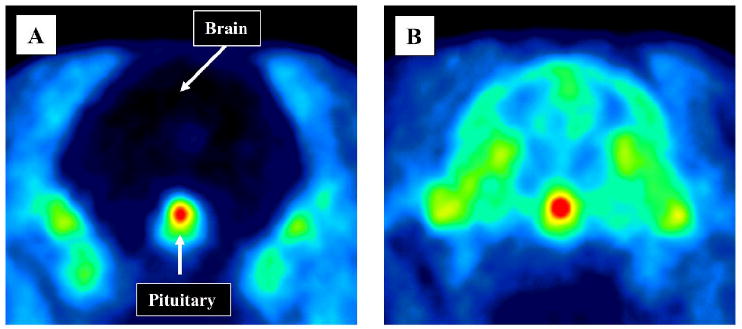
Summed transaxial PET images of the head obtained between 20 to 120 min after the intravenous administration of [11C]3 to monkey under baseline conditions (Panel A) and after P-gp inhibition with DCPQ (8 mg/kg, i.v.) (Panel B).
Figure 7
Figure 7
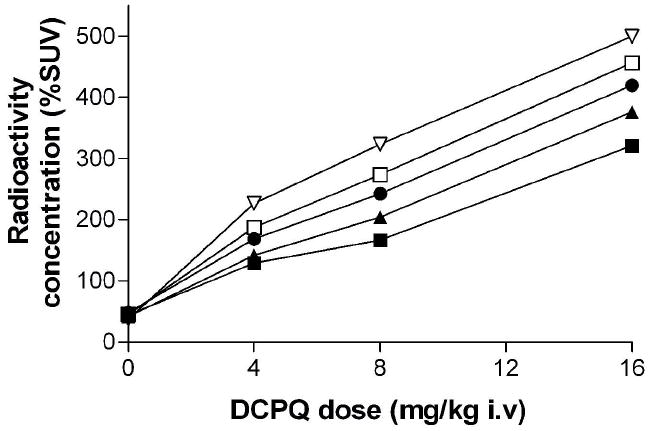
Regional brain uptake of radioactivity after intravenous administration of [11C]3 to monkey – dependence on pre-administered dose of DCPQ. Key: frontal cortex (■); anterior cingulate (▲), hippocampus (●), occipital cortex (□) and cerebellum (▽). Temporal cortex, parietal cortex and putamen gave intermediate curves, but are not shown for Figure clarity.
Figure 8
Figure 8
Time course of composition of radioactivity in plasma after intravenous administration of [11C]3 into monkey. Key: [11C]3 (●); [11C]A (△); [ 11C]B (▽); [11C]C (◊); unextracted for analysis (□).
Figure 9
Figure 9
Structures of DCPQ and zosuquidar.
Scheme 1
Scheme 1
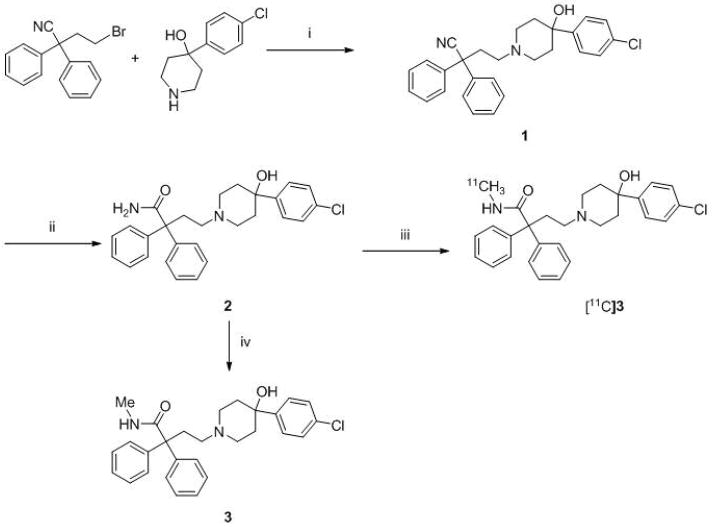
Synthesis of 2, 3, and radiotracer [11C]3.a a Reagents, conditions and yields: (i) DIPEA, MeCN, 70 °C, 31 h, yield 69%; (ii) KOH, tBuOH, 100 °C, 3 d, yield 37%; (iii) [11C]MeI, KOH, DMSO, 80 °C, 5 min, RCY 18% from [11C]carbon dioxide; (iv) MeI, KOH, DMSO, 80 °C, 24 h, 3%.

References

    1. Tsuji A, Tamai I. Blood-brain barrier function of P-glycoprotein. Adv Drug Delivery Rev. 1997;25:287–298.
    1. Cordon-Cardo C, O’Brien JP, Boccia J, Casals D, Bertino JR, Melamed MR. Expression of the multidrug resistance gene product (P-glycoprotein) in human normal and tumor tissues. J Histochem Cytochem. 1990;9:1277–1287. - PubMed
    1. Schinkel A, Wagenaar E, Mol C, van Deemter L. P-glycoprotein in the blood-brain barrier of mice influences the brain penetration and pharmacological activity of many drugs. J Clin Invest. 1996;97:2517–2524. - PMC - PubMed
    1. Kim RB, Fromm MF, Wandel C, Leake B, Wood AJJ, Roden DM, Wilkinson GR. The drug transporter P-glycoprotein limits oral absorption and brain entry of HIV-1 protease inhibitors. J Clin Invest. 1998;101:289–294. - PMC - PubMed
    1. Gottesman M, Fojo T, Bates S. Multidrug resistance in cancer: role of ATP-dependent transporters. Nat Rev Cancer. 2002;2:48–58. - PubMed

Publication types

MeSH terms

LinkOut - more resources