


A population-based study of effect of multiple birth on infant mortality in Nigeria
- PMID: 18783603
- PMCID: PMC2551580
- DOI: 10.1186/1471-2393-8-41
A population-based study of effect of multiple birth on infant mortality in Nigeria
Abstract
Background: Multi-foetal pregnancies and multiple births including twins and higher order multiples births such as triplets and quadruplets are high-risk pregnancy and birth. These high-risk groups contribute to the higher rate of childhood mortality especially during early period of life.
Methods: We examined the relationship between multiple births and infant mortality using univariable and multivariable survival regression procedure with Weibull hazard function, controlling for child's sex, birth order, prenatal care, delivery assistance; mother's age at child birth, nutritional status, education level; household living conditions and several other risk factors.
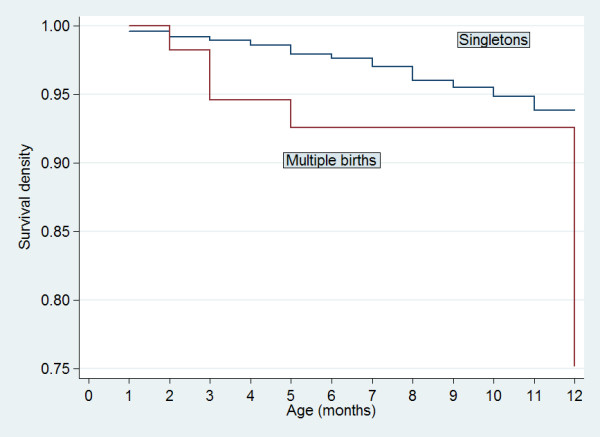
Results: Children born multiple births were more than twice as likely to die during infancy as infants born singleton (hazard ratio = 2.19; 95% confidence interval: 1.50, 3.19) holding other factors constant. Maternal education and household asset index were associated with lower risk of infant mortality.
Conclusion: Multiple births are strongly negatively associated with infant survival in Nigeria independent of other risk factors. Mother's education played a protective role against infant death. This evidence suggests that improving maternal education may be key to improving child survival in Nigeria. A well-educated mother has a better chance of satisfying important factors that can improve infant survival: the quality of infant feeding, general care, household sanitation, and adequate use of preventive and curative health services.
Figures
References
-
- United Nation Development Programme . Human Development Report 2004. New York: UNDP; 2004.
-
- World Bank . World Development Report 2000. Washington, DC: World Bank; 2000.
MeSH terms
LinkOut - more resources
Full Text Sources
