Screening for chronic kidney disease complications in US adults: racial implications of a single GFR threshold
- PMID: 18784208
- PMCID: PMC2572282
- DOI: 10.2215/CJN.01890408
Screening for chronic kidney disease complications in US adults: racial implications of a single GFR threshold
Abstract
Background and objectives: An ideal and effective screening tool should perform equally across ethnic groups. The objective of this study was to determine whether the widely advocated creatinine-based estimated GFR (eGFR) threshold of 60 ml/min per 1.73 m(2) identifies the typical metabolic abnormalities related to chronic kidney disease equally well in minority and nonminority adults.
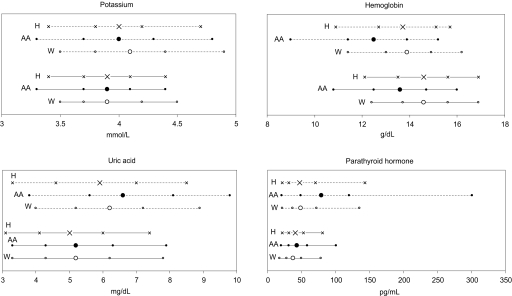
Design, setting, participants, & measurements: This objective was addressed using data for 8918 minority and nonminority adult participants in the National Health and Nutrition Examination Survey 2003 through 2006, which used stratified, multistage, probability sampling methods to assemble a nationwide probability sample of the noninstitutionalized population of the United States. Metabolic abnormalities including BP, potassium, hemoglobin, bicarbonate, uric acid, calcium, phosphorus, and parathyroid hormone were defined by fifth or 95th percentile values.
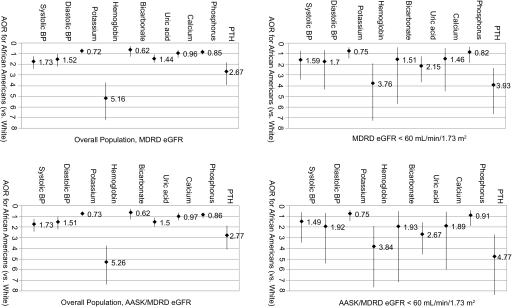
Results: Among participants with eGFR <60 ml/min per 1.73 m(2), black individuals were more likely than white individuals to have low hemoglobin (adjusted odds ratio [aOR] 3.76; 95% confidence interval [CI] 1.94 to 7.28), elevated uric acid (aOR 2.15; 95% CI 1.26 to 3.68), and elevated parathyroid hormone (aOR 3.93; 95% CI 2.33 to 6.66).
Conclusions: Metabolic consequences of reduced eGFR are more common in black individuals and seem to be present at levels well above 60 ml/min per 1.73 m(2); thus, black individuals should be screened for the metabolic complications of chronic kidney at higher GFR levels.
Figures
Comment in
-
Cum hoc, ergo propter hoc: health disparities real and imagined.Clin J Am Soc Nephrol. 2009 Feb;4(2):251-3. doi: 10.2215/CJN.06361208. Clin J Am Soc Nephrol. 2009. PMID: 19201919 No abstract available.
References
-
- Clase CM, Kiberd BA, Garg AX: Relationship between glomerular filtration rate and the prevalence of metabolic abnormalities: Results from the Third National Health and Nutrition Examination Survey (NHANES III). Nephron Clin Pract 105: c178–c184, 2007 - PubMed
-
- Levin A, Bakris GL, Molitch M, Smulders M, Tian J, Williams LA, Andress DL: Prevalence of abnormal serum vitamin D, PTH, calcium, and phosphorus in patients with chronic kidney disease: Results of the study to evaluate early kidney disease. Kidney Int 71: 31–38, 2007 - PubMed
-
- Levey AS, Coresh J, Balk E, Kausz AT, Levin A, Steffes MW, Hogg RJ, Perrone RD, Lau J, Eknoyan G: National Kidney Foundation practice guidelines for chronic kidney disease: Evaluation, classification, and stratification. Ann Intern Med 139: 137–147, 2003 - PubMed
-
- Foley RN, Wang C, Ishani A, Collins AJ: NHANES III: Influence of race on GFR thresholds and detection of metabolic abnormalities. J Am Soc Nephrol 18: 2575–2582, 2007 - PubMed
-
- US Census Bureau: United States Census 2000 Demographic profiles: 100-percent and sample data. Available at: http://www.census.gov/Press-Release/www/2002/demoprofiles.html. Accessed June 24, 2008
MeSH terms
Substances
Grants and funding
LinkOut - more resources
Full Text Sources
Medical
Research Materials
Miscellaneous