Phase I study of a herpes simplex virus type 2 (HSV-2) DNA vaccine administered to healthy, HSV-2-seronegative adults by a needle-free injection system
- PMID: 18784341
- PMCID: PMC2583522
- DOI: 10.1128/CVI.00167-08
Phase I study of a herpes simplex virus type 2 (HSV-2) DNA vaccine administered to healthy, HSV-2-seronegative adults by a needle-free injection system
Abstract
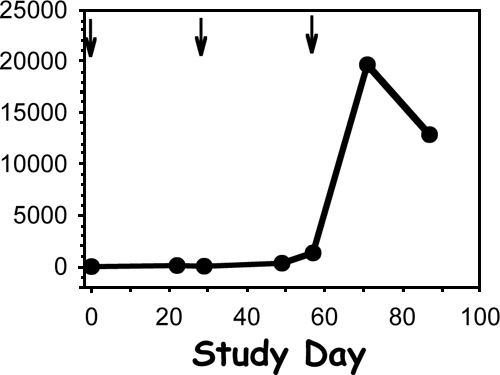
We conducted a double-blind, vehicle-controlled, dose escalation safety and immunogenicity trial of a candidate herpes simplex virus type 2 (HSV-2) surface glycoprotein D2 (gD2) DNA vaccine administered by use of a needle-free device. Sixty-two healthy adults were randomized using a 4:1 vaccine-to-placebo ratio. Half of the participants were HSV-1 seronegative, and all were HSV-2 seronegative. Vaccine doses included 100 microg, 300 microg, 1,000 microg or 3,000 microg of a plasmid expressing the gD2 protein. Subjects received vaccine at 0, 4, 8, and 24 weeks. Some subjects received an additional 1,000-microg boost at 52 weeks. We found that the vaccine was safe and well tolerated, with most adverse events being local site reactions. No dose-limiting toxicities were observed. gD2-specific cytotoxic T-lymphocyte and lymphoproliferation responses were detected 2 weeks after the third vaccine injection in one of four HSV-1-seronegative, HSV-2-seronegative participants who received 3,000 microg of vaccine. A DNA-based vaccination strategy against HSV-2 appears to be safe and may generate a vaccine-specific cellular immune response, but high vaccine doses are likely needed to elicit an immune response in most vaccinees.
Figures
References
-
- Ashley, R., J. Benedetti, and L. Corey. 1985. Humoral immune response to HSV-1 and HSV-2 viral proteins in patients with primary genital herpes. J. Med. Virol. 17:153-166. - PubMed
-
- Bernstein, D., E. Tepe, J. Mester, R. Arnold, L. Stanberry, and T. Higgins. 1999. Effects of DNA immunization formulated with bupivacaine in murine and guinea pig models of genital herpes simplex virus infection. Vaccine 17:1964-1969. - PubMed
-
- Center for Biologics Evaluation and Research, U.S. FDA. 2007. Guidance for industry considerations for plasmid DNA vaccines for infectious disease indications. U.S. FDA, Washington, DC.
-
- Corey, L. 2007. Synergistic copathogens—HIV-1 and HSV-2. N. Engl. J. Med. 356:854-856. - PubMed
Publication types
MeSH terms
Substances
Grants and funding
LinkOut - more resources
Full Text Sources
Other Literature Sources