


Follow-up of mild cognitive impairment and related disorders over four years in adults in their sixties: the PATH Through Life Study
- PMID: 18784412
- PMCID: PMC2790729
- DOI: 10.1159/000154646
Follow-up of mild cognitive impairment and related disorders over four years in adults in their sixties: the PATH Through Life Study
Abstract
Aims: The study aimed to estimate incidence rates of mild cognitive impairment and related disorders, and conversion to dementia.
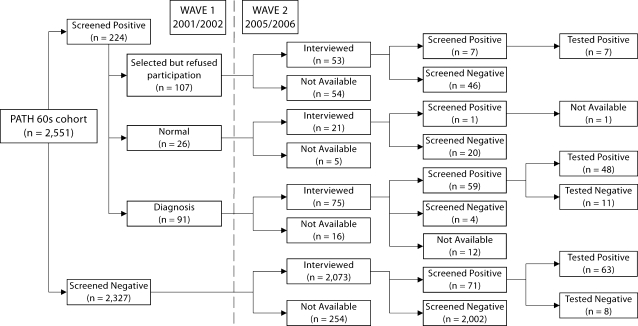
Methods: The data are drawn from the PATH Through Life Study. Baseline assessment in 2001-2002 included 2,551 participants 60-64 years old with 2,222 participating in a 4-year follow-up. Those screened positive with a cognitive assessment received clinical assessment for diagnoses of mild cognitive disorders (MCD) or dementia using established clinical criteria. Prevalence and incidence rates for the cohort were estimated with predictive regression models.
Results: Annual incidence of dementia was 0.25%. Prevalence of mild cognitive impairment was 4.2%, age-associated memory impairment was 2.4%, age-associated cognitive decline was 7.6%, mild neurocognitive disorders occurred in 12.9% and other cognitive disorders in 7.3%. Prevalence of any diagnosis of any MCD (Any-MCD) was 29.5% and the annual incidence rate for Any-MCD was 5.7%. Agreement for specific diagnoses between waves 1 and 2 was fair to poor (0-47.0%), but agreement for Any-MCD over 4 years was 89.0%.
Conclusion: MCD diagnoses do not predict dementia at a 4-year follow-up in young-old adults. Prevalence rates for MCD vary greatly depending on the criteria and time of assessment.
Copyright 2008 S. Karger AG, Basel.
Figures
References
-
- Panza F, D'Introno A, Colacicco AM, Capurso C, Parigi AD, Capurso SA, Caselli RJ, Pilotto A, Scafato E, Capurso A, Solfrizzi V. Cognitive frailty: predementia syndrome and vascular risk factors. Neurobiol Aging. 2006;27:933–940. - PubMed
-
- Levey A, Lah J, Goldstein F, Steenland K, Bliwise D. Mild cognitive impairment: an opportunity to identify patients at high risk for progression to Alzheimer's disease. Clin Ther. 2006;28:991–1001. - PubMed
-
- Tuokko HA, McDowell I. An overview of mild cognitive impairment. In: Tuokko HA, Hultsch DF, editors. Mild Cognitive Impairment: International Perspectives. New York: Taylor & Francis; 2006. pp. 3–28.
-
- Winblad B, Palmer K, Kivipelto M, Jelic V, Fratiglioni L, Wahlund LO, Nordberg A, Backman L, Albert M, Almkvist O, Arai H, Basun H, Blennow K, de Leon M, DeCarli C, Erkinjuntti T, Giacobini E, Graff C, Hardy J, Jack C, Jorm A, Ritchie K, van Duijn C, Visser P, Petersen RC. Mild cognitive impairment – beyond controversies, towards a consensus: report of the International Working Group on Mild Cognitive Impairment. J Intern Med. 2004;256:240–246. - PubMed
-
- Petersen RC, Smith GE, Waring SC, Ivnik RJ, Tangalos EG, Kokmen E. Mild cognitive impairment: clinical characterization and outcome. Arch Neurol. 1999;56:303–308. - PubMed
Publication types
MeSH terms
LinkOut - more resources
Full Text Sources
Medical
