


Respiratory muscle strength predicts decline in mobility in older persons
- PMID: 18784416
- PMCID: PMC2741394
- DOI: 10.1159/000154930
Respiratory muscle strength predicts decline in mobility in older persons
Abstract
Objectives: To test the hypothesis that respiratory muscle strength is associated with the rate of change in mobility even after controlling for leg strength and physical activity.
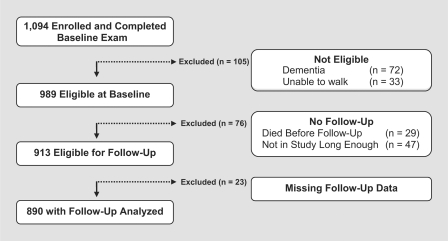
Methods: Prospective study of 890 ambulatory older persons without dementia who underwent annual clinical evaluations to examine change in the rate of mobility over time.
Results: In a linear mixed-effect model adjusted for age, sex, and education, mobility declined about 0.12 unit/year, and higher levels of respiratory muscle strength were associated with a slower rate of mobility decline (estimate 0.043, SE 0.012, p < 0.001). Respiratory muscle strength remained associated with the rate of change in mobility even after controlling for lower extremity strength (estimate 0.036, SE 0.012, p = 0.004). In a model that included terms for respiratory muscle strength, lower extremity strength and physical activity together, all three were independent predictors of mobility decline in older persons. These associations remained significant even after controlling for body composition, global cognition, the development of dementia, parkinsonian signs, possible pulmonary disease, smoking, joint pain and chronic diseases.
Conclusion: Respiratory muscle strength is associated with mobility decline in older persons independent of lower extremity strength and physical activity. Clinical interventions to improve respiratory muscle strength may decrease the burden of mobility impairment in the elderly.
2008 S. Karger AG, Basel.
Figures
References
-
- Woo J, Ho SC, Yu AL. Walking speed and stride length predicts 36 months dependency, mortality, and institutionalization in Chinese aged 70 and older. J Am Geriatr Soc. 1999;47:1257–1260. - PubMed
-
- Cesari M, Kritchevsky SB, Penninx BWHJ, et al. Prognostic value of usual gait speed in well-functioning older people – results from the health, aging and body composition study. J Am Geriatr Soc. 2005;53:1675–1680. - PubMed
-
- Buchman AS, Wilson RS, Boyle PA, Tang Y, Fleischman DA, Bennett DA. Physical activity and leg strength predict decline in mobility performance in older persons. J Am Geriatr Soc. 2007;55:1618–1623. - PubMed
Publication types
MeSH terms
Grants and funding
LinkOut - more resources
Full Text Sources
Medical
