. 2008 Oct 2;455(7213):684-8.
doi: 10.1038/nature07267. Epub 2008 Sep 10.

Eukaryotic initiation factor 6 is rate-limiting in translation, growth and transformation

Affiliations

Eukaryotic initiation factor 6 is rate-limiting in translation, growth and transformation

Valentina Gandin et al. Nature. .

Abstract

Cell growth and proliferation require coordinated ribosomal biogenesis and translation. Eukaryotic initiation factors (eIFs) control translation at the rate-limiting step of initiation. So far, only two eIFs connect extracellular stimuli to global translation rates: eIF4E acts in the eIF4F complex and regulates binding of capped messenger RNA to 40S subunits, downstream of growth factors, and eIF2 controls loading of the ternary complex on the 40S subunit and is inhibited on stress stimuli. No eIFs have been found to link extracellular stimuli to the activity of the large 60S ribosomal subunit. eIF6 binds 60S ribosomes precluding ribosome joining in vitro. However, studies in yeasts showed that eIF6 is required for ribosome biogenesis rather than translation. Here we show that mammalian eIF6 is required for efficient initiation of translation, in vivo. eIF6 null embryos are lethal at preimplantation. Heterozygous mice have 50% reduction of eIF6 levels in all tissues, and show reduced mass of hepatic and adipose tissues due to a lower number of cells and to impaired G1/S cell cycle progression. eIF6(+/-) cells retain sufficient nucleolar eIF6 and normal ribosome biogenesis. The liver of eIF6(+/-) mice displays an increase of 80S in polysomal profiles, indicating a defect in initiation of translation. Consistently, isolated hepatocytes have impaired insulin-stimulated translation. Heterozygous mouse embryonic fibroblasts recapitulate the organism phenotype and have normal ribosome biogenesis, reduced insulin-stimulated translation, and delayed G1/S phase progression. Furthermore, eIF6(+/-) cells are resistant to oncogene-induced transformation. Thus, eIF6 is the first eIF associated with the large 60S subunit that regulates translation in response to extracellular signals.


Conflict of interest statement

The authors have no competing interests.

Figures

Figure 1
Figure 1. eIF6 reduction leads to diminished body weight and affects liver growth at proliferation level
Age-matched mice were weighted and organs growth was followed after birth. a, Body weight of females and males recorded from 30 to 93 days after birth. b, Length of mice at 93 days, expressed as mean ± s.d. (n=8). c, Relative weight of indicated organs was calculated as the ratio between organ/body weight. Values represent mean ± s.d. (n=8). d, Percentage of PCNA-positive cells in 9-days old livers (n=4) and e, Corresponding representative immunohistochemical staining. Scale bar, 100 μm. f, Representative result of western blot analysis of eIF6 expression in organs from eIF6+/+ and eIF6+/− adult mice; bottom, densitometric analysis normalised to actin levels. *, P ≤ 0.01, **, P ≤ 0.05.
Figure 2
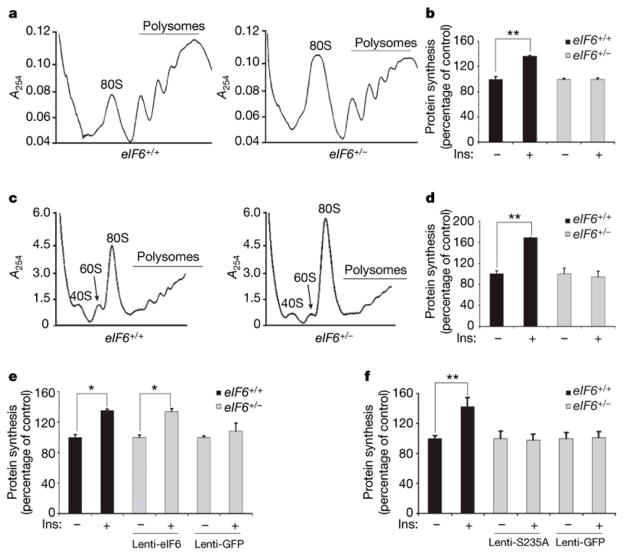
Figure 2. eIF6 reduction results in 80S complex accumulation and a blunted translational response to insulin
a, Polysomal profiles from livers showing the different amount of 80S ribosomal complex and polysomes between eIF6+/+ and eIF6+/−, in vivo. b, 35S-Methionine labelling experiments in isolated primary hepatocytes stimulated with 100 nM insulin (Ins). Basal rate of translation is indicated as 100%. Increase of translation is not detected in eIF6+/− hepatocytes upon insulin stimulation. c, Polysomal profile indicates 80S accumulation in heterozygous cells and d, Representative 35S-Methionine labelling of MEFs shows a blunted response to insulin in eIF6+/−. e, lentiviral-induced re-expression of wt eIF6 results in de novo insulin stimulation of methionine incorporation, whereas (f) lentiviral-induced re-expression of eIF6Ser235Ala does not. All data represent mean ± s.d. of three independent experiments. *, P ≤ 0.01, **, P ≤ 0.05.
Figure 3
Figure 3. eIF6 reduction in the cytoplasmic compartment does not affect 60S ribosomal biogenesis
a,eIF6 distribution analysed in the nucleolus by anti-eIF6 immunostaining of primary MEFs. Nucleolar staining with anti-nucleophosmin (NPM) merged with anti-eIF6 (MERGE) shows nucleolar eIF6, in eIF6+/− MEFs compared to wt. Scale bar, 3 μm. b, Northern blot analysis of steady-state levels of 25S precursors in het. MEFs and livers, and corresponding ethidium bromide staining (c). d, siRNA of eIF6 in NIH3T3 (f) neither abolishes nucleolar staining (g) nor rRNA processing (h).
Figure 4
Figure 4. eIF6 reduction impairs G1/S progression in synchronised cells and causes reduced transformation
a,FACS analysis of asynchronous MEFs. No significant differences in cell cycle distribution are observed between eIF6+/+ and eIF6+/− MEFs. b, 3H-Thymidine labelling of synchronised cells shows a delay in S-phase entry. c–d, Soft agar assay of asynchronous MEFs transformed with DNp53 plus H-rasV12 (n=6) and with Myc plus H-rasV12 (n=6). Number of colonies expressed as mean ± s.d indicates that cellular potential to undergo transformation is impaired in eIF6+/− MEFs.

References

    1. Kapp LD, Lorsch JR. The molecular mechanics of eukaryotic translation. Annu Rev Biochem. 2004;73:657–704. - PubMed
    1. Gebauer F, Hentze MW. Molecular mechanisms of translational control. Nat Rev Mol Cell Biol. 2004;5:827–835. - PMC - PubMed
    1. Proud CG. Signalling to translation: how signal transduction pathways control the protein synthetic machinery. Biochem J. 2007;403:217–234. - PubMed
    1. Sonenberg N, Pause A. Signal transduction. Protein synthesis and oncogenesis meet again. Science. 2006;314:428–429. - PubMed
    1. Mamane Y, Petroulakis E, LeBacquer O, Sonenberg N. mTOR, translation initiation and cancer. Oncogene. 2006;25:6416–6422. - PubMed

Publication types

MeSH terms