


Review
doi: 10.1038/nrn2345.
Epub 2008 Sep 11.
Cognitive therapy versus medication for depression: treatment outcomes and neural mechanisms
Affiliations
- PMID: 18784657
- PMCID: PMC2748674
- DOI: 10.1038/nrn2345
Item in Clipboard
Review
Cognitive therapy versus medication for depression: treatment outcomes and neural mechanisms
Nat Rev Neurosci.
2008 Oct.
Abstract
Depression is one of the most prevalent and debilitating of the psychiatric disorders. Studies have shown that cognitive therapy is as efficacious as antidepressant medication at treating depression, and it seems to reduce the risk of relapse even after its discontinuation. Cognitive therapy and antidepressant medication probably engage some similar neural mechanisms, as well as mechanisms that are distinctive to each. A precise specification of these mechanisms might one day be used to guide treatment selection and improve outcomes.
Figures
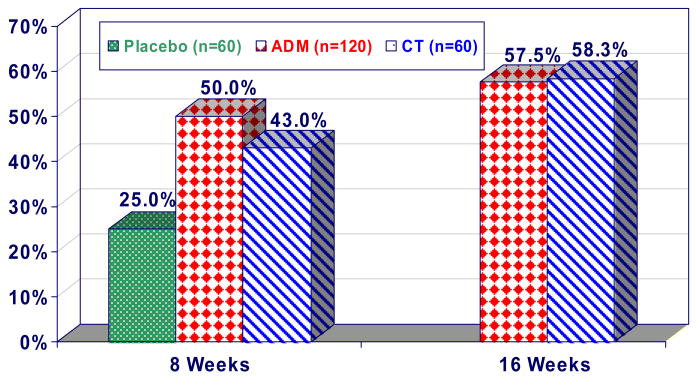
This graph shows the response of outpatients who had moderate to severe depression to cognitive therapy (CT), antidepressant medication (ADM) or placebo (PLA). Patients who were assigned to either ADM or to CT showed a significantly higher response rate after 8 weeks of treatment than those who were assigned to PLA. After 16 of treatment weeks the percentages of patients who responded to ADM and CT were almost identical. Figure modified, with permission, from REF #35.
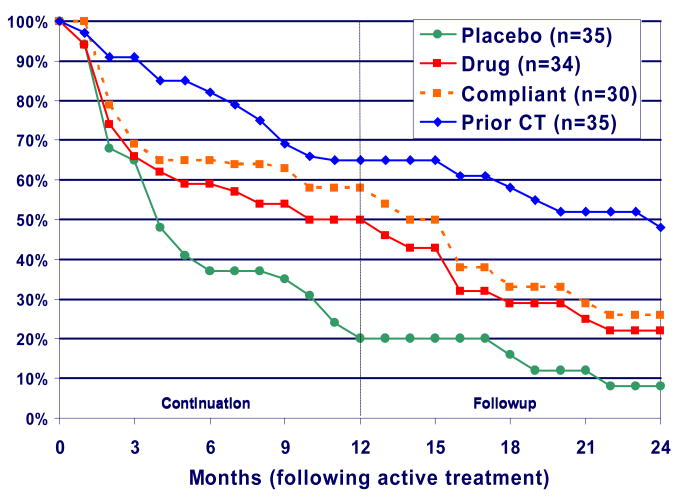
Less relapse after cognitive therapy compared to antidepressant medication. The second phase of the parent study followed patients who had responded to antidepressant medication (ADM) or to cognitive therapy (CT). Patients who responded to ADM were randomly assigned to either continue ADM treatment for one year (beige and red lines), or to change to placebo treatment for one year (green line). Patients who responded to CT were allowed three sessions of CT during the 1-year continuation period. In the follow-up period, none of the patients received any treatment. The figure shows that prior treatment with CT protected against relapse of depression at least as well as the continued provision of ADM, and better than ADM treatment that was subsequently discontinued. Note that the patient group that was given ADM in the continuation year contained a number of patients who did not adhere to the medication regimen. The red line indicates the response of the ADM-continuation group including these non-compliant patients, whereas the beige line shows the response of the patients in this group after the non-compliant patients had been removed from the analysis. Figure modified, with permission, from REF #38, Figure 1 within that paper – need to obtain permission from the Archives of General Psychiatry.
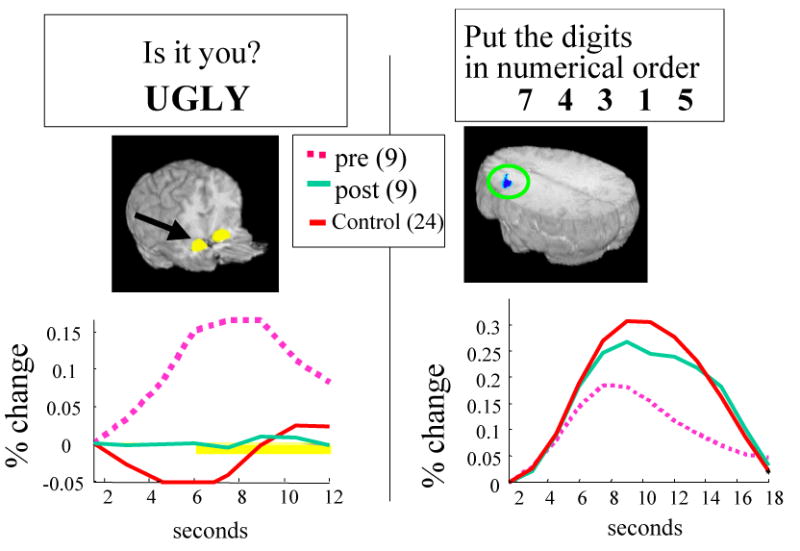
Nine depressed participants and 24 controls completed tasks that involved rating the personal relevance of negative words and arranging digits in numerical order before and after 12 weeks of cognitive therapy (CT). As shown in the figure, CT was associated with normalization of amygdala activity in response to emotional words as well as normalization of dorso-lateral prefrontal activity during a cognitive task that involved putting digits in numerical order in working memory.
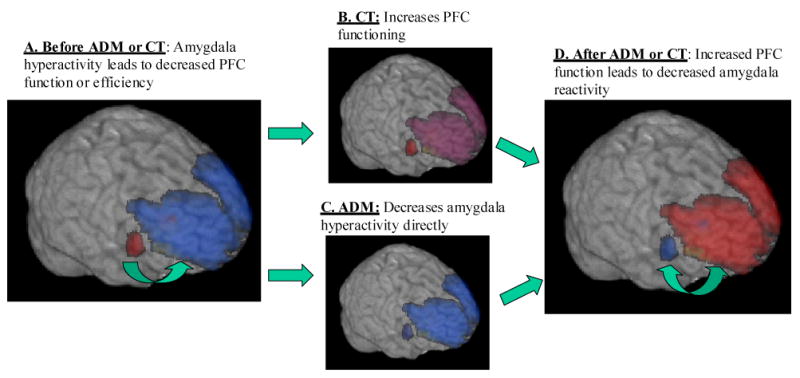
A. During acute depression, amygdala activity is increased (red) and prefrontal activity is decreased (blue) compared to healthy individuals; B. CT effectively exercises the PFC, yielding increased inhibitory function; C. ADM targets amygdala function more directly, decreasing its activity; D. After ADM or CT, amygdala function is decreased and prefrontal function is increased. The double-headed arrow between the amygdala and PFC represents the bidirectional homeostatic influences which are believed to operate in healthy individuals.
References
-
- Kessler RC, et al. The epidemiology of major depressive disorder: Results from the National Comorbidity Survey Replication (NCS-R) JAMA. 2003;289:3095–3105. - PubMed
-
- Murray CJL, Lopez AD. Global mortality, disability, and the contribution of risk factors: Global Burden of Disease Study. Lancet. 1997;349:1436–1442. - PubMed
-
- Greenberg PE, Burnham HG, Lowe SW, Corey-Lisle PK. The economic burden of depression in the United States: how did it change from 1990 to 2000. J Clin Psychiatry. 2003;64:1465–1475. - PubMed
-
- Moussavi S, et al. Depression, chronic diseases, and decrements in health: rsults from the World Health Surveys. Lancet. 2007;370:851–8. - PubMed
-
- DeRubeis RJ, Young PR, Dahlsgaard KK. Affective Disorders. In: Bellack AS, Hersen M, editors. Comprehensive clinical psychology. Vol. 6. Pergamon; Oxford: pp. 339–366.
Publication types
MeSH terms
Substances
Grants and funding
LinkOut - more resources
Full Text Sources
Other Literature Sources
Medical
