. 2009 Feb;118(1):71-84.
doi: 10.1007/s00412-008-0178-0. Epub 2008 Sep 11.

Perturbation of Incenp function impedes anaphase chromatid movements and chromosomal passenger protein flux at centromeres

Affiliations

Perturbation of Incenp function impedes anaphase chromatid movements and chromosomal passenger protein flux at centromeres

Leena J Ahonen et al. Chromosoma. 2009 Feb.

Abstract

Incenp is an essential mitotic protein that, together with Aurora B, Survivin, and Borealin, forms the core of the chromosomal passenger protein complex (CPC). The CPC regulates various mitotic processes and functions to maintain genomic stability. The proper subcellular localization of the CPC and its full catalytic activity require the presence of each core subunit in the complex. We have investigated the mitotic tasks of the CPC using a function blocking antibody against Incenp microinjected into cells at different mitotic phases. This method allowed temporal analysis of CPC functions without perturbation of complex assembly or activity prior to injection. We have also studied the dynamic properties of Incenp and Aurora B using fusion protein photobleaching. We found that in early mitotic cells, Incenp and Aurora B exhibit dynamic turnover at centromeres, which is prevented by the anti-Incenp antibody. In these cells, the loss of centromeric CPC turnover is accompanied by forced mitotic exit without the execution of cytokinesis. Introduction of anti-Incenp antibody into early anaphase cells causes abnormalities in sister chromatid separation through defects in anaphase spindle functions. In summary, our data uncovers new mitotic roles for the CPC in anaphase and proposes that CPC turnover at centromeres modulates spindle assembly checkpoint signaling.


Figures
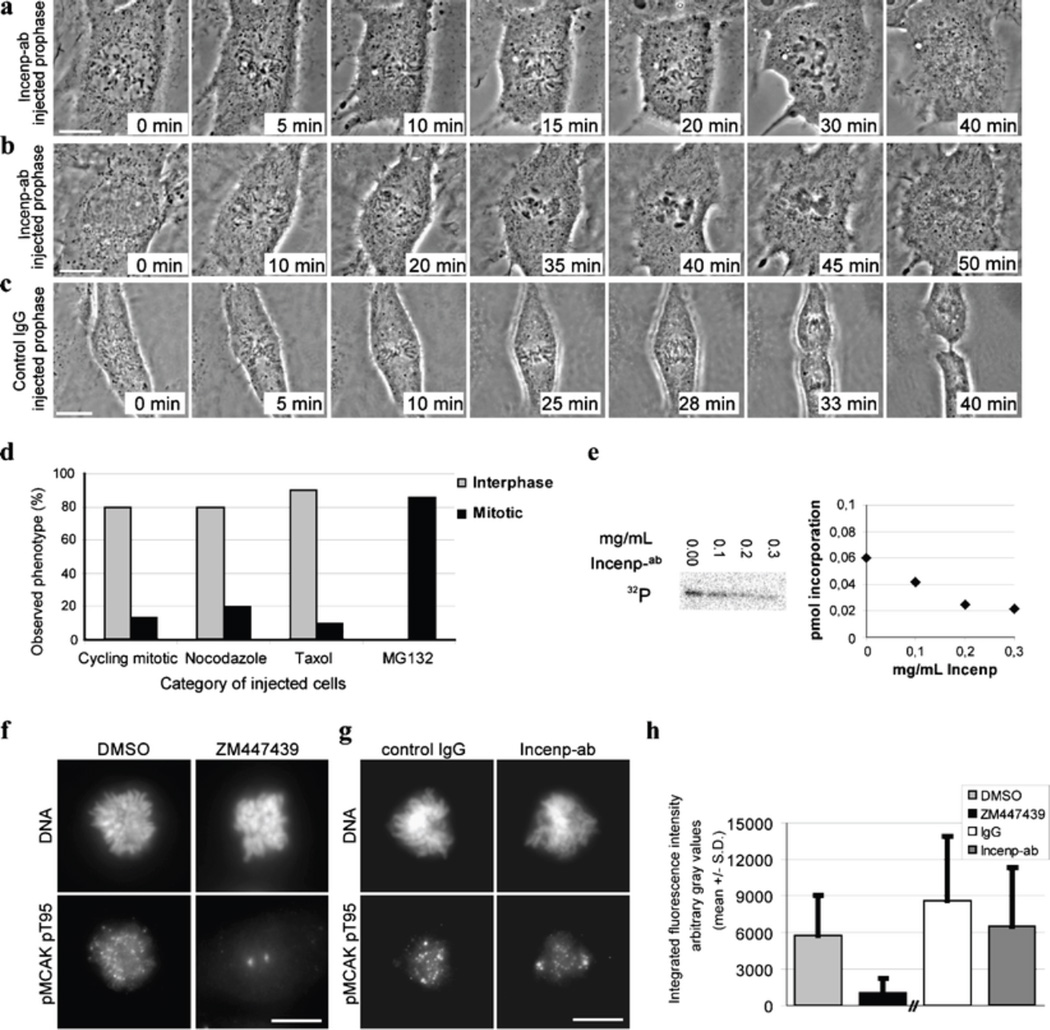
Fig. 1
Fig. 1
Injection of Incenp−ab into early mitotic cells results in chromosome congression defects and override of SAC. a, b Xeno S3 cells injected with Incenp−ab at late prophase. NEB and initial chromosome capture by microtubules appear normal but many chromosomes fail to move to the spindle equator within the time period the chromosomes in control IgG-injected cells (c) form a metaphase plate. Chromosomes of the Incenp−ab-injected cells undergo premature decondensation and cells exit mitosis without execution of cytokinesis. d Mitotic phenotypes of Xeno S3 cells pretreated with various chemicals prior to introduction of Incenp−ab. Cells are categorized as interphase (grey bar) or mitotic (black bar) cells based on their nuclear morphology after the microinjection and subsequent fixation. Most cycling, nocodazole, or taxol-treated cells exit mitosis aberrantly and form polyploid cells with fragmented nuclei indicating forced mitotic exit, whereas MG132-treated cells remain arrested in mitosis. Apoptotic cells are excluded from the grouping. e Aurora B kinase activity in vitro, in the presence of different Incenp−ab concentrations. Incorporation of 32P to histone H3 is moderately reduced indicating partial kinase inhibition. f−h Aurora B kinase activity towards pT95 on MCAK. Prometaphase Xeno S3 cells treated with DMSO or Aurora inhibitor ZM447439 (f), or injected in prophase with control IgG or Incenp−ab (g). h Integrated fluorescence intensity of pMCAK at the centromere-kinetochore regions. ZM447439 abolishes and Incenp−ab partially reduces phospho-MCAK staining at kinetochores. Scale bar = 10 µm. Time-lapse movies corresponding to the still images in panels a and b (Electronic supplementary material, Videos 1 and 2) are available as supplementary material
Fig. 2
Fig. 2
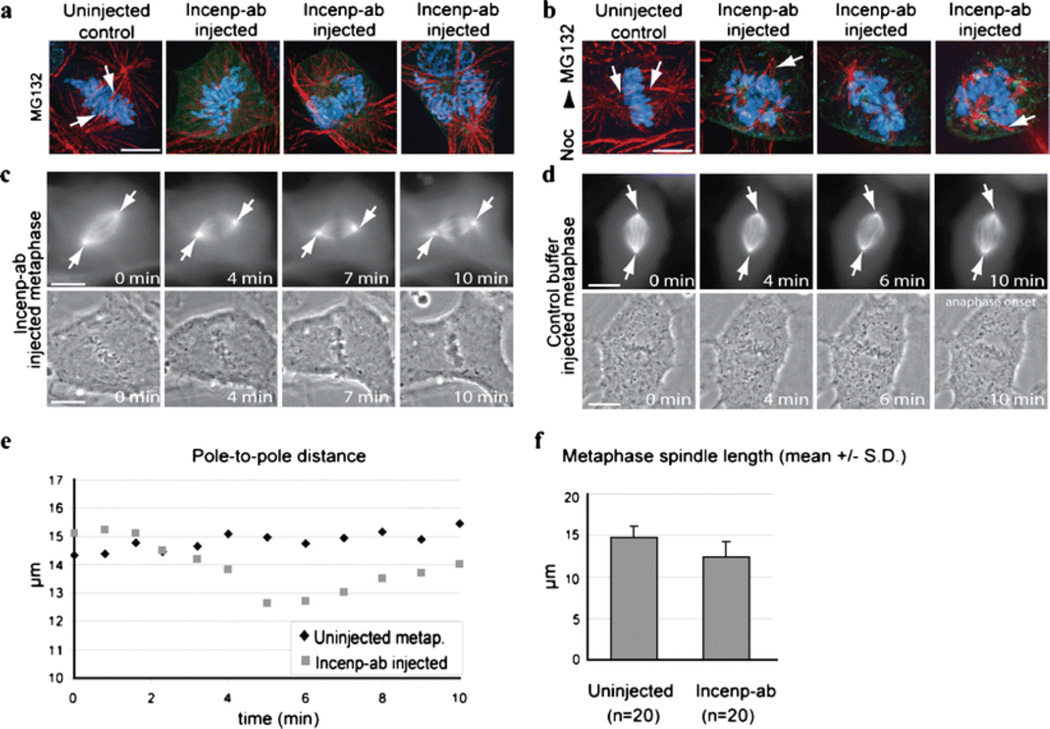
Incenp−ab interferes with the establishment of the mitotic spindle and maintenance of normal spindle length. a, b Images of uninjected control and Incenp−ab-injected cells after fixation and staining for microtubules (red), Incenp−ab (green), and DNA (blue, DAPI). Prior to fixation the cells were (a) treated with MG132 and injected with Incenp−ab or (b) treated with nocodazole, injected with Incenp−ab, and washed out of nocodazole into MG132 containing medium. Incenp−ab-injected cells exhibit unorganized spindle morphology characterized by fewer and thinner kinetochore microtubule bundles compared to control cells, which show normal spindle structure with robust kinetochore microtubule bundles (white arrows). c, d Time-lapse images of Incenp−ab (c) and control buffer (d) injected metaphase Xeno S3 cells expressing GFP-tubulin (arrows mark spindle poles). e Pole-to-pole distance in cells from panel c vs. panel d plotted over time. f Quantification of spindle length from Incenp−ab and control buffer injected cells after fixation. Scale bars = 10 µm. Video corresponding to still images in panel c (Electronic supplementary material, Video 3) is available as supplementary material
Fig. 3
Fig. 3
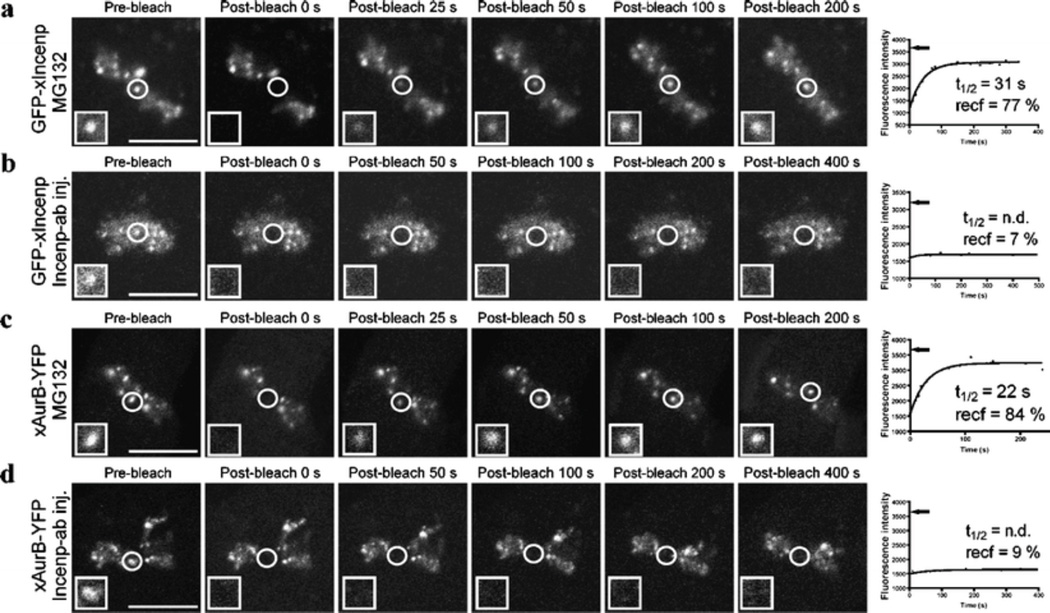
Incenp−ab prevents the dynamic exchange of Incenp and Aurora B at inner centromeres. a, c FRAP analyses of GFP-xIncenp and xAurora B-YFP turnover at the inner centromeres of Xeno S3 cells in the presence of MG132. b, d GFP-xIncenp and xAurora B-YFP turnover after Incenp−ab injection in the presence of MG132. Introduction of Incenp−ab significantly limits the recovery of both fusion proteins to the photobleached areas. Fluorescent images show fusion protein signal before and at different time points after photobleaching. White squares show higher magnification views of the target areas. The recovery half-time (t1/2) and total recovery of fluorescence (recf) are determined from the recovery curves that correspond to the still images. Black arrows indicate the level of fluorescence intensity of the target area prior to photobleaching. Scale bars = 10 µm. Videos corresponding to still images in panels a–d (Electronic supplementary material, Videos 4, 5, 6, 7) are available as supplementary material
Fig. 4
Fig. 4
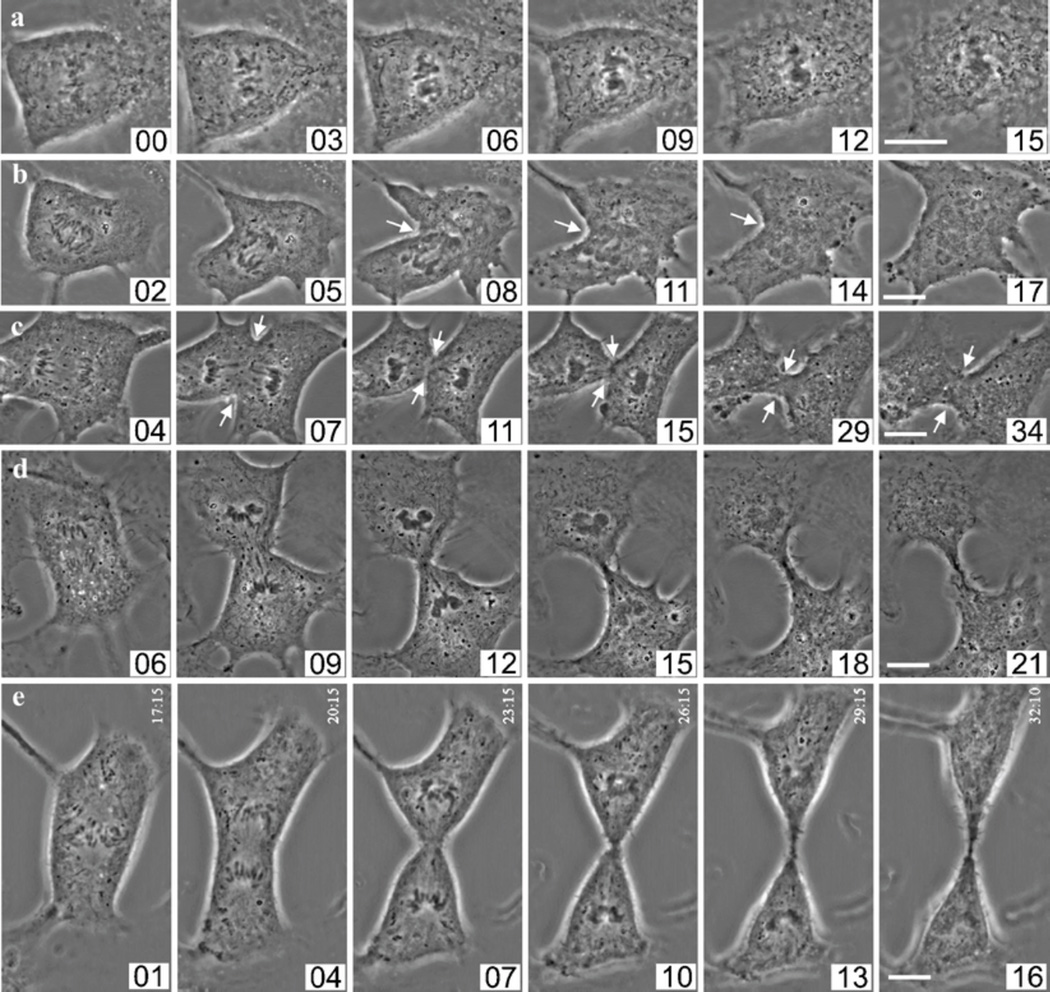
Interference with Incenp function after anaphase onset disrupts sister chromatid separation and cytokinesis. a Xeno S3 cell injected with Incenp−ab at the onset of anaphase showing perturbed sister chromatid separation and cytokinesis. b Xeno S3 cell injected with Incenp−ab 1 min after the onset of anaphase showing incomplete sister chromatid separation and failure of cytokinesis. Cleavage furrow formation (white arrows) is initiated but the furrow soon regresses and the cell exits mitosis forming a polyploid progeny cell. c Xeno S3 cell injected with Incenp−ab 3 min after the onset of anaphase showing incomplete sister chromatid separation and spindle elongation. Also the cleavage furrow regresses (white arrows) and midbody is not formed. d Xeno S3 cell injected with Incenp−ab 5 min after the onset of anaphase undergoes normal anaphase and telophase. e Xeno S3 cell injected with control IgG 30 s after the onset of anaphase undergoes normal anaphase and telophase. Scale bars = 10 µm. The first image in each row shows the first frame after the injection except in panel a where the first image was taken right before the injection. The numbers correspond to minutes after the onset of anaphase. Scale bars = 10 µm. Videos corresponding to still images in panels a–d (Electronic supplementary material, Videos 8, 9, 10, 11) are available as supplementary material
Fig. 5
Fig. 5
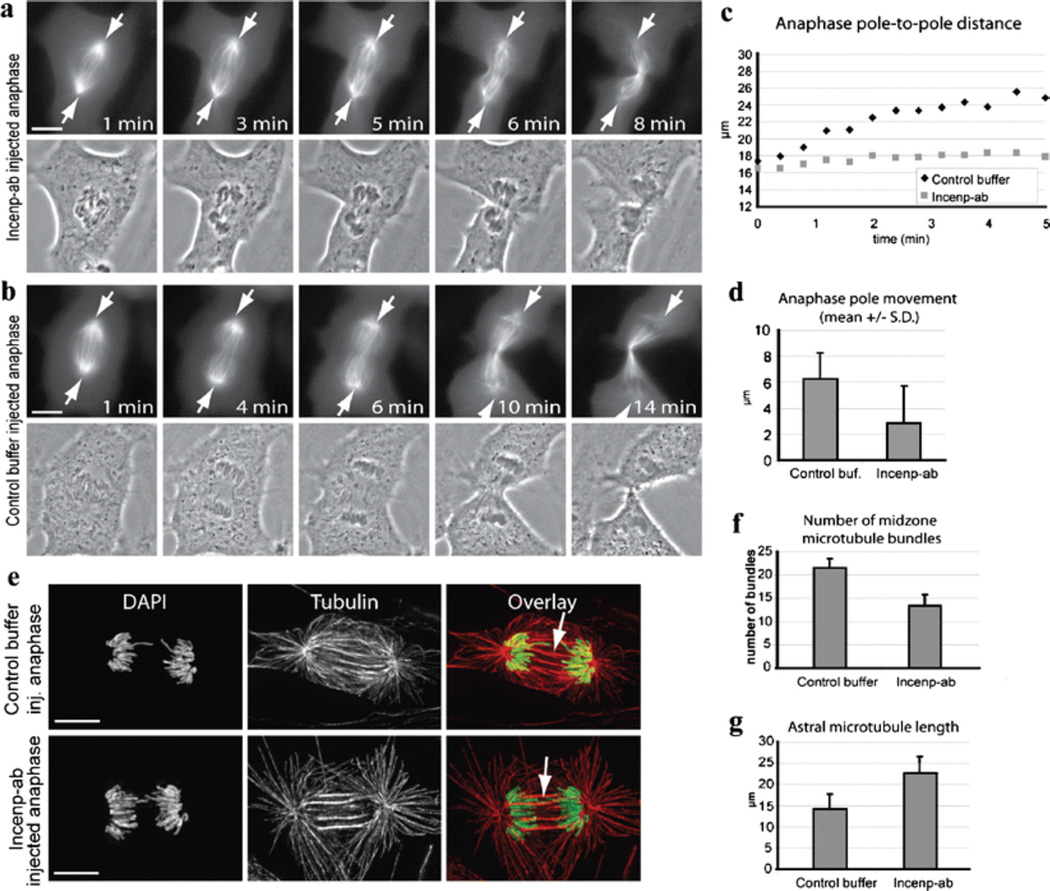
Incenp−ab prevents normal spindle elongation and induces abnormal bundling of midzone microtubules. a GFP-tubulin expressing Xeno S3 cell injected with Incenp−ab 1 min after the onset of anaphase shows defects in spindle elongation, spindle pole separation, and anaphase sister chromatid movements (arrows mark spindle poles). b Xeno S3 cell injected with buffer 1 min after anaphase onset shows normal sister chromatid separation and cytokinesis. The first image in panel a and b shows the first frame after injection. The numbers correspond to minutes after anaphase onset. c Spindle pole movements of the cells in panels a and b plotted over time. d Quantification of spindle pole separation in live Incenp−ab (n = 5) and control buffer (n = 5) injected anaphase cells within 5 min from injection. e Incenp−ab and control buffer injected cells after fixation and staining for microtubules (red) and DNA (DAPI, green). Incenp−ab-injected cell exhibits a narrower anaphase spindle with reduced number of microtubule bundles in the spindle midzone (white arrows) and elongated astral microtubules compared to control. f, g Quantification of the number of midzone microtubule bundles and astral microtubule length in Incenp−ab (n = 5) and control buffer injected cells (n = 5). Scale bars = 10 µm. Videos corresponding to still images in panels a and b (Electronic supplementary material, Videos 12 and 13) are available as supplementary material

References

    1. Adams RR, Wheatley SP, Gouldsworthy AM, Kandels-Lewis SE, Carmena M, Smythe C, Gerloff DL, Earnshaw WC. INCENP binds the Aurora-related kinase AIRK2 and is required to target it to chromosomes, the central spindle and cleavage furrow. Curr Biol. 2000;10:1075–1078. - PubMed
    1. Adams RR, Maiato H, Earnshaw WC, Carmena M. Essential roles of Drosophila inner centromere protein (INCENP) and aurora B in histone H3 phosphorylation, metaphase chromosome alignment, kinetochore disjunction, and chromosome segregation. J Cell Biol. 2001;153:865–880. - PMC - PubMed
    1. Beardmore VA, Ahonen LJ, Gorbsky GJ, Kallio MJ. Survivin dynamics increases at centromeres during G2/M phase transition and is regulated by microtubule-attachment and Aurora B kinase activity. J Cell Sci. 2004;117:4033–4042. - PubMed
    1. Bishop JD, Schumacher JM. Phosphorylation of the carboxyl terminus of inner centromere protein (INCENP) by the Aurora B Kinase stimulates Aurora B kinase activity. J Biol Chem. 2002;277:27577–27580. - PMC - PubMed
    1. Bolton MA, Lan W, Powers SE, McCleland ML, Kuang J, Stukenberg PT. Aurora B kinase exists in a complex with survivin and INCENP and its kinase activity is stimulated by survivin binding and phosphorylation. Mol Biol Cell. 2002;13:3064–3077. - PMC - PubMed

Publication types