


Ten-year follow-up study of PTSD diagnosis, symptom severity and psychosocial indices in aging holocaust survivors
- PMID: 18785948
- PMCID: PMC2670556
- DOI: 10.1111/j.1600-0447.2008.01248.x
Ten-year follow-up study of PTSD diagnosis, symptom severity and psychosocial indices in aging holocaust survivors
Abstract
Objective: We performed a longitudinal study of holocaust survivors with and without post-traumatic stress disorder (PTSD) by assessing symptoms and other measures at two intervals, approximately 10 years apart.
Method: The original cohort consisted of 63 community-dwelling subjects, of whom 40 were available for follow-up.
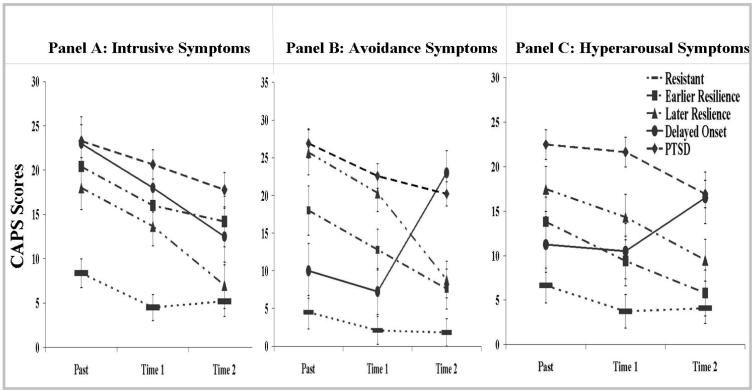
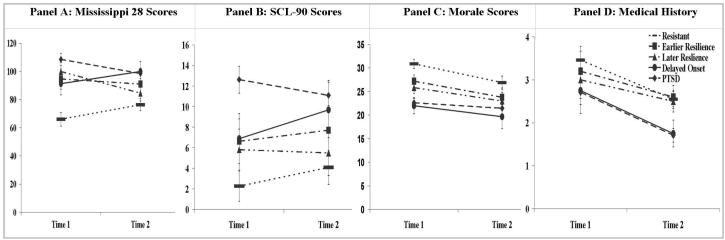
Results: There was a general diminution in PTSD symptom severity over time. However, in 10% of the subjects (n=4), new instances of delayed onset PTSD developed between time 1 and time 2. Self-report ratings at both assessments revealed a worsening of trauma-related symptoms over time in persons without PTSD at time 1, but an improvement in those with PTSD at time 1.
Conclusion: The findings suggest that a nuanced characterization of PTSD trajectory over time is more reflective of PTSD symptomatology than simple diagnostic status at one time. The possibility of delayed onset trajectory complicates any simplistic overall trajectory summarizing the longitudinal course of PTSD.
Figures
References
-
- Zeiss RA, Dickman HR. PTSD 40 years later: incidence and person-situation correlates in former POWs. J Clin Psychol. 1989;45:80–7. - PubMed
-
- Fontana A, Rosenheck R. Traumatic war stressors and psychiatric symptoms among World War II, Korean, and Vietnam War veterans. Psychol Aging. 1994;9:27–33. - PubMed
-
- Kluznik JC, Speed N, Van Valkenburg C, Magraw R. Forty-year follow-up of United States prisoners of war. Am J Psychiatry. 1986;143:1443–1446. - PubMed
-
- Tennant C, Fairley MJ, Dent OF, Sulway MR, Broe GA. Declining prevalence of psychiatric disorder in older former prisoners of war. J Nerv Ment Dis. 1997;185:686–689. - PubMed
-
- Yehuda R, Schmeidler J, Siever LJ, Binder-Brynes K, Elkin A. Individual differences in posttraumatic stress disorder symptom profiles in Holocaust survivors in concentration camps or in hiding. J Trauma Stress. 1997;10:453–463. - PubMed
Publication types
MeSH terms
Grants and funding
LinkOut - more resources
Full Text Sources
Medical
