


Review
doi: 10.1128/JVI.01314-08.
Epub 2008 Sep 10.
Role of Zn2+ ions in host-virus interactions
Affiliations
- PMID: 18787005
- PMCID: PMC2583646
- DOI: 10.1128/JVI.01314-08
Item in Clipboard
Review
Role of Zn2+ ions in host-virus interactions
J Virol.
2008 Dec.
No abstract available
Figures
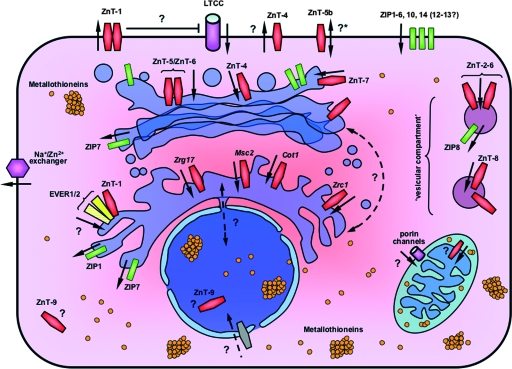
The system that manages cellular zinc homeostasis. Cellular Zn2+ uptake is conferred by ZIP transporters (shown in green), although L-type calcium channels (LTCC) might participate in this process. An excess of unbound cytoplasmic Zn2+ is transported outside the cell by ZnT/CDF family members (shown in red), mainly ZnT-1. However, the influence of ZnT-1 on Zn2+ transport may also result from indirect suppression of Zn2+ influx through L-type calcium channels. The exact role of other ZnTs (ZnT-4 and ZnT-5) and the Na+/Zn2+ exchanger in Zn2+ efflux is not yet fully clarified and might differ, depending on cellular background. It is noteworthy that the splice variant ZnT-5b (*) constitutes the only known exception, and in contrast to other ZnT members, it might also transport Zn2+ into the cytoplasm. The cytoplasmic Zn2+ is buffered by binding to cellular proteins, metallothioneins, in particular, or is redistributed among organelles. So far, several proteins transporting Zn2+ into the Golgi apparatus have been identified (ZnT-4, ZnT-5, ZnT-6, and ZnT-7). The transfer of Zn2+ into the ER in mammalian cells is much less clarified, although the EVER/ZnT-1 complex might be involved in this process. Furthermore, a mutual exchange of Zn2+ between the ER and Golgi apparatus through antero- and retrograde vesicular transport has been postulated. Zn2+ is transported into the “vesicular compartment” by different sets of ZnT proteins, depending on the tissue context. Zn2+ possibly crosses the outer membrane of mitochondria through porin channels; subsequently, it might be bound to the metallothioneins in the intermembrane space and/or further transported to the mitochondrial matrix by not-yet-defined proteins. Zn2+ is transported in the reverse direction, from organelles to the cytosol, by ZIP family members, and ZIP1, ZIP7 (ER and Golgi apparatus), and ZIP8 (vesicles) have been implicated in this process. The arrows represent the directions of Zn2+ transport (the dashed arrows correspond to the hypothetical routes). The names of nonmammalian ER-residing transporters have been italicized. The “vesicular compartment” comprises different types of cellular vesicles (endosomes, lysosomes, synaptic vesicles, and secretory vesicles) without further distinction, depending on the tissue context.
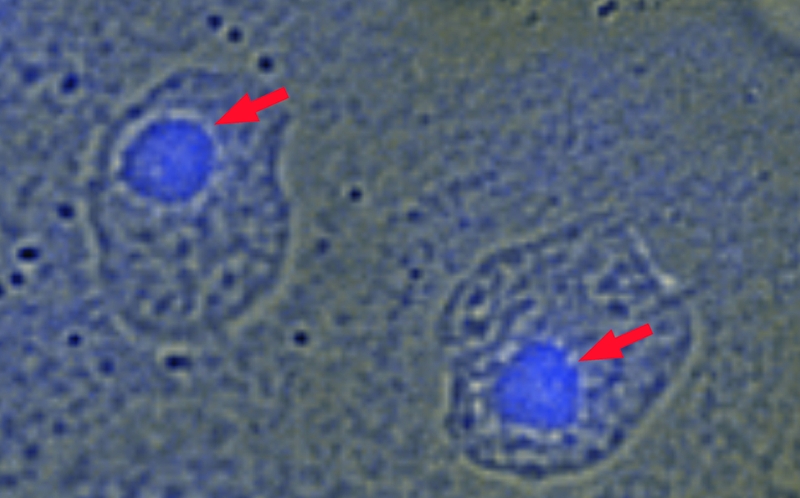
Free-zinc ions in keratinocytes. Keratinocytes with a mutated EVER gene (EVER2−/−) were loaded with Zinquin, a fluorescent indicator specific for free zinc; subsequently, the cells were incubated for 15 min in 100 μM zinc. A strong fluorescence, corresponding to places with a high concentration of free zinc, is visible mainly in the nucleoli (indicated by red arrows).
References
-
- Barthel, A., E. A. Ostrakhovitch, P. L. Walter, A. Kampkötter, and L. O. Klotz. 2007. Stimulation of phosphoinositide 3-kinase/Akt signaling by copper and zinc ions: mechanisms and consequences. Arch. Biochem. Biophys. 463175-182. - PubMed
-
- Beerheide, W., H. U. Bernard, Y. J. Tan, A. Ganesan, W. G. Rice, and A. E. Ting. 1999. Potential drugs against cervical cancer: zinc-ejecting inhibitors of the human papillomavirus type 16 E6 oncoprotein. J. Natl. Cancer Inst. 911211-1220. - PubMed
-
- Boyle, W. J., T. Smeal, L. H. Defize, P. Angel, J. R. Woodgett, M. Karin, and T. Hunter. 1991. Activation of protein kinase C decreases phosphorylation of c-Jun at sites that negatively regulate its DNA-binding activity. Cell 64573-584. - PubMed
Publication types
MeSH terms
Substances
LinkOut - more resources
Full Text Sources
