Cognitive behaviour therapy-based intervention by community health workers for mothers with depression and their infants in rural Pakistan: a cluster-randomised controlled trial
- PMID: 18790313
- PMCID: PMC2603063
- DOI: 10.1016/S0140-6736(08)61400-2
Cognitive behaviour therapy-based intervention by community health workers for mothers with depression and their infants in rural Pakistan: a cluster-randomised controlled trial
Abstract
Background: The treatment of perinatal depression is a public-health priority because of its high prevalence and association with disability and poor infant development. We integrated a cognitive behaviour therapy-based intervention into the routine work of community-based primary health workers in rural Pakistan and assessed the effect of this intervention on maternal depression and infant outcomes.
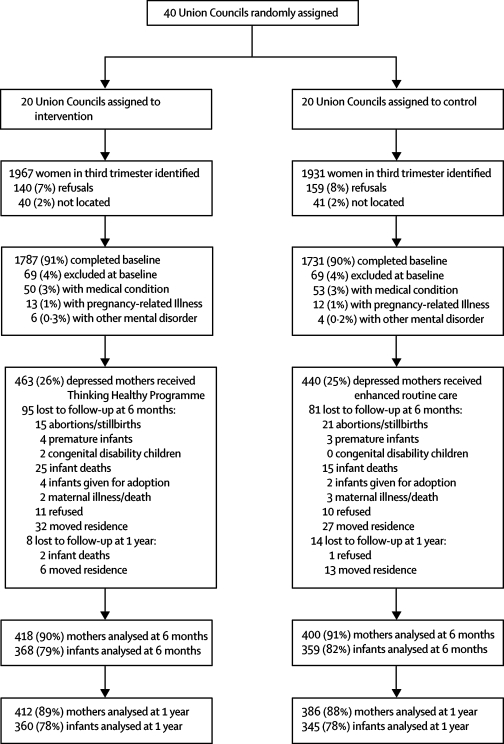
Methods: We randomly assigned 40 Union Council clusters in rural Rawalpindi, Pakistan, in equal numbers to intervention or control. Married women (aged 16-45 years) in their third trimester of pregnancy with perinatal depression were eligible to participate. In the intervention group, primary health workers were trained to deliver the psychological intervention, whereas in the control group untrained health workers made an equal number of visits to the depressed mothers. The primary outcomes were infant weight and height at 6 months and 12 months, and secondary outcome was maternal depression. The interviewers were unaware of what group the participants were assigned to. Analysis was by intention to treat. The study is registered as ISRCTN65316374.
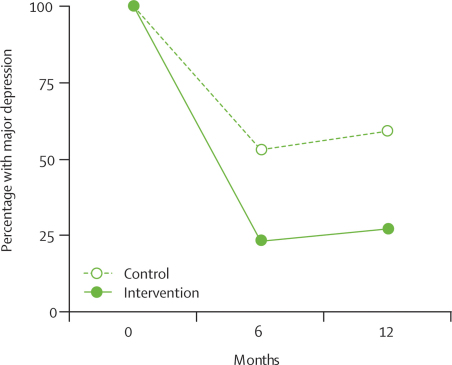
Findings: The number of clusters per group was 20, with 463 mothers in the intervention group and 440 in the control group. At 6 months, 97 (23%) of 418 and 211 (53%) of 400 mothers in the intervention and control groups, respectively, met the criteria for major depression (adjusted odds ratio (OR) 0.22, 95% CI 0.14 to 0.36, p<0.0001). These effects were sustained at 12 months (111/412 [27%] vs 226/386 [59%], adjusted OR 0.23, 95% CI 0.15 to 0.36, p<0.0001). The differences in weight-for-age and height-for-age Z scores for infants in the two groups were not significant at 6 months (-0.83 vs -0.86, p=0.7 and -2.03 vs -2.16, p=0.3, respectively) or 12 months (-0.64 vs -0.8, p=0.3 and -1.10 vs -1.36, p=0.07, respectively).
Interpretation: This psychological intervention delivered by community-based primary health workers has the potential to be integrated into health systems in resource-poor settings.
Figures
Comment in
-
Perinatal depression treated by community health workers.Lancet. 2008 Sep 13;372(9642):868-9. doi: 10.1016/S0140-6736(08)61374-4. Lancet. 2008. PMID: 18790294 No abstract available.
-
Cognitive behaviour therapy for depressed Pakistani mothers.Lancet. 2008 Dec 20;372(9656):2111; author reply 2111-2. doi: 10.1016/S0140-6736(08)61919-4. Lancet. 2008. PMID: 19101382 No abstract available.
-
Cognitive behaviour therapy for depressed Pakistani mothers.Lancet. 2008 Dec 20;372(9656):2111; author reply 2111-2. doi: 10.1016/S0140-6736(08)61918-2. Lancet. 2008. PMID: 19101384 No abstract available.
-
CBT improves maternal perinatal depression in rural Pakistan.Evid Based Ment Health. 2009 May;12(2):45. doi: 10.1136/ebmh.12.2.45. Evid Based Ment Health. 2009. PMID: 19395604 No abstract available.
References
-
- Lopez A, Mathers C, Ezzati M, Jamison D, Murray C. Global burden of disease and risk factors. World Bank; Washington: 2006. - PubMed
-
- Rahman A, Iqbal Z, Harrington R. Life events, social support and depression in childbirth: perspectives from a rural community in the developing world. Psychol Med. 2003;33:1161–1167. - PubMed
-
- Rahman A, Iqbal Z, Bunn J, Lovel H, Harrington R. Impact of maternal depression on infant nutritional status and illness: a cohort study. Arch Gen Psychiatry. 2004;61:946–952. - PubMed
Publication types
MeSH terms
Associated data
Grants and funding
LinkOut - more resources
Full Text Sources
Medical
Miscellaneous