. 2008 Sep 23;105(38):14573-8.
doi: 10.1073/pnas.0806221105. Epub 2008 Sep 12.

Conserved factors Ryp2 and Ryp3 control cell morphology and infectious spore formation in the fungal pathogen Histoplasma capsulatum

Affiliations

Conserved factors Ryp2 and Ryp3 control cell morphology and infectious spore formation in the fungal pathogen Histoplasma capsulatum

Rachael Hanby Webster et al. Proc Natl Acad Sci U S A. .

Abstract

The human fungal pathogen Histoplasma capsulatum grows in a sporulating filamentous form in the soil and, after inhalation of infectious spores, converts to a pathogenic yeast form inside host macrophages in response to temperature. Here we report the identification of two genes (RYP2 and RYP3) required for yeast-phase growth. Ryp2 and Ryp3 are homologous to each other and to the Velvet A family of regulatory proteins in Aspergillus species and other filamentous fungi. Wild-type H. capsulatum grows as filaments at room temperature and as yeast cells at 37 degrees C, but ryp2 and ryp3 mutants constitutively grow as filaments independent of temperature. RYP2 and RYP3 transcripts accumulate to higher levels at 37 degrees C than at room temperature. This differential expression is similar to the previously identified RYP1 transcript, which encodes a transcriptional regulator required for the yeast-phase expression program. Ryp1 associates with the upstream region of RYP2, and each of the three RYP genes is required for the differential expression of the others at 37 degrees C. In addition to responding to the elevated temperature of the mammalian host, RYP2 and RYP3 are essential for viable spore production and regulation of sporulation at room temperature. This regulatory function is strikingly similar to the role of the Aspergillus Velvet A protein family in spore development in response to light, with the notable distinction that the H. capsulatum circuit responds to temperature.


Conflict of interest statement

The authors declare no conflict of interest.

Figures
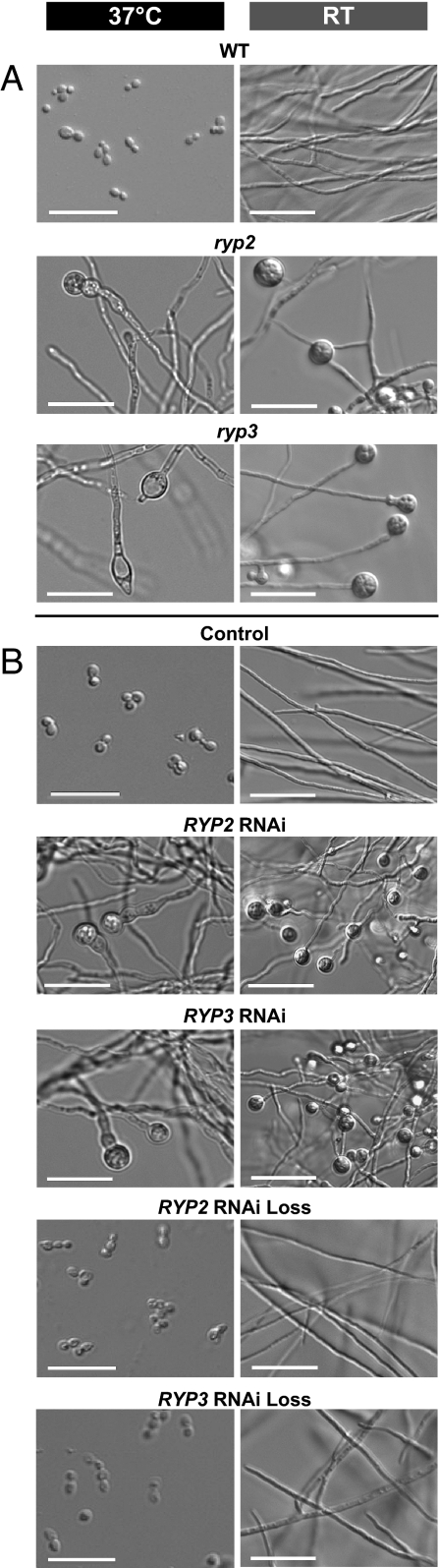
Fig. 1.
Fig. 1.
RYP2 and RYP3 are required for yeast phase growth at 37°C and regulating sporulation at room temperature. (A) Microscopic analysis of wild-type (G217B), a representative ryp2 insertion mutant (M9), and the ryp3 insertion mutant (F14) identified by the screen. The cells were grown in aerated liquid cultures at either 37°C or room temperature (RT). (B) Microscopic analysis of the control, RYP2, or RYP3 RNA interference (RNAi) strains, and RNAi loss strains that no longer contain the RNAi constructs, grown under the same conditions as in (A). Strains shown are representative of at least four independent isolates.
Fig. 2.
Fig. 2.
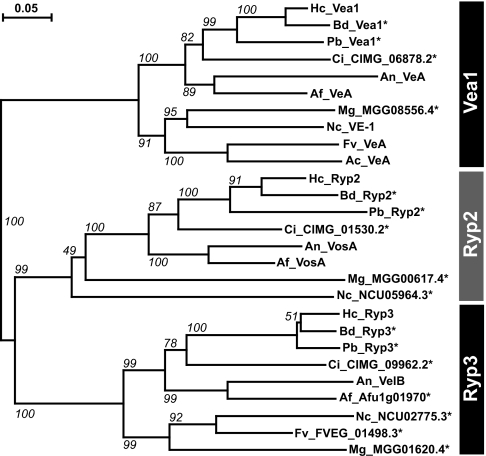
Ryp2 and Ryp3 are homologous to VeA and are part of a family of conserved proteins in both dimorphic and filamentous fungi. The phylogenetic tree shows the relationship of the three VeA homologs (Vea1, Ryp2, and Ryp3) in an array of fungal species [H. capsulatum (Hc), B. dermatititis (Bd), P. brasiliensis (Pb), C. immitis (Ci), A. nidulans (An), A. fumigatus (Af), M. grisea (Mg), N. crassa (Nc), F. verticillioides (Fv), and A. chrysogenum (Ac)]. Bootstrapping values for 1,000 iterations are shown. An * indicates predicted protein.
Fig. 3.
Fig. 3.
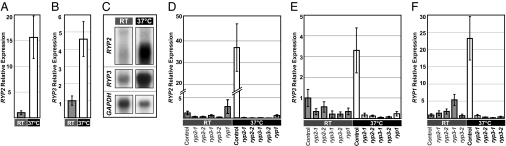
RYP2 and RYP3 expression is regulated in response to temperature and by other RYP genes. All strains were grown in aerated conditions at either 37°C or RT as in Fig. 1. (A) and (B) Quantification of the relative expression of RYP2 and RYP3 in wild-type cells as measured by qRTPCR signal normalized to levels of TEF1. (C) Northern blot analysis of RYP2, RYP3, and GAPDH transcripts in wild-type cells. (D and E) Relative expression levels of RYP2 and RYP3 in the control strain, two independent RYP2 or RYP3 RNAi isolates, and the ryp1 mutant measured by qRTPCR signal normalized to levels of TEF1. (F) Relative RYP1 expression in the control and RYP2 or RYP3 RNAi isolates measured by qRTPCR signal normalized to levels of TEF1.
Fig. 4.
Fig. 4.
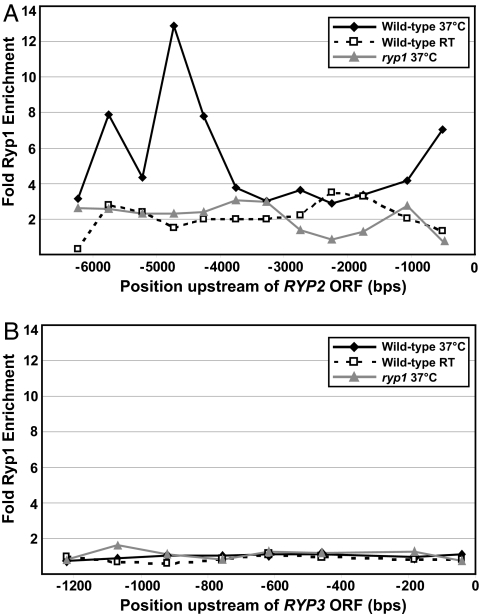
The transcriptional regulator Ryp1 associates with the region upstream of RYP2, but not RYP3. ChIP was performed with α-Ryp1 antibodies in wild-type cells grown at 37°C or at RT and in ryp1 cells grown at 37°C. Ryp1 ChIP enrichment was measured by qPCR at 500-bp intervals across the 6-kb intergenic region immediately upstream of the RYP2 ORF (A) or at 150-bp intervals across the 1.2-kb intergenic region immediately upstream of the RYP3 ORF (B). The enrichment values shown are for each position upstream of the ORFs relative to the reference gene TEF1.
Fig. 5.
Fig. 5.
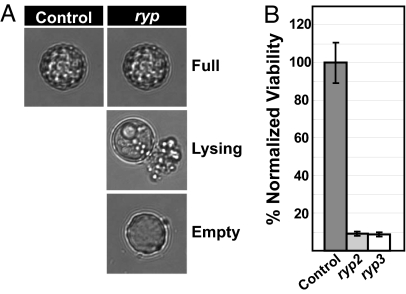
RYP2 and RYP3 are required for the production of viable spores. Cells carrying control, RYP2, or RYP3 RNAi constructs were grown on sporulation plates for at least 4 weeks at room temperature (RT). Spores were harvested in PBS and quantified. (A) Representative microscopic images of the spore populations observed from the control and ryp (ryp2 and ryp3) mutant strains. (B) The spores were stored at 4°C for 7 days and plated to calculate viable CFUs at Days 0, 1, 3, 5, and 7. The viability data were similar for the entire time course, and only the Day 0 time point is shown. The percent viable spores were calculated as described in Materials and Methods. The plot shown is representative of two independent experiments with two RYP2 or RYP3 RNAi isolates.
Fig. 6.
Fig. 6.
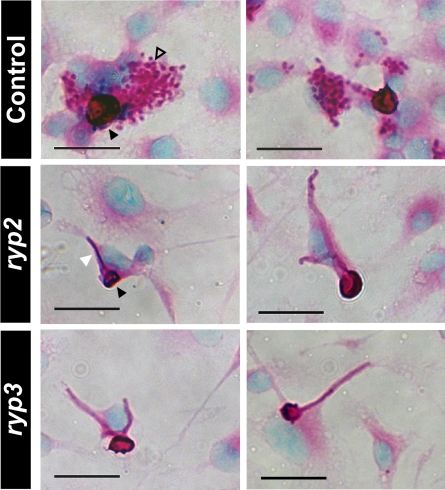
Induction of yeast-phase growth in macrophages depends on RYP2 and RYP3. Bone marrow-derived macrophages were infected with spores from the control strain, RYP2, or RYP3 RNAi isolates at an MOI of 0.1 for 72 h and stained at the 48-h timepoint with PAS and methyl green. Two representative images are shown for each infection. The infections were performed in triplicate with 2 independent RYP2 or RYP3 RNAi isolates. Black arrowheads point to representative spores, the open arrowhead points to a cluster of yeast cells, and the white arrowhead points to a representative filament.
Fig. 7.
Fig. 7.
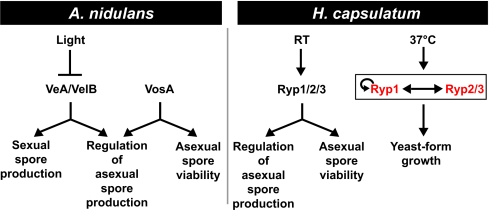
Regulatory diagram comparing homologous developmental regulators in A. nidulans and H. capsulatum. Although the inputs (light and temperature) into these regulatory pathways are different, the outputs are remarkably similar (regulation of cellular development). Light inhibits A. nidulans VeA accumulation in the nucleus, resulting in the inhibition of sexual spore development and the production of asexual spores. VeA has been shown to bind VelB (the Ryp3 ortholog), and both are required for sexual spore formation in the absence of light. VosA, the Ryp2 ortholog, is required to produce viable asexual spores and to inhibit inappropriate asexual sporulation. In H. capsulatum, Ryp2, Ryp3, and the transcriptional regulator Ryp1 function at room temperature (RT) to produce viable asexual spores and to inhibit inappropriate asexual sporulation. At 37°C, each of these Ryp transcripts accumulates to higher levels than at RT, as indicated by the red color. This transcript accumulation is interdependent, as described in the text and indicated by the bidirectional arrow. In addition, Ryp1 associates with the Ryp2 promoter, implying that Ryp1 directly regulates Ryp2 accumulation. We showed previously that Ryp1 associates with its own promoter at 37°C, suggesting the presence of a positive feedback loop as indicated by the circular arrow (5).

References

    1. Holbrook ED, Rappleye CA. Histoplasma capsulatum pathogenesis: Making a lifestyle switch. Curr Opin Microbiol. 2008;11:318–324. - PubMed
    1. Calvo AM. The VeA regulatory system and its role in morphological and chemical development in fungi. Fungal Genet and Biol. 2008;45:1053–1061. - PubMed
    1. Medoff G, et al. Irreversible block of the mycelial to yeast phase transition of H capsulatum. Science. 1986;231:476–479. - PubMed
    1. Nemecek JC, Wuthrich M, Klein BS. Global control of dimorphism and virulence in fungi. Science. 2006;312:583–588. - PubMed
    1. Nguyen VQ, Sil A. Temperature-induced switch to the pathogenic yeast form of Histoplasma capsulatum requires Ryp1, a conserved transcriptional regulator. Proc Natl Acad Sci USA. 2008;105:4880–4885. - PMC - PubMed

Publication types

Substances

Associated data