


A potent dauer pheromone component in Caenorhabditis elegans that acts synergistically with other components
- PMID: 18791072
- PMCID: PMC2567175
- DOI: 10.1073/pnas.0806676105
A potent dauer pheromone component in Caenorhabditis elegans that acts synergistically with other components
Abstract
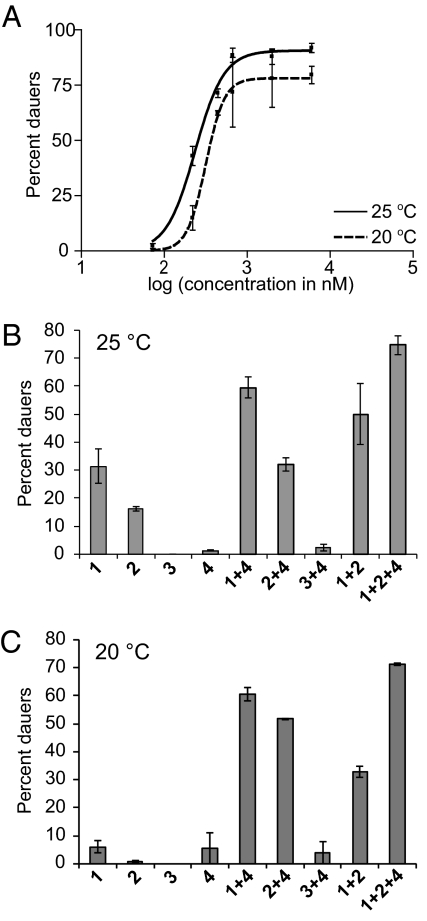
In the model organism Caenorhabditis elegans, the dauer pheromone is the primary cue for entry into the developmentally arrested, dauer larval stage. The dauer is specialized for survival under harsh environmental conditions and is considered "nonaging" because larvae that exit dauer have a normal life span. C. elegans constitutively secretes the dauer pheromone into its environment, enabling it to sense its population density. Several components of the dauer pheromone have been identified as derivatives of the dideoxy sugar ascarylose, but additional unidentified components of the dauer pheromone contribute to its activity. Here, we show that an ascaroside with a 3-hydroxypropionate side chain is a highly potent component of the dauer pheromone that acts synergistically with previously identified components. Furthermore, we show that the active dauer pheromone components that are produced by C. elegans vary depending on cultivation conditions. Identifying the active components of the dauer pheromone, the conditions under which they are produced, and their mechanisms of action will greatly extend our understanding of how chemosensory cues from the environment can influence such fundamental processes as development, metabolism, and aging in nematodes and in higher organisms.
Conflict of interest statement
The authors declare no conflict of interest.
Figures

References
-
- Cassada RC, Russell RL. The dauerlarva, a post-embryonic developmental variant of the nematode Caenorhabditis elegans. Dev Biol. 1975;46:326–342. - PubMed
-
- Golden JW, Riddle DL. A pheromone influences larval development in the nematode Caenorhabditis elegans. Science. 1982;218:578–580. - PubMed
-
- Golden JW, Riddle DL. The Caenorhabditis elegans dauer larva: Developmental effects of pheromone, food, and temperature. Dev Biol. 1984;102:368–378. - PubMed
-
- Klass M, Hirsh D. Non-ageing developmental variant of Caenorhabditis elegans. Nature. 1976;260:523–525. - PubMed
-
- Golden JW, Riddle DL. A Caenorhabditis elegans dauer-inducing pheromone and an antagonistic component of the food supply. J Chem Ecol. 1984;10:1265–1280. - PubMed
Publication types
MeSH terms
Substances
Grants and funding
LinkOut - more resources
Full Text Sources
Other Literature Sources
