


Transcriptional autoregulatory loops are highly conserved in vertebrate evolution
- PMID: 18791639
- PMCID: PMC2527657
- DOI: 10.1371/journal.pone.0003210
Transcriptional autoregulatory loops are highly conserved in vertebrate evolution
Abstract
Background: Feedback loops are the simplest building blocks of transcriptional regulatory networks and therefore their behavior in the course of evolution is of prime interest.
Methodology: We address the question of enrichment of the number of autoregulatory feedback loops in higher organisms. First, based on predicted autoregulatory binding sites we count the number of autoregulatory loops. We compare it to estimates obtained either by assuming that each (conserved) gene has the same chance to be a target of a given factor or by assuming that each conserved sequence position has an equal chance to be a binding site of the factor.
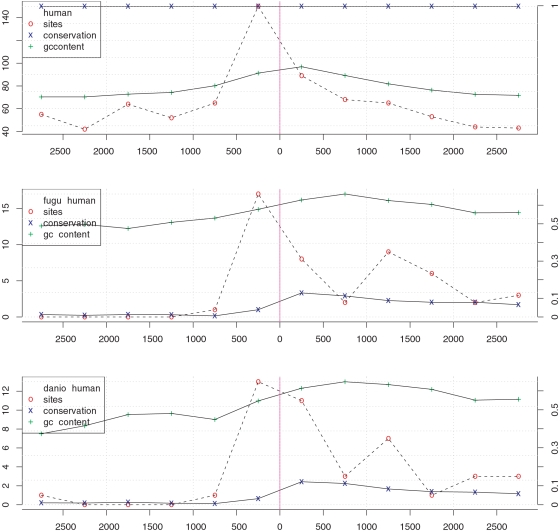
Conclusions: We demonstrate that the numbers of putative autoregulatory loops conserved between human and fugu, danio or chicken are significantly higher than expected. Moreover we show, that conserved autoregulatory binding sites cluster close to the factors' starts of transcription. We conclude, that transcriptional autoregulatory feedback loops constitute a core transcriptional network motif and their conservation has been maintained in higher vertebrate organism evolution.
Conflict of interest statement
Figures

 predicted to have a conserved binding site of f. Vertical axes give the fraction of regulated genes
  . Three cases are shown: no conservation, conservation to danio and to fugu.
References
-
- Alon U. Network motifs: theory and experimental approaches. Nat Rev Genet. 2007;8(6):450–61. - PubMed
-
- Tao Y. Intrinsic and external noise in an auto-regulatory genetic network. J Theor Biol. 2004;229(2):147–56. - PubMed
-
- Bai G, Sheng N, Xie Z, Bian W, Yokota Y, et al. Id sustains Hes1 expression to inhibit precocious neurogenesis by releasing negative autoregulation of Hes1. Dev Cell. 2007;13(2):283–97. - PubMed
-
- Smith S, Watada H, Scheel D, Mrejen C, German M. Autoregulation and maturity onset diabetes of the young transcription factors control the human PAX4 promoter. J Biol Chem. 2000;275(47):36910–9. - PubMed
-
- Johnson D, Ohtani K, Nevins J. Autoregulatory control of E2F1 expression in response to positive and negative regulators of cell cycle progression. Genes Dev. 1994;8(13):1514–25. - PubMed
Publication types
MeSH terms
Substances
LinkOut - more resources
Full Text Sources
Other Literature Sources
