


A pooled analysis of melanocytic nevus phenotype and the risk of cutaneous melanoma at different latitudes
- PMID: 18792098
- PMCID: PMC2656967
- DOI: 10.1002/ijc.23869
A pooled analysis of melanocytic nevus phenotype and the risk of cutaneous melanoma at different latitudes
Abstract
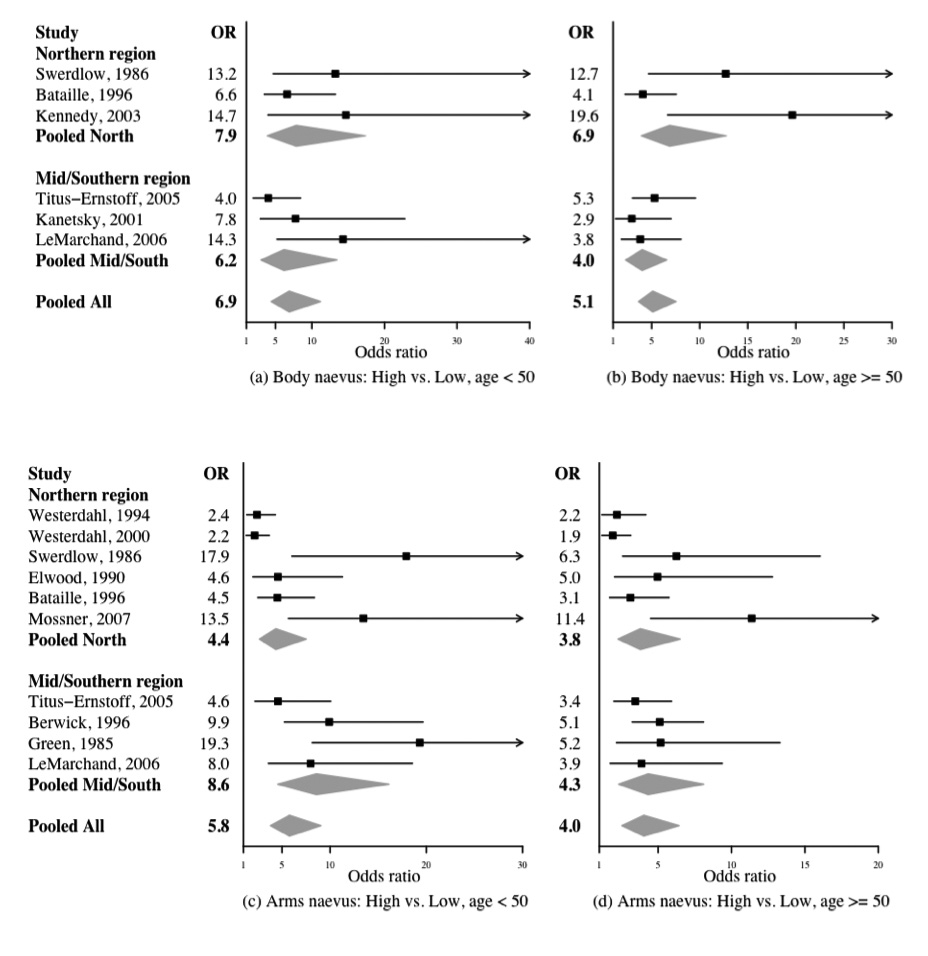
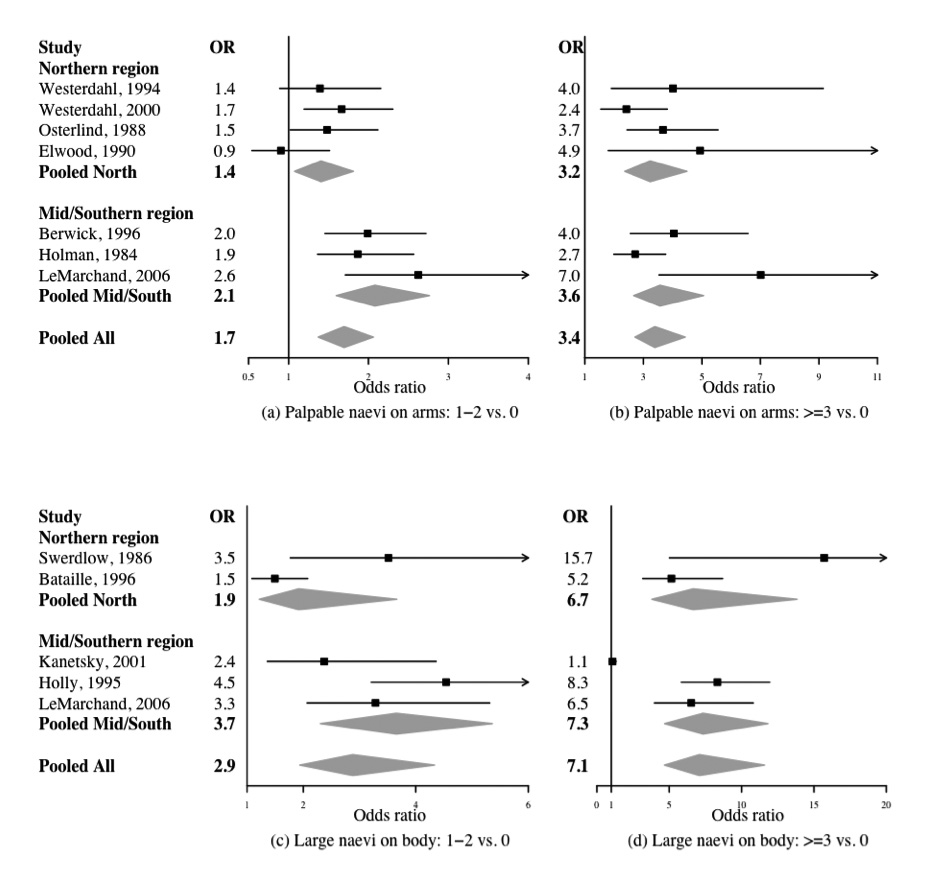
An abnormal nevus phenotype is associated with an increased risk of melanoma. We report a pooled analysis conducted using individual nevus data from 15 case-control studies (5,421 melanoma cases and 6,966 controls). The aims were to quantify the risk better and to determine whether relative risk is varied by latitude. Bayesian unconditional logistic random coefficients models were employed to study the risk associated with nevus characteristics. Participants with whole body nevus counts in the highest of 4 population-based categories had a greatly increased risk of melanoma compared with those in the lowest category (pooled odds ratio (pOR) 6.9 (95% confidence interval (CI): 4.4, 11.2) for those aged<50 years and pOR 5.1 (95% CI: 3.6, 7.5) for those aged>or=50). The pOR for presence compared with absence of any clinically atypical nevi was 4.0 (95% CI: 2.8, 5.8). The pORs for 1-2 and >or=3 large nevi on the body compared with none were 2.9 (95% CI: 1.9, 4.3) and 7.1 (95% CI: 4.7, 11.6), respectively. The relative heterogeneities among studies were small for most measures of nevus phenotype, except for the analysis of nevus counts on the arms, which may have been due to methodological differences among studies. The pooled analysis also suggested that an abnormal nevus phenotype is associated most with melanomas on intermittently sun-exposed sites. The presence of increased numbers of nevi, large nevi and clinically atypical nevi on the body are robust risk factors for melanoma showing little variation in relative risk among studies performed at different latitudes.
Copyright (c) 2008 Wiley-Liss, Inc.
Figures
References
-
- Gandini S, Sera F, Cattaruzza MS, Pasquini P, Abeni D, Boyle P, Melchi CF. Meta-analysis of risk factors for cutaneous melanoma: I. Common and atypical naevi. Eur J Cancer. 2005;41:28–44. - PubMed
-
- Gandini S, Sera F, Cattaruzza MS, Pasquini P, Picconi O, Boyle P, Melchi CF. Meta-analysis of risk factors for cutaneous melanoma: II. Sun exposure. Eur J Cancer. 2005;41:45–60. - PubMed
-
- Mössner R, Anders N, König IR, Krüger U, Schmidt D, Berking C, Ziegler A, Brockmöller J, Kaiser R, Volkenandt M, Westphal GA, Reich K. Variations of the melanocortin-1 receptor and the glutathione-S transferase T1 and M1 genes in cutaneous malignant melanoma. Arch Dermatol Res. 2007;298:371–379. - PubMed
-
- Le Marchand L, Saltzman BS, Hankin JH, Wilkens LR, Franke AA, Morris SJ, Kolonel LN. Sun exposure, diet, and melanoma in Hawaii Caucasians. Am J Epidemiol. 2006;164:232–245. - PubMed
-
- MacKie RM, English J, Aitchison TC, Fitzsimons CP, Wilson P. The number and distribution of benign pigmented moles (melanocytic naevi) in a healthy British population. Br J Dermatol. 1985;113:167–174. - PubMed
Publication types
MeSH terms
Grants and funding
LinkOut - more resources
Full Text Sources
Medical
