Trajectories of social withdrawal from grades 1 to 6: prediction from early parenting, attachment, and temperament
- PMID: 18793064
- PMCID: PMC4305444
- DOI: 10.1037/a0012954
Trajectories of social withdrawal from grades 1 to 6: prediction from early parenting, attachment, and temperament
Abstract
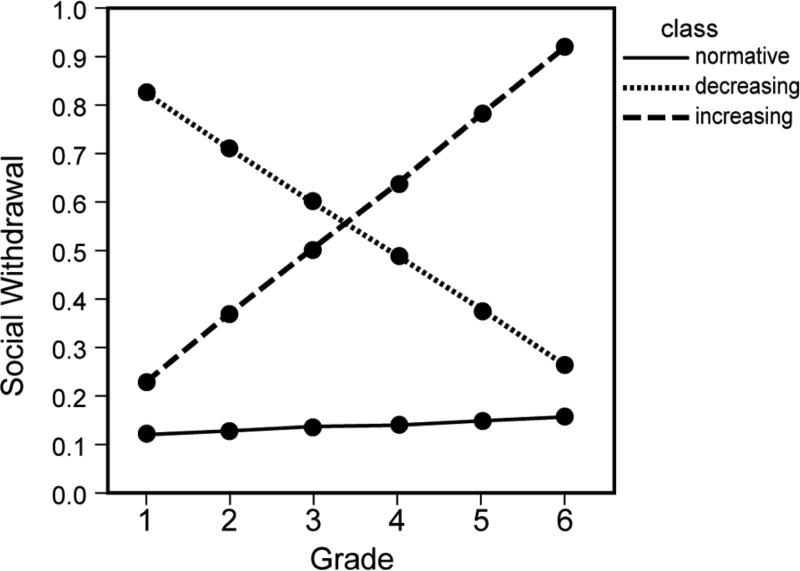
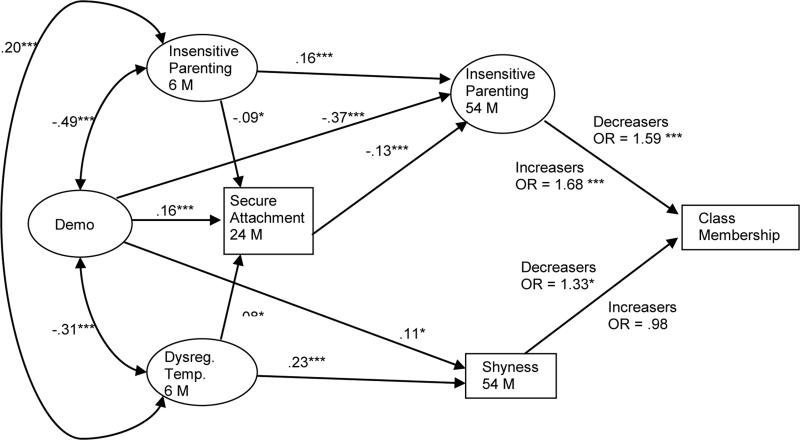
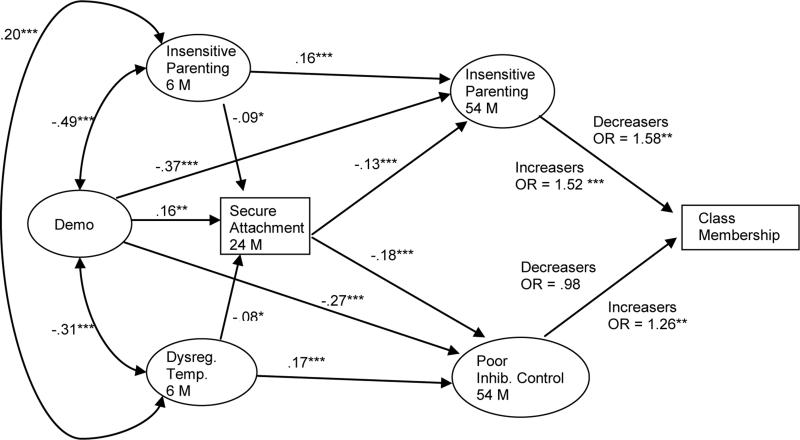
From 1,092 children in the NICHD Study of Early Child Care and Youth Development, the authors identified 3 trajectory patterns of social withdrawal from teacher reports in Grades 1-6: a normative consistently low group (86%), a decreasing group (5%) with initially high withdrawal that decreased, and an increasing group (9%) with initially low withdrawal that increased. Prediction models supported the role of early dysregulated temperament, insensitive parenting, and attachment. Preschool shy temperament was a specific pathway to decreasing withdrawal, and poor inhibitory control was a specific pathway to increasing withdrawal. Children on the increasing pathway were more lonely, solitary, and were excluded by peers. Results suggest differentiated pathways to varying trajectories of social withdrawal and highlight the importance of identification of longitudinal patterns in relation to risk.
Figures
References
-
- Achenbach TM. Manual for the Teacher's Report Form and 1991 Profile. University of Vermont, Department of Psychiatry; Burlington, VT: 1991.
-
- Asendorpf JB. The development of inhibition during childhood: Evidence for situational specificity and a two-factor model. Developmental Psychology. 1990;26:721–730.
-
- Asendorpf JB. Development of inhibited children's coping with unfamiliarity. Child Development. 1991;62:1460–1474. - PubMed
-
- Bentler PM. On the fit of models to covariances and methodology to the Bulletin. Psychological Bulletin. 1992;112:400–404. - PubMed
-
- Bergman LR, El-Khouri BM. SLEIPNER: A statistical package for pattern-oriented analyses, V 2.0. Stockholm University Department of Psychology; Stockholm: 1998.