


Reward-guided learning beyond dopamine in the nucleus accumbens: the integrative functions of cortico-basal ganglia networks
- PMID: 18793321
- PMCID: PMC2756656
- DOI: 10.1111/j.1460-9568.2008.06422.x
Reward-guided learning beyond dopamine in the nucleus accumbens: the integrative functions of cortico-basal ganglia networks
Abstract
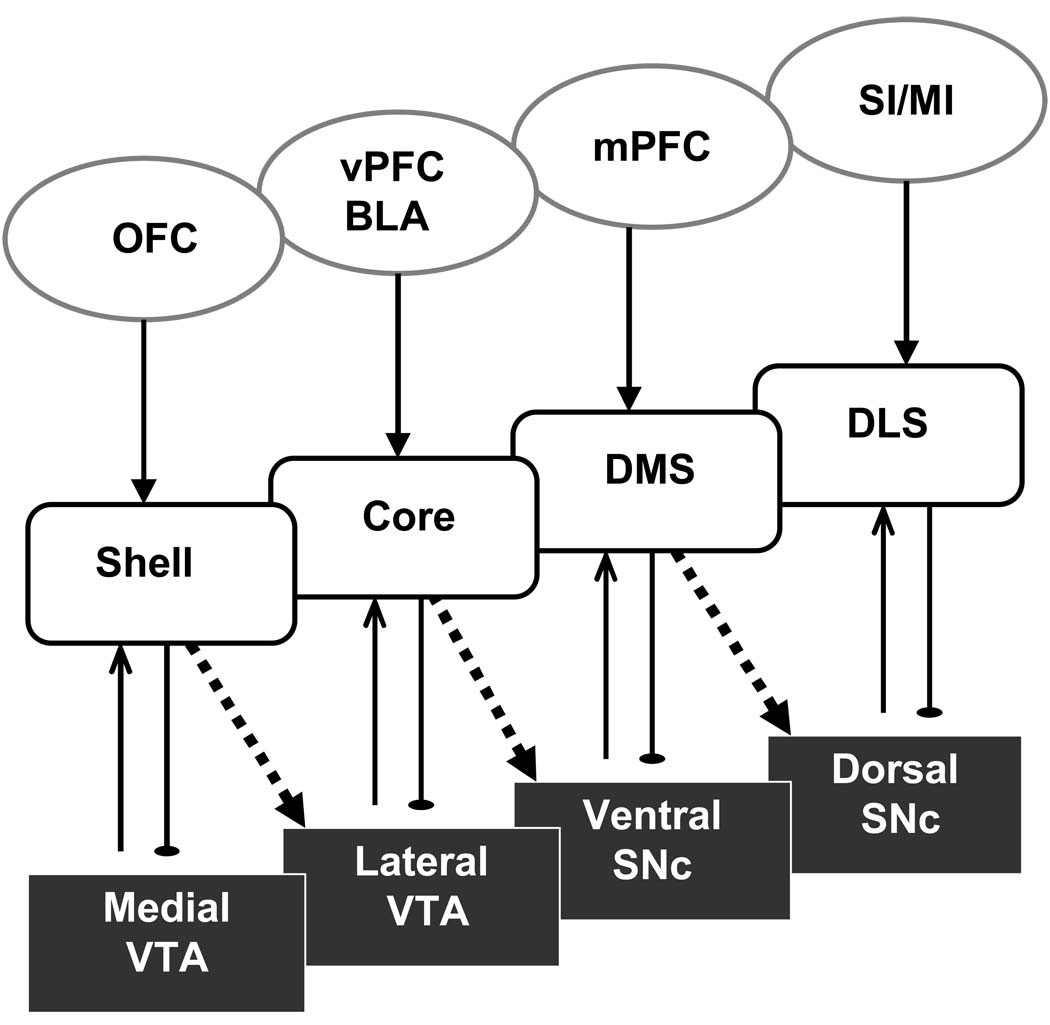
Here we challenge the view that reward-guided learning is solely controlled by the mesoaccumbens pathway arising from dopaminergic neurons in the ventral tegmental area and projecting to the nucleus accumbens. This widely accepted view assumes that reward is a monolithic concept, but recent work has suggested otherwise. It now appears that, in reward-guided learning, the functions of ventral and dorsal striata, and the cortico-basal ganglia circuitry associated with them, can be dissociated. Whereas the nucleus accumbens is necessary for the acquisition and expression of certain appetitive Pavlovian responses and contributes to the motivational control of instrumental performance, the dorsal striatum is necessary for the acquisition and expression of instrumental actions. Such findings suggest the existence of multiple independent yet interacting functional systems that are implemented in iterating and hierarchically organized cortico-basal ganglia networks engaged in appetitive behaviors ranging from Pavlovian approach responses to goal-directed instrumental actions controlled by action-outcome contingencies.
Figures

References
-
- Adams CD. Variations in the sensitivity of instrumental responding to reinforce devaluation. Quarterly journal of experimental psychology. 1982;33b:109–122.
-
- Adams CD, Dickinson A. Instrumental responding following reinforce devaluation. Quarterly Journal of Experimental Psychology. 1981;33:109–122.
-
- Alexander GE, DeLong MR, Strick PL. Parallel organization of functionally segregated circuits linking basal ganglia and cortex. Annu Rev Neurosci. 1986;9:357–381. - PubMed
-
- Ashby WR. Design for a Brain. second Edition. Chapman & Hall; 1960.
-
- Atallah HE, Lopez-Paniagua D, Rudy JW, O'Reilly RC. Separate neural substrates for skill learning and performance in the ventral and dorsal striatum. Nat Neurosci. 2007;10:126–131. - PubMed
Publication types
MeSH terms
Substances
Grants and funding
LinkOut - more resources
Full Text Sources
