Review
. 2008 Oct 15;314(17):3093-106.
doi: 10.1016/j.yexcr.2008.08.013. Epub 2008 Aug 28.

Endocytosis and intracellular trafficking of ErbBs

Affiliations
Review

Endocytosis and intracellular trafficking of ErbBs

Alexander Sorkin et al. Exp Cell Res. .

Abstract

This review article describes the pathways and mechanisms of endocytosis and post-endocytic sorting of the EGF receptor (EGFR/ErbB1) and other members of the ErbB family. Growth factor binding to EGFR accelerates its internalization through clathrin-coated pits which is followed by the efficient lysosomal targeting of internalized receptors and results in receptor down-regulation. The role of EGFR interaction with the Grb2 adaptor protein and Cbl ubiquitin ligase, and receptor ubiquitination in the clathrin-dependent internalization and sorting of EGFR in multivesicular endosomes is discussed. Activation and phosphorylation of ErbB2, ErbB3 and ErbB4 also results in their ubiquitination. However, these ErbBs are internalized and targeted to lysosomes less efficiently than EGFR. When overexpressed endocytosis-impaired ErbBs may inhibit the internalization and degradation of EGFR.


Figures
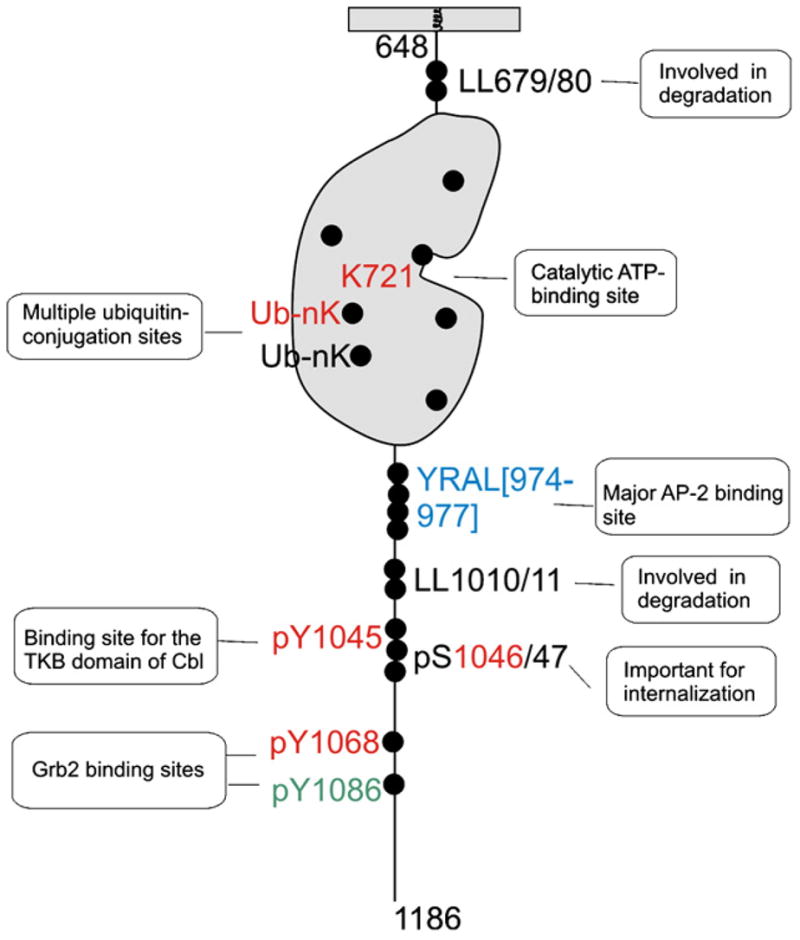
Fig. 1
Fig. 1
Molecular trafficking signals in EGFR. Schematic representation of the molecular signals in the intracellular part of the EGFR molecule (residues 648–1186) which have been implicated in the endocytic trafficking of the receptor. Sequence motifs and phosphorylation sites/motifs that are not conserved in other ErbBs are shown in “black”, conserved in ErbB2 only — in “blue”, conserved in ErbB3 and/or ErbB4 in addition to ErbB2 — in “red”, and in ErbB3/ErbB4 but not in ErbB2 — in “green”. There are ubiquitin-conjugation sites in the kinase domain that are either conserved in all ErbBs or present only in EGFR.
Fig. 2
Fig. 2
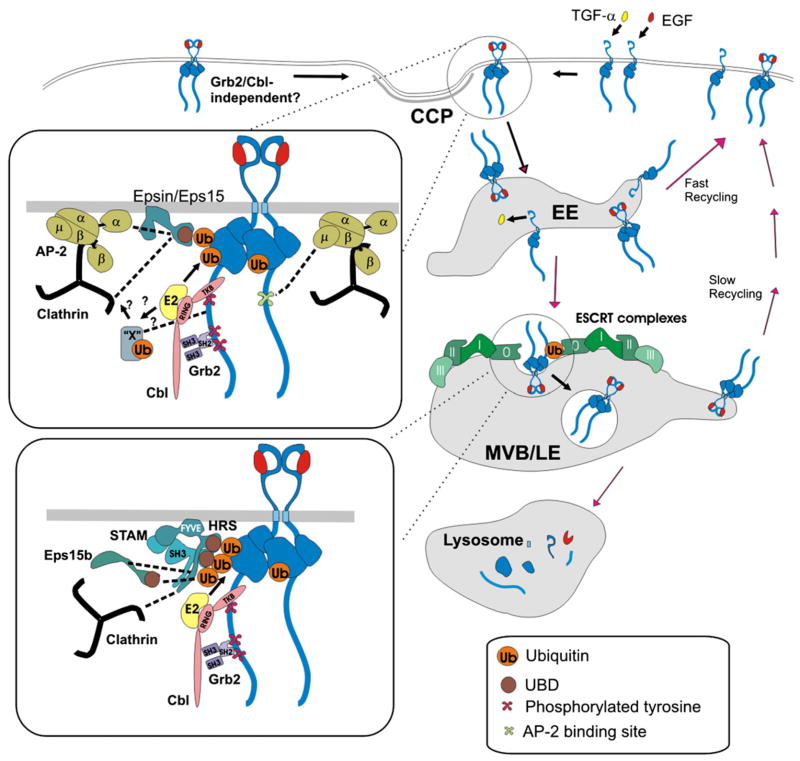
A hypothetic model of EGFR endocytosis and intracellular sorting (in the presence of low concentrations of EGF or TGFα). EGF binding to EGFR leads to receptor dimerization and phosphorylation. Grb2–Cbl complex is recruited to C-terminal phosphotyrosine-containing motifs. E2 enzymes (UbcH4/5) are recruited to the RING domain to promote receptor ubiquitination. Ubiquitinated EGFR can be recognized by UBDs of epsin, Eps15 and Eps15R in the plasma membrane and clathrin-coated pits (CCP). These proteins are associated with AP-2 and clathrin heavy chain, a main component of the clathrin triskelion (clathrin). Alternatively, Cbl can mediate ubiquitination of an unknown adaptor protein (“X”) that mediates internalization of EGFR through coated pits by interacting with EGFR and/or clathrin or clathrin-associated proteins. EGFR can directly interact with AP-2 via YRAL and possibly LL motifs. There might be also a Grb2-independent pathway of internalization through coated pits. After internalization EGF-receptor complexes can be rapidly recycled from early endosomes (EE) or remain in these endosomes during their maturation into MVB and late endosomes (LE). In contrast, TGF-α dissociates from EGFR in endosomes, which results in the recycling of the monomeric, inactive receptor. In MVB, ubiquitinated EGFR is engaged into multi-valent interactions with UBDs of the ESCRT-0 complex (HRS and STAM) and associated Eps15b, and then incorporated into internal vesicles of MVB. The concentric ring model of the inward invagination of MVB membrane is depicted. Receptors that are not ubiquitinated can be recycled back to the plasma membrane through the tubular extensions of the limiting membrane of MVB at a slower rate. Recycling of occupied and unoccupied receptors may also involve a late recycling compartment (not shown). MVB fuses with primary lysosomes, which subsequently results in degradation of EGF and EGFR.

References

    1. Carpenter G, Cohen S. 125I-Labeled human epidermal growth factor: binding internalization, and degradation in human fibroblasts. J Cell Biol. 1976;71:159–171. - PMC - PubMed
    1. Stoscheck CM, Carpenter G. “Down-regulation” of EGF receptors: direct demonstration of receptor degradation in human fibroblasts. J Cell Biol. 1984;98:1048–1053. - PMC - PubMed
    1. Wells A, Welsh JB, Lazar CS, Wiley HS, Gill GN, Rosenfeld MG. Ligand-induced transformation by a noninternalizing epidermal growth factor receptor. Science. 1990;247:962–964. - PubMed
    1. Sorkin A, Von Zastrow M. Signal transduction and endocytosis: close encounters of many kinds. Nat Rev Mol Cell Biol. 2002;3:600–614. - PubMed
    1. Wiley HS. Trafficking of the ErbB receptors and its influence on signaling. Exp Cell Res. 2003;284:78–88. - PubMed

Publication types

MeSH terms