


Young-onset colorectal cancer in patients with no known genetic predisposition: can we increase early recognition and improve outcome?
- PMID: 18794708
- PMCID: PMC4437192
- DOI: 10.1097/MD.0b013e3181881354
Young-onset colorectal cancer in patients with no known genetic predisposition: can we increase early recognition and improve outcome?
Abstract
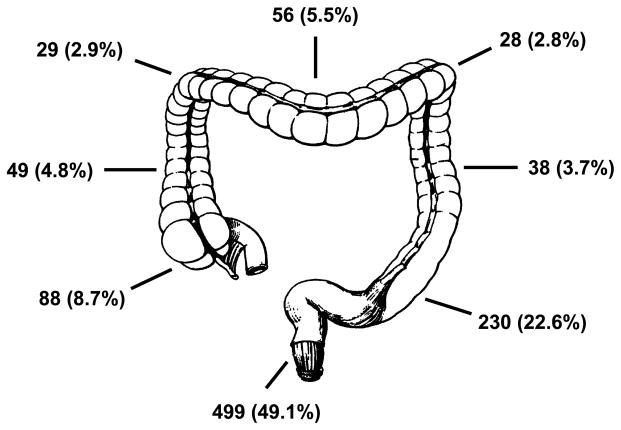
Early recognition of colorectal cancer (CRC) in young patients without known genetic predisposition is a challenge, and clinicopathologic features at time of presentation are not well described. We conducted the current study to review these features in a large population of patients with young-onset CRC (initial diagnosis at age <or=50 yr without established risk factors). We reviewed the records of all patients aged 50 years or younger diagnosed with a primary CRC at our institution between 1976 and 2002. Patients with inflammatory bowel disease, polyposis syndromes, or a known genetic predisposition for CRC were excluded. Data regarding clinical and pathologic features at time of initial presentation were abstracted by trained personnel. We identified 1025 patients, 585 male. Mean age at presentation was 42.4 years (standard deviation 6.4). Eight hundred eighty-six (86%) patients were symptomatic at time of diagnosis. Clinical features in symptomatic patients included rectal bleeding (51%), change in bowel habits (18%), abdominal pain (32%), weight loss (13%), nausea/vomiting (7%), melena (2%), and other (26%). Evaluation of asymptomatic patients was pursued with findings of anemia (14%), positive fecal occult blood test (7%), abdominal mass (2%), mass on digital rectal exam (2%), and other (80%). Site of primary tumor was colonic in 51% and rectal in 49%. Synchronous malignant lesions were noted in 1%. Mucinous and signet cell histology was seen in 11% and 2%, respectively. Tumor grade distribution was grade 1 (2%), grade 2 (54%), grade 3 (34%), and grade 4 (7%). The stage distribution was stage I (13%), stage II (21%), stage III (32%), and stage IV (34%). To our knowledge, the current study is the largest cohort of young-onset CRC patients with no known genetic predisposition for disease. Most patients were symptomatic, had left-colon or rectal cancers and presented with more advanced stage disease. Our findings should promote increased awareness and the aggressive pursuit of symptoms in otherwise young, low-risk patients, as these symptoms may represent an underlying colorectal malignancy.
Figures
References
-
- Adloff M, Arnaud JP, Bergamaschi R, Schloegel M. Synchronous carcinoma of the colon and rectum: prognostic and therapeutic implications. Am J Surg. 1989;157:299–302. - PubMed
-
- American Cancer Society. Cancer Facts and Figures 2002 (Publication 02-250M-No 5008.02) New York: American Cancer Society Surveillance Research; 2002. pp. 20–26.
-
- Chiang JM, Chen MC, Changchien CR, Chen JS, Tang R, Wang JY, Yeh CY, Fan CW, Tsai WS. Favorable influence of age on tumor characteristics of sporadic colorectal adenocarcinoma: patients 30 years of age or younger may be a distinct patient group. Dis Colon Rectum. 2003;46:904–910. - PubMed
-
- Domergue J, Ismail M, Astre C, Saint-Aubert B, Joyeux H, Solassol C, Pujol H. Colorectal carcinoma in patients younger than 40 years of age: Montpellier Cancer Institute experience with 78 patients. Cancer. 1998;61:835–840. - PubMed
-
- Fairley TL, Cardinez CJ, Martin J, Alley L, Friedman C, Edwards B, Jamison P. Colorectal cancer in U.S. adults younger than 50 years of age, 1998–2001. Cancer. 2006;107(Suppl 5):1153–1161. - PubMed
MeSH terms
Grants and funding
LinkOut - more resources
Full Text Sources
Medical
