


Adeno-associated virus (AAV) serotype 9 provides global cardiac gene transfer superior to AAV1, AAV6, AAV7, and AAV8 in the mouse and rat
- PMID: 18795839
- PMCID: PMC2940566
- DOI: 10.1089/hum.2008.123
Adeno-associated virus (AAV) serotype 9 provides global cardiac gene transfer superior to AAV1, AAV6, AAV7, and AAV8 in the mouse and rat
Abstract
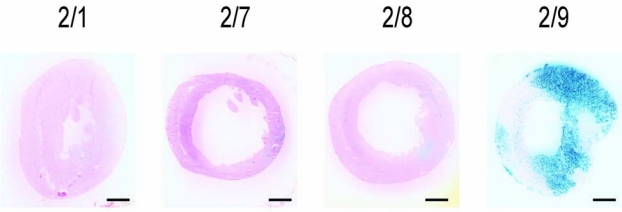
Heart disease is the leading cause of morbidity and mortality. Cardiac gene transfer may serve as a novel therapeutic approach. This investigation was undertaken to compare cardiac tropisms of adeno-associated virus (AAV) serotypes 1, 6, 7, 8, and 9. Neonatal mice were injected with 2.5 x 10(11) genome copies (GC) of AAV serotype 1, 6, 7, 8, or 9 expressing LacZ under the control of the constitutive chicken beta-actin promoter with cytomegalovirus enhancer promoter via intrapericardial injection and monitored for up to 1 year. Adult rats were injected with 5 x 10(11) GC of the AAV vectors via direct cardiac injection and monitored for 1 month. Cardiac distribution of LacZ expression was assessed by X-Gal histochemistry, and beta-galactosidase activity was quantified in a chemiluminescence assay. Cardiac functional data and biodistribution data were also collected in the rat. AAV9 provided global cardiac gene transfer stable for up to 1 year that was superior to other serotypes. LacZ expression was relatively cardiac specific, and cardiac function was unaffected by gene transfer. AAV9 provides high-level, stable expression in the mouse and rat heart and may provide a simple alternative to the creation of cardiac-specific transgenic mice. AAV9 should be used in rodent cardiac studies and may be the vector of choice for clinical trials of cardiac gene transfer.
Figures




References
-
- Andino L.M. Takeda M. Kasahara H. Jakymiw A. Byrne B.J. Lewin A.S. AAV-mediated knockdown of phospholamban leads to improved contractility and calcium handling in cardiomyocytes. J. Gene Med. 2008;10:132–142. - PubMed
-
- Bostick B. Ghosh A. Yue Y. Long C. Duan D. Systemic AAV-9 transduction in mice is influenced by animal age but not by the route of administration. Gene Ther. 2007;14:1605–1609. - PubMed
-
- Carter B.J. Adeno-associated virus and the development of adeno-associated virus vectors: A historical perspective. Mol. Ther. 2004;10:981–989. - PubMed
Publication types
MeSH terms
Substances
Grants and funding
LinkOut - more resources
Full Text Sources
Other Literature Sources
Miscellaneous
