


Utilization of upper endoscopy for surveillance of gastric ulcers in the United States
- PMID: 18796092
- PMCID: PMC3883105
- DOI: 10.1111/j.1572-0241.2008.01945.x
Utilization of upper endoscopy for surveillance of gastric ulcers in the United States
Abstract
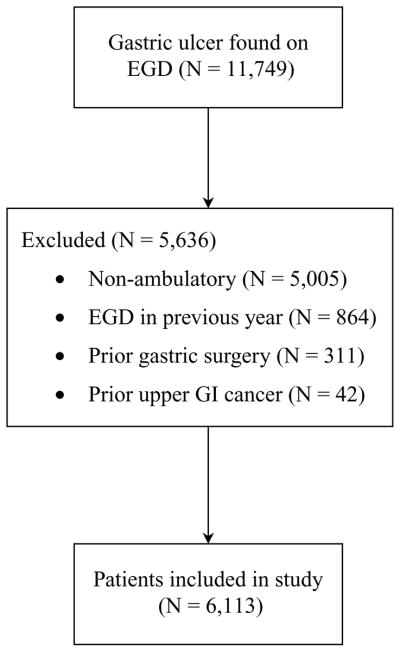
Background: Current guidelines recommend that all gastric ulcers (GUs) be biopsied extensively to exclude underlying malignancy. However, many gastroenterologists opt to also perform surveillance endoscopy (EGD) to document ulcer healing. The purpose of this study was to examine frequency of utilization of surveillance EGD in patients found to have GUs using a national endoscopic database.
Methods: The Clinical Outcomes Research Initiative (CORI) database was used to identify ambulatory patients diagnosed with a GU between 2001 and 2005. A surveillance EGD was defined as any EGD performed < or =3 months after index EGD. Results were stratified by patient demographic factors, index ulcer size and location, practice setting, and geographic region. Multivariate logistic regression was performed to identify independent predictors of surveillance EGD utilization.
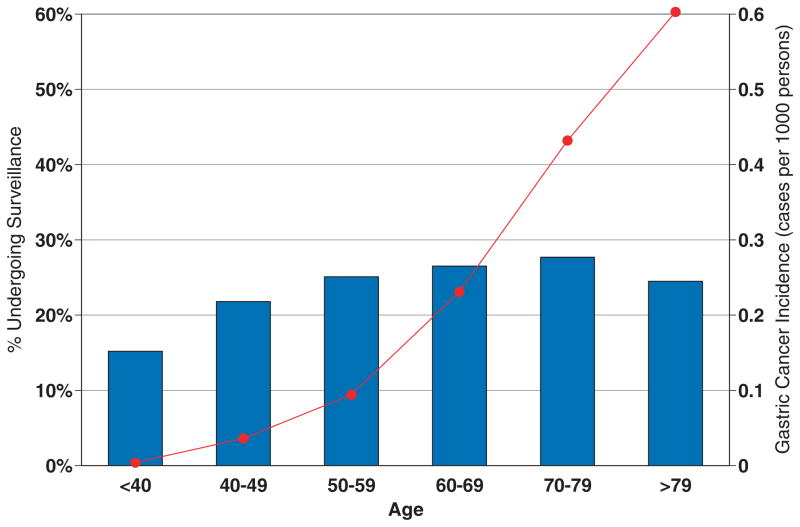
Results: In the database, 6,113 patients met our inclusion/exclusion criteria, of which 1,510 (24.7%) underwent surveillance EGD. Older patients were more likely to undergo surveillance than younger patients (P < 0.0001), though a substantial minority (15.2%) of patients <40 years of age underwent a surveillance examination. Index ulcer size > or =1 cm and care in a Veterans Affairs (VA) setting were also independent predictors of surveillance EGD utilization. Significant geographic variation was noted, with surveillance rates varying from 16.0% to 35.9% across the United States (P < 0.0001).
Conclusions: In contrast to guideline recommendations, approximately 25% of ambulatory patients diagnosed with GUs underwent surveillance EGD within 3 months. Notably, patients at low-risk for gastric cancer, including young patients, those with small index ulcers, and those with antral ulcers, underwent surveillance at higher than expected rates, which suggests overuse of surveillance EGD.
Conflict of interest statement
Figures
Comment in
-
Is surveillance upper endoscopy indicated for gastric ulcers?Curr Gastroenterol Rep. 2008 Dec;10(6):521-2. doi: 10.1007/s11894-008-0096-6. Curr Gastroenterol Rep. 2008. PMID: 19006604 No abstract available.
-
Appropriate use or overutilization of the CORI database?Am J Gastroenterol. 2009 Mar;104(3):785-6; author reply 786-7. doi: 10.1038/ajg.2008.113. Epub 2009 Feb 10. Am J Gastroenterol. 2009. PMID: 19209169 No abstract available.
References
-
- Akdamar K, Ertan A, Agrawal NM, et al. Upper gastrointestinal endoscopy in normal asymptomatic volunteers. Gastrointest Endosc. 1986;32:78–80. - PubMed
-
- Aro P, Storskrubb T, Ronkainen J, et al. Peptic ulcer disease in a general adult population: The Kalixanda study: A random population-based study. Am J Epidemiol. 2006;163:1025–34. - PubMed
-
- Arroyo MT, Forne M, de Argila CM, et al. The prevalence of peptic ulcer not related to Helicobacter pylori or non-steroidal anti-inflammatory drug use is negligible in southern Europe. Helicobacter. 2004;9:249–54. - PubMed
-
- Nishikawa K, Sugiyama T, Kato M, et al. Non-Helicobacter pylori and non-NSAID peptic ulcer disease in the Japanese population. Eur J Gastroenterol Hepatol. 2000;12:635–40. - PubMed
Publication types
MeSH terms
Grants and funding
LinkOut - more resources
Full Text Sources
Miscellaneous
