Randomized Controlled Trial
. 2008 Sep 16:7:179.
doi: 10.1186/1475-2875-7-179.

Ototoxicity of artemether/lumefantrine in the treatment of falciparum malaria: a randomized trial

Affiliations
Randomized Controlled Trial

Ototoxicity of artemether/lumefantrine in the treatment of falciparum malaria: a randomized trial

Robert Gürkov et al. Malar J. .

Abstract

Background: Due to increasing drug resistance, artemisinin-based combination chemotherapy (ACT) has become the first-line treatment of falciparum malaria in many endemic countries. However, irreversible ototoxicity associated with artemether/lumefantrine (AL) has been reported recently and suggested to be a serious limitation in the use of ACT. The aim of the study was to compare ototoxicity, tolerability, and efficacy of ACT with that of quinine and atovaquone/proguanil in the treatment of uncomplicated falciparum malaria.

Methods: Ninety-seven patients in south-west Ethiopia with slide-confirmed malaria were randomly assigned to receive either artemether/lumefantrine or quinine or atovaquone/proguanil and followed-up for 90 days. Comprehensive audiovestibular testing by pure tone audiometry (PTA), transitory evoked (TE) and distortion product (DP) otoacoustic emissions (OAE) and brain stem evoked response audiometry (BERA) was done before enrolment and after seven, 28 and 90 days.

Results: PTA and DP-OAE levels revealed transient significant cochlear hearing loss in patients treated with quinine but not in those treated with artemether/lumefantrine or atovaquone/proguanil. TE-OAE could be elicited in all examinations, except for three patients in the Q group on day 7, who suffered a transient hearing loss greater than 30 dB. There was no evidence of drug-induced brain stem lesions by BERA measurements.

Conclusion: There was no detrimental effect of a standard oral regimen of artemether/lumefantrine on peripheral hearing or brainstem auditory pathways in patients with uncomplicated falciparum malaria. In contrast, transient hearing loss is common after quinine therapy and due to temporary outer hair cell dysfunction.


Figures
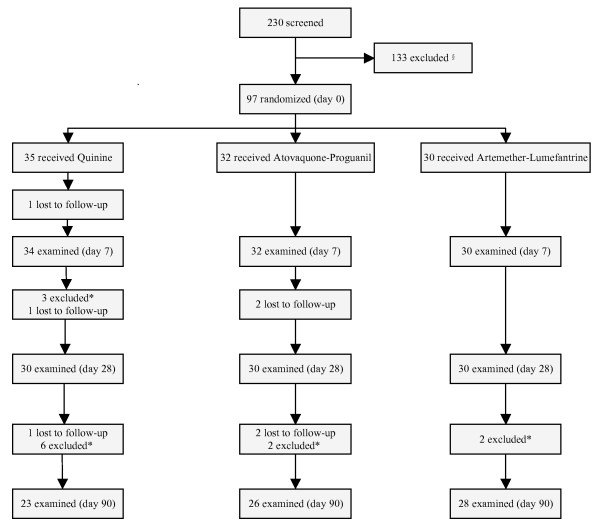
Figure 1
Figure 1
patient flow chart. Enrollment, randomization and follow-up of the patients. § The reasons for exclusion (number of patients) were ear discharge (20), impacted ear wax (18), repeated previous otitis media (14), perforated ear drum (6), negative TEOAE recording (15), Weber test lateralized (10), self-treatment with chloroquine (18), mixed infection (17), pregnancy (15). * Patients treated with a second course of antimalarials because of recrudescence or new infection were excluded from audiovestibular evaluation.
Figure 2
Figure 2
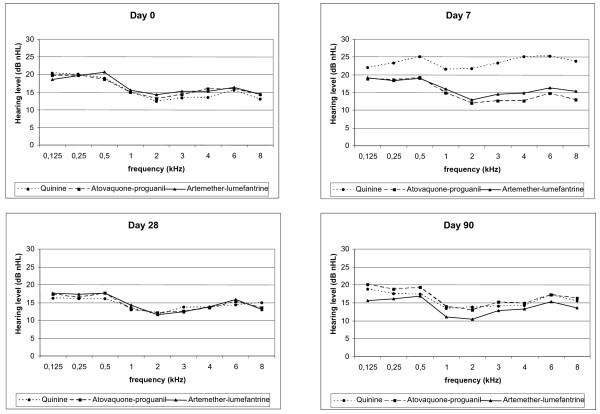
pure tone hearing levels. Audiometrically determined mean hearing levels on day 0, 7, 28 and 90. Transient hearing loss in the quinine treated group is observed on day 7. No permanent hearing loss in either group occurred. Measuring unit of y-axis is dB nHL.
Figure 3
Figure 3
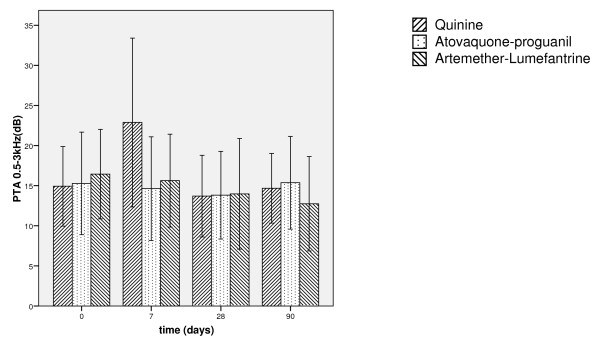
Pure tone average 0,5–3 kHz. Plot of means +/- 1 standard deviation of the pure tone average at 0.5, 1, 2, and 3 kHz for day 0, 7, 28 and 90 stratified by therapy group (solid line: Quinine, dashed line: Atovaquone/proguanil, dotted line: Artemether/lumefantrine). As depicted in the graph a slight improvement of PTA was found during the first 28 days after treatment in the Atovaquone/proguanil and Artemether/lumefantrine group unlike the Quinine group, which experienced a marked but transient hearing loss measured on day 7. On day 90, the differences of means were larger than those on day 28, which can be explained as an effect of the long-term observation. No permanent hearing loss in either group occurred. The results presented in the graph are strongly confirmed by multivariate analysis. Measuring unit of y-axis is dB nHL.
Figure 4
Figure 4
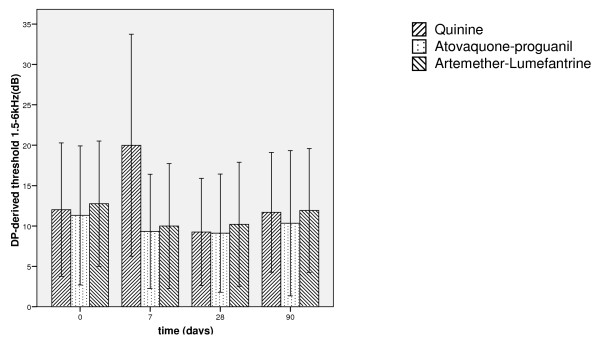
DPOAE level 1,5–6 kHz. Mean DPOAE estimated hearing levels +/- 1 standard deviation at 1.5, 2, 3, 4 and 6 kHz (solid line: Quinine, dashed line: Atovaquone/proguanil, dotted line: Artemether/lumefantrine). Estimated hearing levels are elevated in the quinine treated group on day 7. No permanent elevation in estimated hearing levels in either group occurred, which is confirmed by multivariate analysis. Measuring unit of y-axis is dB nHL.
Figure 5
Figure 5
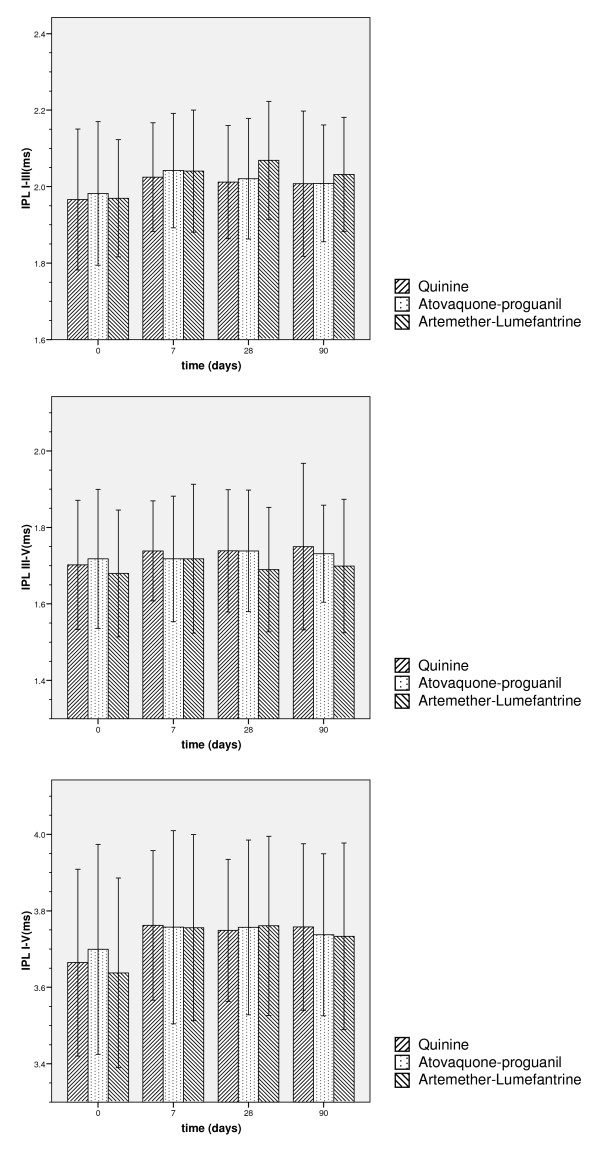
Interpeak latencies I–V, I–III, III–V. Mean interpeak latencies between Jewett waves I, III and V +/- 1 standard deviation (solid line: Quinine, dashed line: Atovaquone/proguanil, dotted line: Artemether/lumefantrine). Interpeak latencies in all groups are shorter on day 0, when patients have elevated body temperature. The difference in IPL I–III between the Artemether/lumefantrine group and the other two groups is limited to the right ear. No permanent drug-related prolongation of interpeak latencies occurs, as confirmed by multivariate analysis.

References

    1. Olumese P. Antimalarial treatment policies for P. falciparum and P. vivaxby country in WHO Africa region. Anti-Malarial Drug Policies: AFRO Global AMDP Database; 2007. http://www.who.int/malaria/amdp/amdp_afro.htm
    1. World Health Organization (WHO) Guidelines for the treatment of malaria (NLM classification: WC 770) 2007. http://www.who.int/malaria/docs/TreatmentGuidelines2006.pdf
    1. Miller LG, Panosian CB. Ataxia and slurred speech after artesunate treatment for falciparum malaria. N Engl J Med. 1997;336:1328. doi: 10.1056/NEJM199705013361818. - DOI - PubMed
    1. Elias Z, Bonnet E, Marchou B, Massip P. Neurotoxicity of artemisinin: possible counseling and treatment of side effects. Clin Infect Dis. 1999;28:1330–1331. doi: 10.1086/517789. - DOI - PubMed
    1. Toovey S, Jamieson A. Audiometric changes associated with the treatment of uncomplicated falciparum malaria with co-artemether. Trans R Soc Trop Med Hyg. 2004;98:261–267. doi: 10.1016/j.trstmh.2003.11.001. - DOI - PubMed

Publication types

MeSH terms

LinkOut - more resources