


Monkeypox virus evades antiviral CD4+ and CD8+ T cell responses by suppressing cognate T cell activation
- PMID: 18796610
- PMCID: PMC2567221
- DOI: 10.1073/pnas.0800589105
Monkeypox virus evades antiviral CD4+ and CD8+ T cell responses by suppressing cognate T cell activation
Abstract
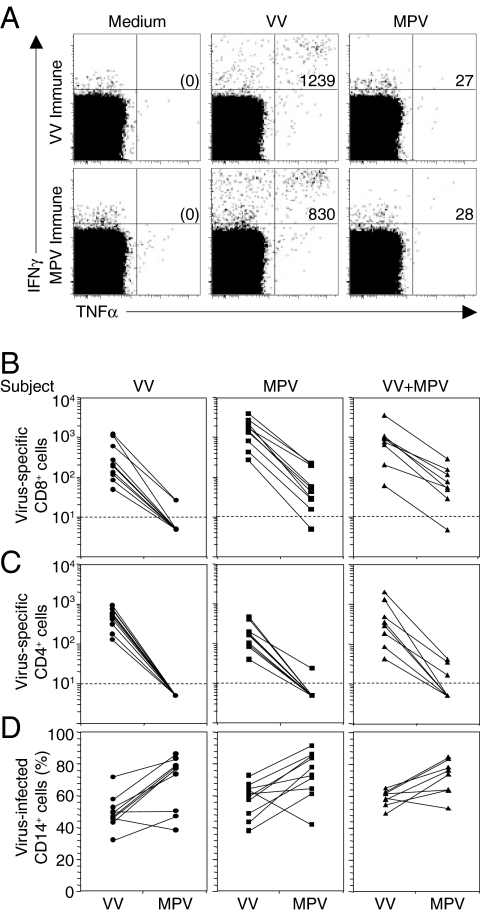
Monkeypox virus (MPV) is a virulent human pathogen that has gained increased attention because of its potential use as a bioterrorism agent and inadvertent introduction into North America in 2003. The US outbreak also provided an important opportunity to study MPV-specific T cell immunity. Although MPV-specific CD4(+) and CD8(+) T cells could recognize vaccinia virus (VV)-infected monocytes and produce inflammatory cytokines such as IFNgamma and TNFalpha, they were largely incapable of responding to autologous MPV-infected cells. Further analysis revealed that, unlike cowpox virus (CPV), MPV did not interfere with MHC expression or intracellular transport of MHC molecules. Instead, MPV-infected cells were capable of preventing T cell receptor (TcR)-mediated T cell activation in trans. The ability to trigger a state of nonresponsiveness represents a unique MHC-independent mechanism for blocking antiviral T cell activation and inflammatory cytokine production and is likely an important attribute involved with viral dissemination in the infected host.
Conflict of interest statement
The authors declare no conflict of interest.
Figures


References
-
- Henderson DA. The looming threat of bioterrorism. Science. 1999;283:1279–1282. - PubMed
-
- O'Toole T, Mair M, Inglesby TV. Shining light on “Dark Winter.”. Clin Infect Dis. 2002;34:972–983. - PubMed
-
- Smith GL, McFadden G. Smallpox: Anything to declare? Nat Rev Immunol. 2002;2:521–527. - PubMed
-
- Jezek Z, Szczeniowski M, Paluku KM, Mutombo M. Human monkeypox: Clinical features of 282 patients. J Infect Dis. 1987;156:293–298. - PubMed
Publication types
MeSH terms
Substances
Grants and funding
LinkOut - more resources
Full Text Sources
Other Literature Sources
Medical
Research Materials
