


Hallucinations, dreaming, and frequent dozing in Parkinson disease: impact of right-hemisphere neural networks
- PMID: 18797256
- PMCID: PMC2630478
- DOI: 10.1097/WNN.0b013e318185e698
Hallucinations, dreaming, and frequent dozing in Parkinson disease: impact of right-hemisphere neural networks
Abstract
Objective: To relate sleep disturbances in Parkinson disease (PD) to hemispheric asymmetry of initial presentation.
Background: Sleep disturbances are common in PD arising from the neurodegenerative process underlying the disease, which is usually lateralized at onset. Patients with left-side Parkinson disease onset (LPD: right hemisphere dysfunction) exhibit reduced vigilance relative to those with right-side Parkinson disease onset (RPD: left hemisphere dysfunction), leading us to hypothesize that sleep-related disturbances, particularly excessive daytime sleepiness, would be more severe for LPD than for RPD.
Methods: Thirty-one nondemented participants with PD (17 RPD and 14 LPD) and 17 age-matched control (CO) participants with chronic health conditions were administered the Parkinson Disease Sleep Scale and polysomnography was performed on a subset of the PD participants.
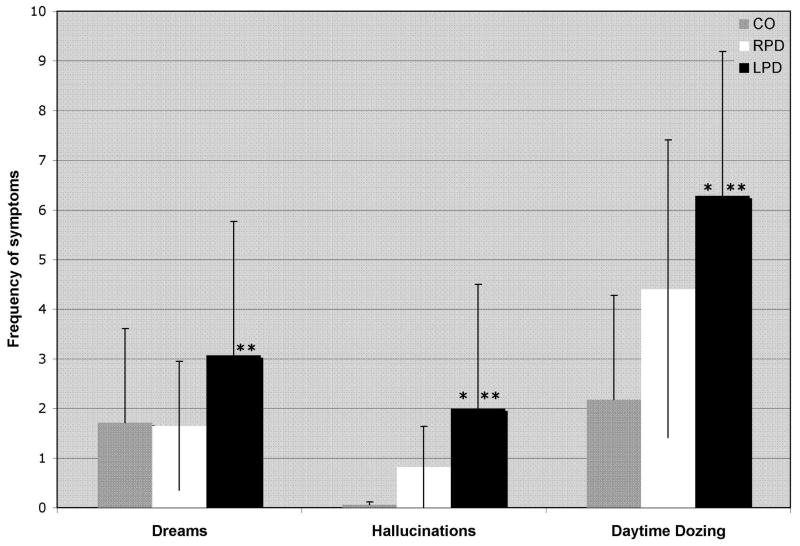
Results: Both PD subgroups exhibited more nighttime motor symptoms than the CO group, but only LPD endorsed more nocturnal hallucinations and daytime dozing. Controlling for mood additionally revealed more vivid dreaming in LPD than RPD. There were no significant differences between LPD and RPD on measures of sleep architecture.
Conclusions: Increased dreaming, hallucinations, and daytime somnolescence in LPD may be related to changes in right-hemisphere neural networks implicated in the generation and control of visual images, arousal, and vigilance. Our results underscore the need to consider side of onset in regard to sleep disturbances in PD.
Figures
References
-
- Zgaljardic DJ, Borod JC, Foldi NS, Mattis P. A review of the cognitive and behavioral sequelae of Parkinson’s disease: relationship to frontostriatal circuitry. Cogn Behav Neurol. 2003;16(4):193–210. - PubMed
-
- Amick MM, Cronin-Golomb A, Gilmore GC. Visual processing of rapidly presented stimuli is normalized in Parkinson’s disease when proximal stimulus strength is enhanced. Vision Res. 2003;43(26):2827–35. - PubMed
-
- Nausieda PA. Sleep disorders. In: Koller W, editor. Handbook of Parkinson’s disease. New York: Marcel Dekker, Inc; 1987. pp. 371–380.
Publication types
MeSH terms
Substances
Grants and funding
LinkOut - more resources
Full Text Sources
Medical
