


Effects of bradykinin on venous capacitance in health and treated chronic heart failure
- PMID: 18798730
- PMCID: PMC2636358
- DOI: 10.1042/CS20080096
Effects of bradykinin on venous capacitance in health and treated chronic heart failure
Abstract
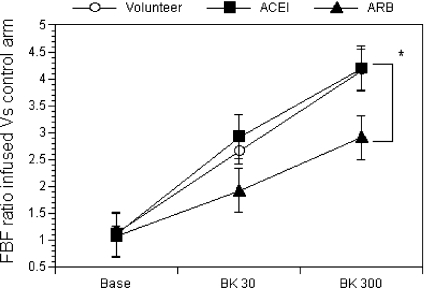
In the present study, we investigated the effects of basal and intra-arterial infusion of bradykinin on unstressed forearm vascular volume (a measure of venous tone) and blood flow in healthy volunteers (n=20) and in chronic heart failure patients treated with ACEIs [ACE (angiotensin-converting enzyme) inhibitors] (n=16) and ARBs (angiotensin receptor blockers) (n=14). We used radionuclide plethysmography to examine the effects of bradykinin and of the bradykinin antagonists B9340 [B1 (type 1)/B2 (type 2) receptor antagonist] and HOE140 (B2 antagonist). Bradykinin infusion increased unstressed forearm vascular volume in a similar dose-dependent manner in healthy volunteers and ARB-treated CHF patients (healthy volunteers maximum 12.3+/-2.1%, P<0.001 compared with baseline; ARB-treated CHF patients maximum 9.3+/-3.3%, P<0.05 compared with baseline; P=not significant for difference between groups), but the increase in unstressed volume in ACEI-treated CHF patients was higher (maximum 28.8+/-7.8%, P<0.001 compared with baseline; P<0.05 for the difference between groups). In contrast, while the increase in blood flow in healthy volunteers (maximum 362+/-9%, P<0.001) and in ACEI-treated CHF patients (maximum 376+/-12%, P<0.001) was similar (P=not significant for the difference between groups), the increase in ARB-treated CHF patients was less (maximum 335+/-7%, P<0.001; P<0.05 for the difference between groups). Infusion of each receptor antagonist alone similarly reduced basal unstressed volume and blood flow in ACEI-treated CHF patients, but not in healthy volunteers or ARB-treated CHF patients. In conclusion, bradykinin does not contribute to basal venous tone in health, but in ACEI-treated chronic heart failure it does. In ARB-treated heart failure, venous responses to bradykinin are preserved but arterial responses are reduced compared with healthy controls. Bradykinin-mediated vascular responses in both health and heart failure are mediated by the B2, rather than the B1, receptor.
Figures


References
-
- Cockcroft J. R., Sciberras D. G., Goldberg M. R., Ritter J. M. Comparison of angiotensin-converting enzyme inhibition with angiotensin II receptor antagonism in the human forearm. J. Cardiovasc. Pharmacol. 1993;22:579–584. - PubMed
-
- Davie A. P., Dargie H. J., McMurray J. J. Role of bradykinin in the vasodilator effects of losartan and enalapril in patients with heart failure. Circulation. 1999;100:268–273. - PubMed
-
- Witherow F. N., Helmy A., Webb D. J., Fox K. A., Newby D. E. Bradykinin contributes to the vasodilator effects of chronic angiotensin-converting enzyme inhibition in patients with heart failure. Circulation. 2001;104:2177–2181. - PubMed
-
- Cruden N. L., Witherow F. N., Webb D. J., Fox K. A., Newby D. E. Bradykinin contributes to the systemic hemodynamic effects of chronic angiotensin-converting enzyme inhibition in patients with heart failure. Arterioscler. Thromb. Vasc. Biol. 2004;24:1043–1048. - PubMed
Publication types
MeSH terms
Substances
Grants and funding
LinkOut - more resources
Full Text Sources
Medical
Miscellaneous
