


Review
doi: 10.1016/j.immuni.2008.08.005.
Tuning microenvironments: induction of regulatory T cells by dendritic cells
Affiliations
- PMID: 18799144
- PMCID: PMC3415213
- DOI: 10.1016/j.immuni.2008.08.005
Item in Clipboard
Review
Tuning microenvironments: induction of regulatory T cells by dendritic cells
Immunity.
.
Abstract
The body requires the generation of regulatory T (Treg) cells to preserve its integrity. Each microenvironment is controlled by a specific set of regulatory elements that have to be finefrly and constantly tuned to maintain local homeostasis. These environments could be site specific, such as the gut environment, or induced by chronic exposure to microbes or tumors. Various populations of dendritic cells (DCs) are central to the orchestration of this control. In this review, we will discuss some new findings associating DCs from defined compartments with the induction of antigen-specific Treg cells.
Figures
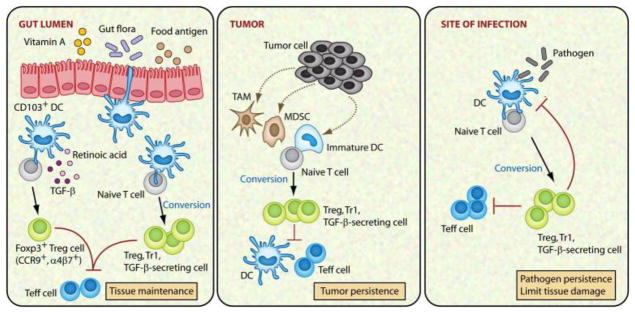
Induction of Regulatory T Cells in Defined MicroenvironnementsIn intestine lamina propria, several subsets of DCs reside and are in close contact with lumen antigen, like gut flora and food-derived antigens. To maintain local homeostasis, these DCs can induce the differentiation of Tr1 cells, TGF-β-secreting T cells, and Foxp3 Treg cells. In particular, CD103+ DCs can induce the neoconversion of Foxp3+ Treg cells via their capacity to release TGF-β and retinoic acid. These de novo-induced Foxp3+ Treg cells express the gut-homing receptors CC-chemokine receptor 9 (CCR9) and α4β7-integrin. In the tumor microenvironment, tumor cells produce suppressive factors that license DCs, myeloid-derived suppressor cells, or tumor-associated macrophages to induce Treg cells. The consequence of this induction is enhanced local immune suppression. In chronic infections, Treg cells can be induced. The consequence of this induction is maintenance of microbial persistence and limitation of collateral tissue damages.

Various Populations of DCs Can Induce Antigen-Specific Treg CellsSteady-state immature DCs can induce Treg cells. Defined subsets of gut DCs such as CD11cloCD45RBhi or CD103+ can induce new populations of Treg cells. In some cases, DCs conditioned by Foxp3+ Treg cells, pathogen-derived molecules (e.g., filamentous haemagglutinin [FHA], adenylate cyclase toxin [CyaA]) or exogenous signals [e.g., TNF-α, adenosine, prostaglandin D(2), or immunosuppressive drugs like Vitamin D3 metabolite 1a,25-(OH)2D3, corticosteroids] can induce new population of Treg cells. Various populations of Treg cells are induced to control local homeostasis. Foxp3+ Treg cells can control local responses via mechanisms including the production of IL-10, TGF-β, cAMP, Granzyme B, adenosine, IL-35, or CTLA-4 (Vignali, 2008). Tr1 cells can control immune responses via their capacity to release TGF-β and IL-10. TGF-β producing Th cells can control local responses via their production of TGF-β.
References
-
- Awasthi A, Carrier Y, Peron JP, Bettelli E, Kamanaka M, Flavell RA, Kuchroo VK, Oukka M, Weiner HL. A dominant function for interleukin 27 in generating interleukin 10-producing anti-inflammatory T cells. Nat Immunol. 2007;8:1380–1389. - PubMed
-
- Backhed F, Ley RE, Sonnenburg JL, Peterson DA, Gordon JI. Host-bacterial mutualism in the human intestine. Science. 2005;307:1915–1920. - PubMed
-
- Balmer JE, Blomhoff R. Gene expression regulation by retinoic acid. J Lipid Res. 2002;43:1773–1808. - PubMed
-
- Barnard JA, Warwick GJ, Gold LI. Localization of transforming growth factor beta isoforms in the normal murine small intestine and colon. Gastroenterology. 1993;105:67–73. - PubMed
Publication types
MeSH terms
Substances
Grants and funding
LinkOut - more resources
Full Text Sources
Other Literature Sources
