. 2008 Nov 10;381(1):22-8.
doi: 10.1016/j.virol.2008.08.018. Epub 2008 Sep 17.

Analysis of cytokine secretion from human plasmacytoid dendritic cells infected with H5N1 or low-pathogenicity influenza viruses

Affiliations

Analysis of cytokine secretion from human plasmacytoid dendritic cells infected with H5N1 or low-pathogenicity influenza viruses

Matthew R Sandbulte et al. Virology. .

Abstract

Mechanisms underlying the virulence of H5N1 influenza viruses in humans are poorly understood, though evidence of hyperinflammation and systemic viral replication has been reported. Plasmacytoid dendritic cells (PDCs), a major source of type I interferon, potentially affect host defense against influenza viruses. To analyze how influenza virus infection alters PDC function, we measured cytokine secretion from primary human PDCs infected with high- or low-pathogenicity influenza viruses. IFN-alpha responses induced by H5N1 viruses were several-fold higher than those induced by low-pathogenicity strains; differences in the secretion of the proinflammatory cytokines TNF-alpha and IP-10 were less pronounced, in contrast with findings from human macrophage studies. Reassortant viruses bearing H5N1-derived NS genes did not elicit enhanced IFN-alpha secretion by PDCs; thus, other H5N1 gene(s) are responsible for the heightened response. Their central role in the induction of an effective antiviral immune response and the finding that they respond differently to influenza viruses of different pathogenicities suggest that PDCs may play a role in the hypercytokinemia associated with H5N1 infection in humans.


Figures
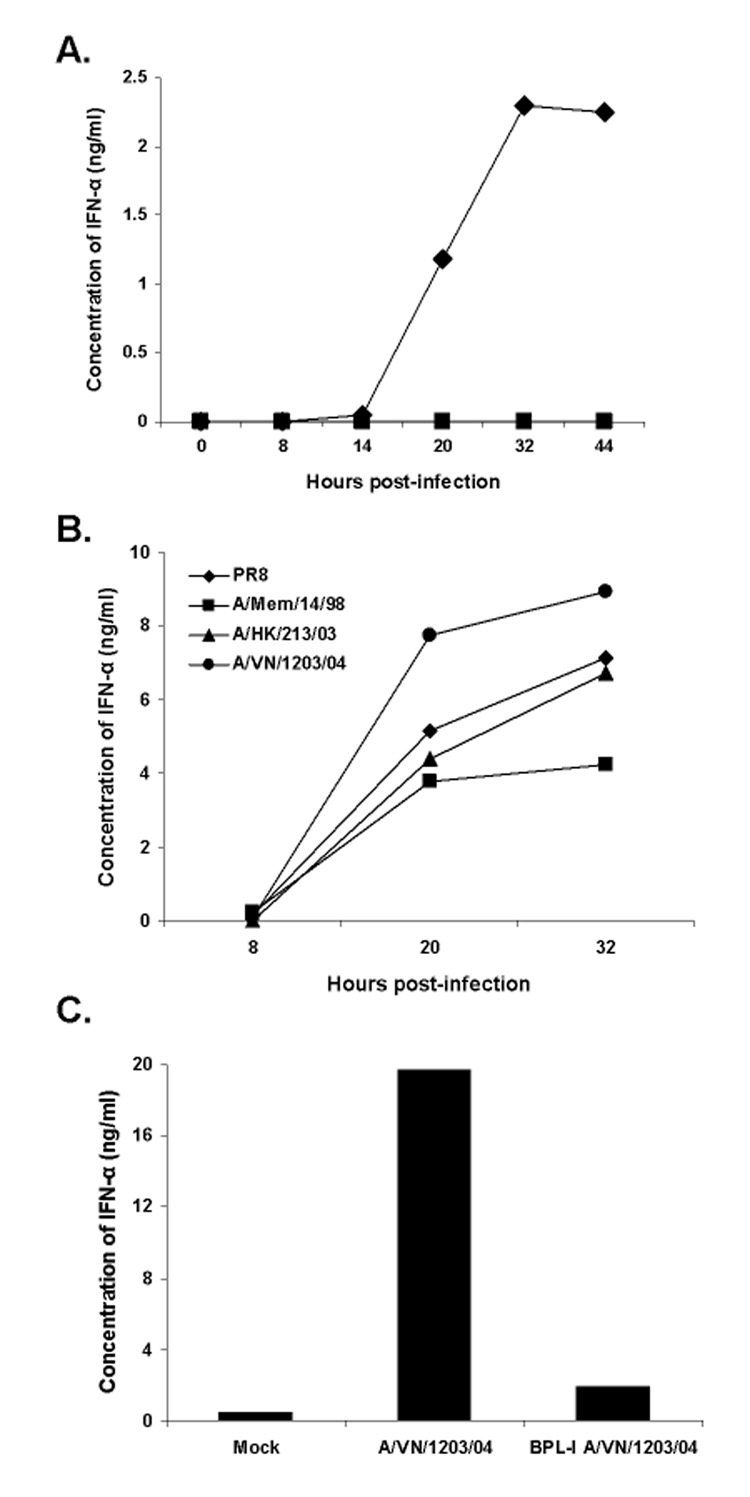
Figure 1
Figure 1
Characterization of IFN-α secretion from influenza-infected PDCs. IFN-α concentrations were measured by ELISA in supernatants of primary human PDCs infected in vitro with 5 MOI. (A) PDCs were either mock infected (squares) or infected with the laboratory strain PR8 (diamonds) and supernatants were sampled over a 44 hour timecourse. (B) PDCs were infected with PR8, A/Memphis/14/98, A/Hong Kong/213/03, or A/Vietnam/1203/04 and supernatants were sampled at 8, 20, and 32 hours. (C) PDCs were stimulated with mock infection, live A/Vietnam/1203/04 or BPL-inactivated A/Vietnam/1203/04 (data shown are from one representative experiment out of three performed with cells from different individuals).
Figure 2
Figure 2
Secretion of cytokines from PDCs in response to low- and high-pathogenicity IAVs. PDCs isolated from the peripheral blood of six human donors were aliquoted and infected at an MOI of 5 with PR8, A/Memphis/14/98, A/Hong Kong/213/03, or A/Vietnam/1203/04 viruses. Supernatants were collected 20 hours postinfection, and the concentrations of (A) IFN-α, (B) TNF-α, and (C) IP-10 were analyzed by ELISA. To account for donor-to-donor variation, cytokine concentrations produced in response to each virus are shown as percentages of the concentration produced in response to PR8 within the same experiment. Each data point is denoted (diamonds), and the median cytokine response to each virus is presented (horizontal bar). Statistically significant differences are denoted by * (P < 0.05) or ** (P < 0.005).
Figure 3
Figure 3
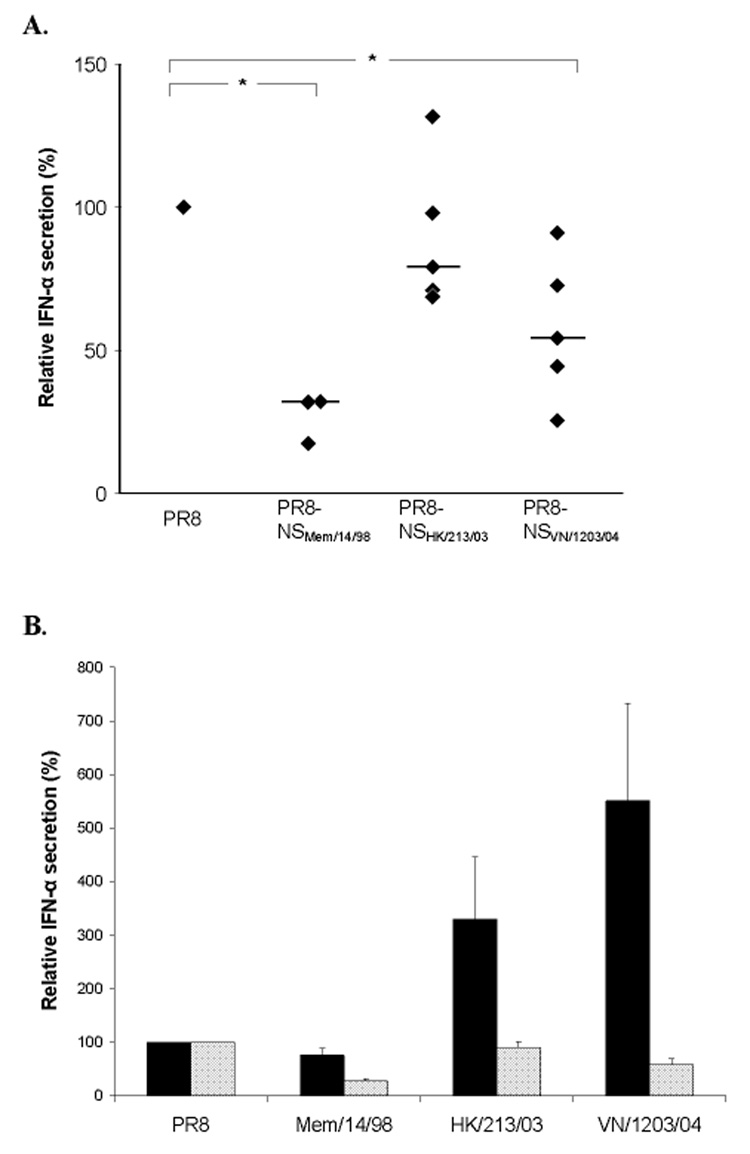
IFN-α production by PDCs infected with reassortant PR8 viruses bearing different NS genes. PDCs from five donors were aliquoted and infected with PR8 or recombinant viruses at an MOI of 5 (n=3 for PR8-NSMem/14/98 infection). (A) Supernatants were collected at 20 hours postinfection, and IFN-α concentrations were determined by multiplex assay. Cytokine concentrations produced in response to each virus are plotted as changes relative to the concentrations of cytokines elicited by infection with PR8. Horizontal bars denote the median levels of IFN-α induced by each virus. Statistically significant differences in IFN-α induction between parent virus PR8 and reassortant PR8 viruses are indicated by * (P < 0.05). (B) The IFN-α concentrations resulting from infection of PDCs with each wild-type influenza virus (black bars) are compared with those elicited with reassortant PR8 viruses bearing the corresponding NS gene segments (gray bars).
Figure 4
Figure 4
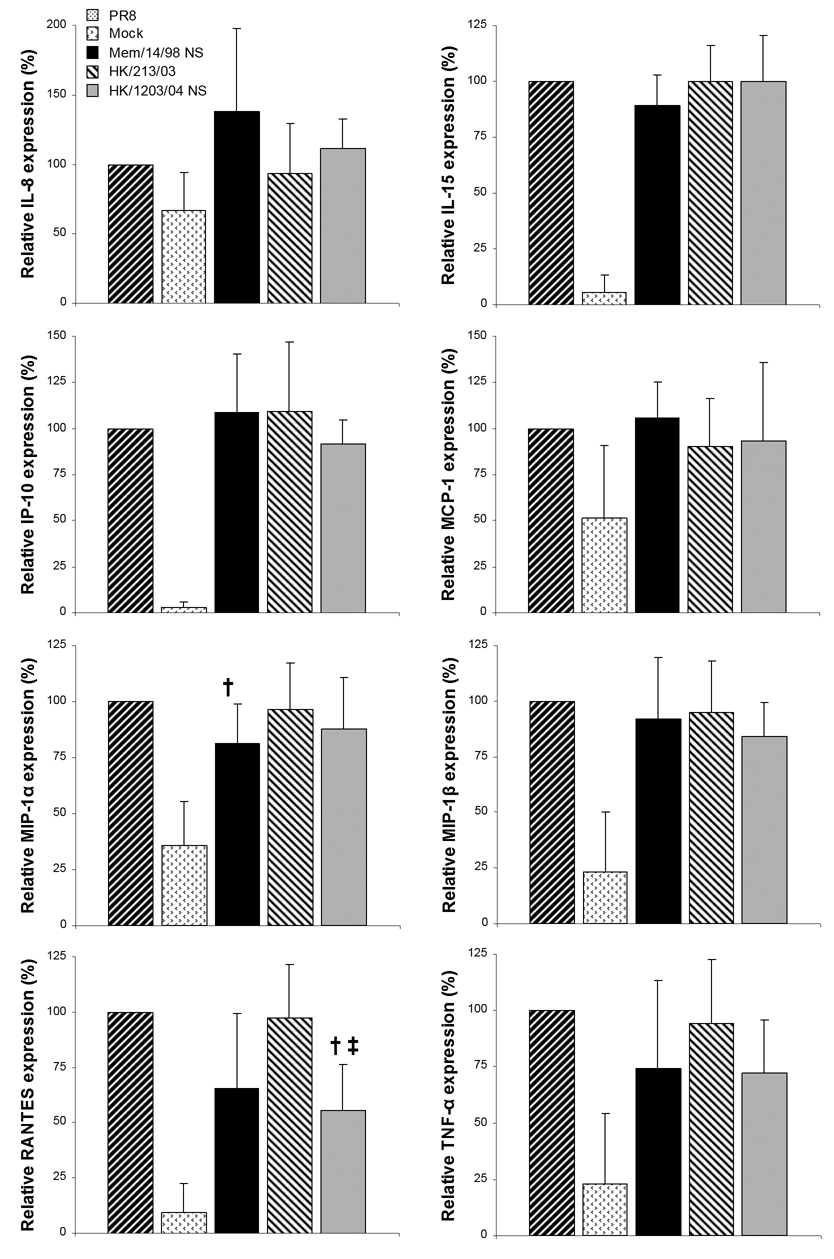
Cytokine and chemokine production by PDCs infected with reassortant PR8 viruses bearing different NS genes. PDCs from five donors were aliquoted and infected with parent PR8 or recombinant viruses at an MOI of 5 for 20 hours, followed by multiplex evaluations of cytokines (n=3 for PR8-NSMem/14/98 infection). The concentrations of IL-8, IL-15, IP-10, MCP-1, MIP-1α, MIP-1β, RANTES, and TNF-α produced in response to each virus are normalized to their respective concentrations elicited by PR8. Statistically significant differences between the effects of parent PR8 virus and reassortant PR8 viruses are indicated by † (P < 0.05) and that between PR8-NSMem/14/98 and PR8-NSVN/1203/04 is indicated by ‡ (P < 0.05).

References

    1. Asselin-Paturel C, Trinchieri G. Production of type I interferons: plasmacytoid dendritic cells and beyond. J. Exp. Med. 2005;202(4):461–465. - PMC - PubMed
    1. Cella M, Facchetti F, Lanzavecchia A, Colonna M. Plasmacytoid dendritic cells activated by influenza virus and CD40L drive a potent TH1 polarization. Nat. Immunol. 2000;1(4):305–310. - PubMed
    1. Chan MC, Cheung CY, Chui WH, Tsao SW, Nicholls JM, Chan YO, Chan RW, Long HT, Poon LL, Guan Y, Peiris JS. Proinflammatory cytokine responses induced by influenza A (H5N1) viruses in primary human alveolar and bronchial epithelial cells. Respir. Res. 2005;6:135. - PMC - PubMed
    1. Cheung CY, Poon LL, Lau AS, Luk W, Lau YL, Shortridge KF, Gordon S, Guan Y, Peiris JS. Induction of proinflammatory cytokines in human macrophages by influenza A (H5N1) viruses: a mechanism for the unusual severity of human disease? Lancet. 2002;360(9348):1831–1837. - PubMed
    1. Coro ES, Chang WL, Baumgarth N. Type I IFN receptor signals directly stimulate local B cells early following influenza virus infection. J. Immunol. 2006;176(7):4343–4351. - PubMed

Publication types

MeSH terms