Review
. 2008 Nov;15(8):753-64.
doi: 10.1080/10739680802229076.

Modeling structural adaptation of microcirculation

Affiliations
Review

Modeling structural adaptation of microcirculation

Axel R Pries et al. Microcirculation. 2008 Nov.

Abstract

The functional properties of microcirculation crucially depend on its angioarchitecture, (i.e., vessel arrangement and morphology). The microcirculation is subject to continuous dynamic structural adaptation (i.e., remodeling) controlled by hemodynamic and metabolic stimuli. Due to the complexity of the interactions among stimuli, reactions, and functional properties, an adequate understanding of structural adaptation requires mathematical models in addition to experimental investigations. Mathematical models have been developed that allow the prediction of realistic vascular properties, based on generic patterns of vascular responses. These models can be used to investigate and predict distributions of vessel morphology consistent with certain putative adaptation principles of terminal vascular beds in response to local hemodynamic and metabolic conditions. They have suggested new hypotheses, including the importance of conducted responses in network adaptation, and can explain the mechanisms underlying observed structural and functional network properties. In the future, the value of such models can be enhanced by including the effects of longitudinal stretch and pulsatility, the relationship between acute tone and structural adaptation, and the description of molecular and cellular mechanisms underlying structural responses of microvessels.


Figures
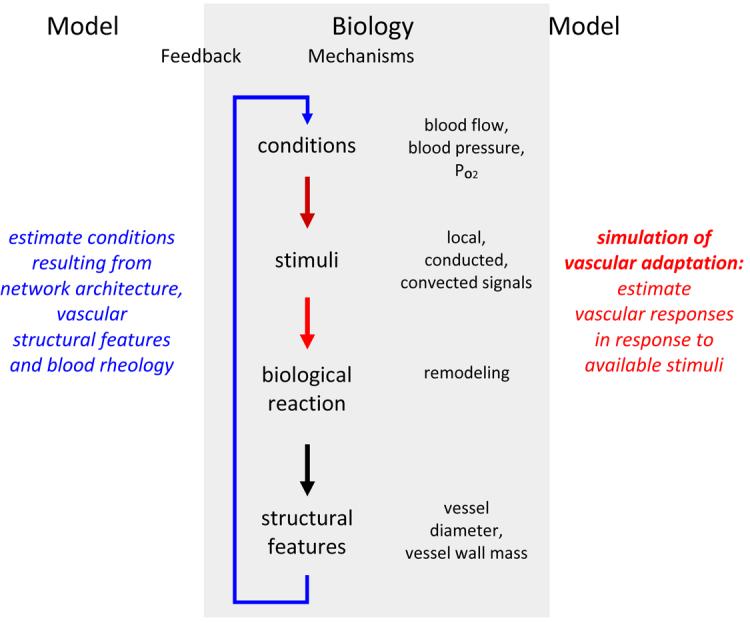
Figure 1
Figure 1
Schematic representation of biological mechanisms of structural vascular adaptation (remodeling). A feedback loop links network structures resulting from adaptation and functional network properties which in turn are the basis for structural adaptation (center). The use of mathematical modeling approaches includes the calculation of functional properties (hemodynamic and metabolic models, left) and the estimation of adaptive vascular responses to these conditions (right).
Figure 2
Figure 2
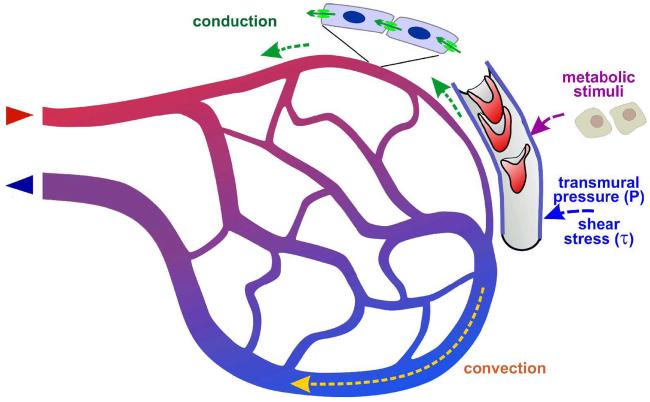
Integration of hemodynamic and metabolic stimuli in microvascular networks. Effects of blood flow, blood pressure and oxygen availability elicit local signals. Adequate adaptation of proximal feeding and draining vessels also requires the transfer of information on these local conditions ; ; . In the downstream direction, the most probable mechanism of information transfer is the convection of metabolic signaling substances ; ; ; . A possible route for upstream information transfer is the conduction of electrical signals in the vessel wall ; ; . In order to avoid diameter increase of short proximal arterio-venous connections and consequential shunting of blood flow, it has to be assumed that conduction occurs in the upstream direction only at vascular branch points.
Figure 3
Figure 3
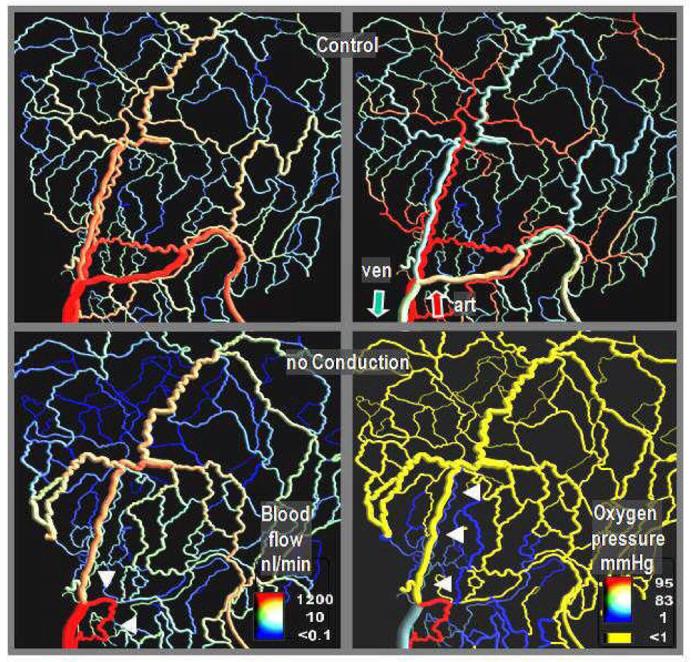
Blood flow distribution (left) and intravascular oxygen partial pressure resulting from simulations of vascular adaptation, with (top row) and without (bottom row) signal propagation along arterial vessel walls via conduction. Calculations were performed for a network in the rat mesentery (546 vessel segments) investigated by intravital microscopy. In the absence of conduction, most arterial vessels (distinguished by the high oxygen partial pressure on the top right panel) shrink to a very narrow diameter (arrow heads on the lower right panel). The blood flow mainly passes through a short arterio-venous shunt (arrow heads on the lower left panel) leading to oxygen depletion in large tissue areas. The results imply that increases in shear stress elicit eutrophic (or slightly hypertrophic/hypotrophic) outward remodeling, while wall stress increases lead to hypertrophic inward remodeling (methods described in 40; 42).
Figure 4
Figure 4
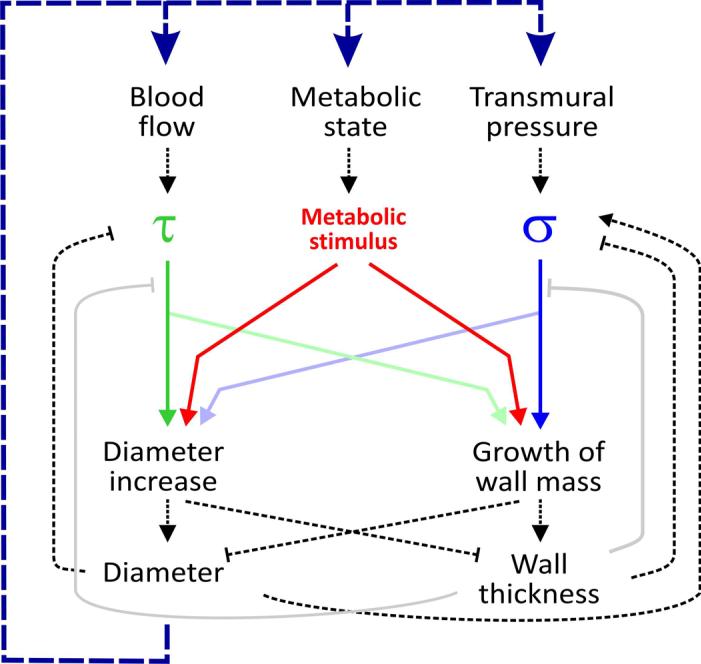
Local hemodynamic and metabolic signals in structural vascular adaptation in an individual vessel segment. The main hemodynamic stimuli are related to the blood flow through the vessel generating wall shear stress at the endothelial surface (τ) and to the transmural pressure difference causing circumferential wall stress (hub stress, σ). A metabolic stimulus is generated by the vessel and/or the tissue cells in response to the local oxygen availability. These stimuli elicit structural vascular responses (remodeling) in vessel diameter and vessel wall mass. The strength and nature of the underlying biological reactions, depicted as colored continuous lines (reactions to τ, σ and the metabolic state) grey continuous lines (effects of vessel wall thickness on sensitivity to τ and σ), critically determines the properties of the vascular bed. The dashed lines indicate physical relations of local nature (black, e.g. according to the law of Laplace) or indirectly via changes in the distribution of flow resistance, blood pressure and oxygen within the vascular network (blue line).
Figure 5
Figure 5
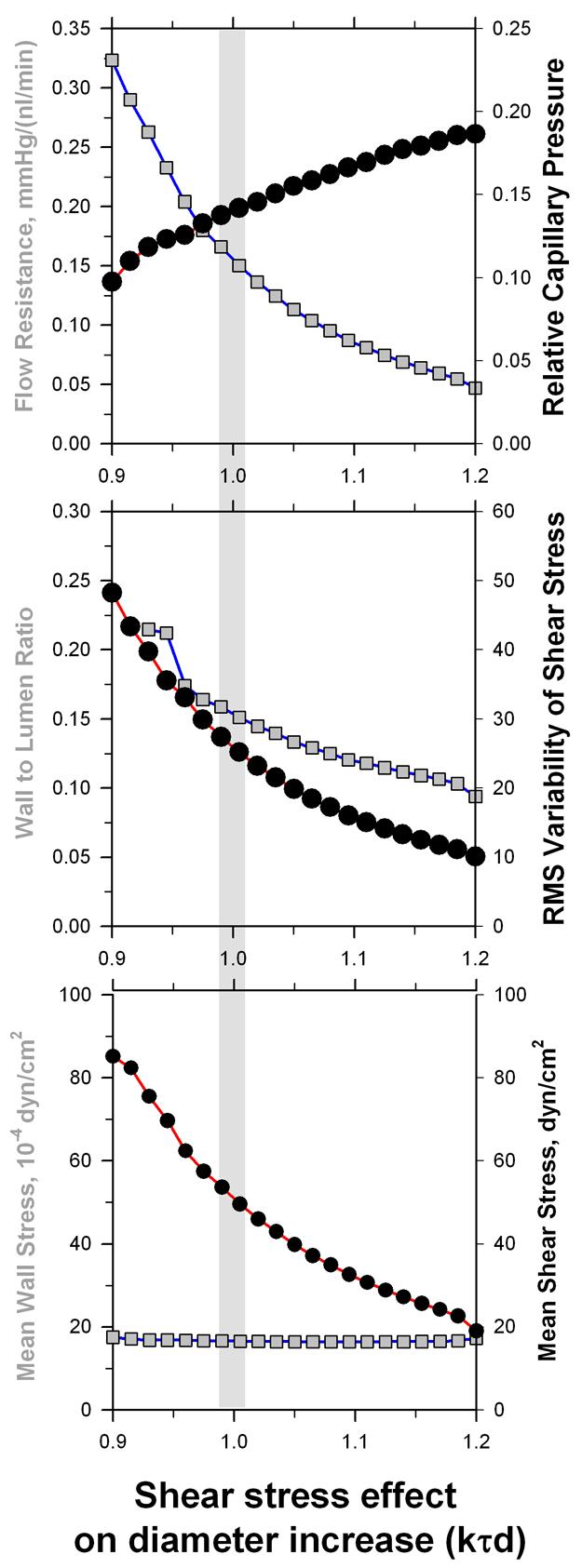
Dependence of structural and functional network parameters for graded changes of the sensitivity of vascular diameter reactions to wall shear stress (kτd in equation (3), standard reference value 1.0). Mean values for a vascular network with 546 individual vessel segments are given. The effects on mean capillary pressure relative to the difference between arterial input pressure and the venous outflow pressure (upper panel) and the root-mean-square variability of shear stress in individual vessel segments (middle panel) are highlighted. Increased shear stress sensitivity leads to a more homogeneous shear stress distribution, i.e. a closer adherence to the requirements of Murrey's optimization law. However, an increased reactivity to shear stress also reduces the arterio-venous difference in shear stress and pressure drop leading to an increased mean capillary pressure. This would increase net outward filtration from the microvascular bed and thus increase the risk of edema generation.

References

    1. Adair TH, Gay WJ, Montani JP. Growth regulation of the vascular system: evidence for a metabolic hypothesis. Am J Physiol. 1990;259:R393–R404. - PubMed
    1. Berne RM. Metabolic regulation of blood flow. Circ Res. 1964;14,15:I-261–I-268. - PubMed
    1. Berne RM, Knabb RM, Ely SW, Rubio R. Adenosine in the local regulation of blood flow: a brief overview. Fed Proc. 1983;42:3136–3142. - PubMed
    1. Björnberg J, Maspers M, Mellander S. Metabolic control of large-bore arterial resistance vessels, arterioles, and veins in cat skeletal muscle during exercise. Acta Physiol Scand. 1989;135:83–94. - PubMed
    1. Buschmann I, Schaper W. Arteriogenesis Versus Angiogenesis: Two Mechanisms of Vessel Growth. News Physiol Sci. 1999;14:121–125. - PubMed

Publication types