Comparative Study
. 2008 Sep 19:8:254.
doi: 10.1186/1471-2148-8-254.

Phylogenetic and chromosomal analyses of multiple gene families syntenic with vertebrate Hox clusters

Affiliations
Comparative Study

Phylogenetic and chromosomal analyses of multiple gene families syntenic with vertebrate Hox clusters

Görel Sundström et al. BMC Evol Biol. .

Abstract

Background: Ever since the theory about two rounds of genome duplication (2R) in the vertebrate lineage was proposed, the Hox gene clusters have served as the prime example of quadruplicate paralogy in mammalian genomes. In teleost fishes, the observation of additional Hox clusters absent in other vertebrate lineages suggested a third tetraploidization (3R). Because the Hox clusters occupy a quite limited part of each chromosome, and are special in having position-dependent regulation within the multi-gene cluster, studies of syntenic gene families are needed to determine the extent of the duplicated chromosome segments. We have analyzed in detail 14 gene families that are syntenic with the Hox clusters to see if their phylogenies are compatible with the Hox duplications and the 2R/3R scenario. Our starting point was the gene family for the NPY family of peptides located near the Hox clusters in the pufferfish Takifugu rubripes, the zebrafish Danio rerio, and human.

Results: Seven of the gene families have members on at least three of the human Hox chromosomes and two families are present on all four. Using both neighbor-joining and quartet-puzzling maximum likelihood methods we found that 13 families have a phylogeny that supports duplications coinciding with the Hox cluster duplications. One additional family also has a topology consistent with 2R but due to lack of urochordate or cephalochordate sequences the time window when these duplications could have occurred is wider. All but two gene families also show teleost-specific duplicates.

Conclusion: Based on this analysis we conclude that the Hox cluster duplications involved a large number of adjacent gene families, supporting expansion of these families in the 2R, as well as in the teleost 3R tetraploidization. The gene duplicates presumably provided raw material in early vertebrate evolution for neofunctionalization and subfunctionalization.


Figures
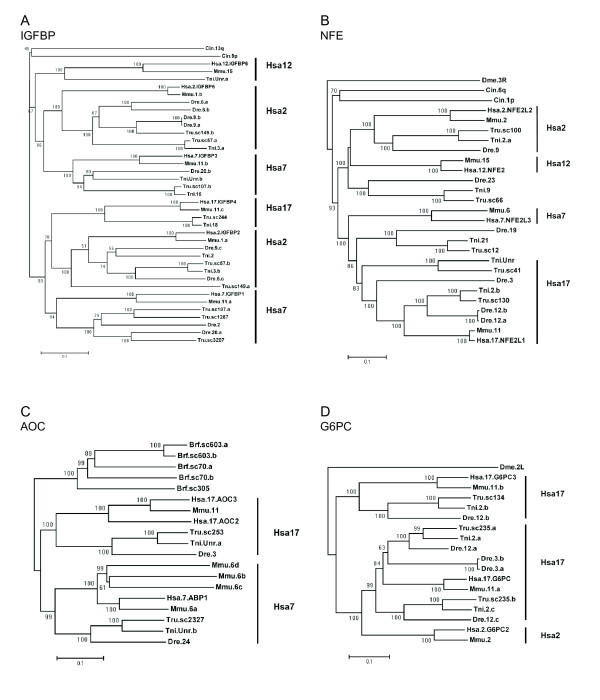
Figure 1
Figure 1
A-D – Phylogenetic trees for four of the investigated gene families. Phylogenetic neighbor-joining trees for four of the gene families analyzed in this study (A: IGFBP, B: NFE, C: AOC and D: G6PC). All trees constructed with the NJ method as implemented in Clustal W 1.81 with 1000 bootstrap replicates (values shown for each node). For IGFBP, sequences without the domains PF00219 (Insulin-like growth factor binding protein) and PF00086 (Thyroglobulin type-1 repeat) were removed from the alignment. Note that the tree contains two subfamilies relevant for this paralogon. Hsa is human (Homo sapiens), Mmu: Mouse (Mus musculus), Dre: zebrafish (Danio rerio), Tru: fugu (Takifugu rubripes), Tni: tetraodon (Tetraodon nigroviridis), Cin: (Ciona intestinalis), Brf (Branchiostoma floridae) and Dme: (Drosophila melanogaster). For complete phylogenetic analysis of all 14 families see Additional files 1 and 2.
Figure 2
Figure 2
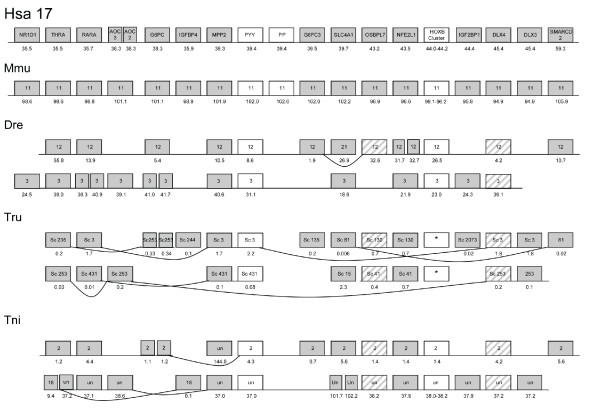
Conserved synteny between human chromosome 17 and chromosomes of other vertebrate species. Picture illustrating conservation of synteny between the species included in this analysis. Gene order is depicted based on the positions in the human genome. Genes located on the same chromosomes or scaffolds in other species are connected with lines in the figure. The names of the gene families are given in the boxes representing the human genes and chromosome number or scaffold number is given in the boxes representing the mouse and fish genes. Numbers below boxes indicate chromosomal or scaffold position in megabases. Two narrow boxes next to each other indicate local duplications. White boxes represent gene families not analyzed with phylogenetic methods in this study (NPY and Hox). Striped boxes indicate genes for which phylogeny is inconclusive but where the positional information is in agreement with the proposed paralogon. Boxes denoted "*" for Takifugu rubripes Hox clusters indicates that the Hox cluster is scattered on multiple scaffolds, due to incomplete assembly of the genome. Note that two separate parts of Tetraodon nigroviridis chromosome 2 displays conserved synteny with human chromosome 2 and 17.
Figure 3
Figure 3
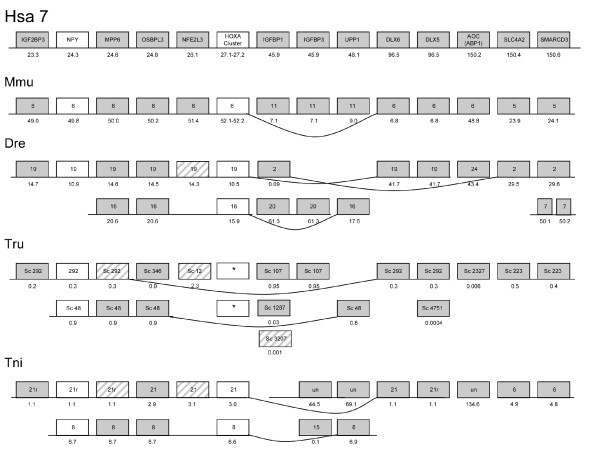
Conserved synteny between human chromosome 7 and chromosomes of other vertebrate species. Gene order, gene name, position, local duplications and linkage of genes are indicated in the same way as in Fig. 2.
Figure 4
Figure 4
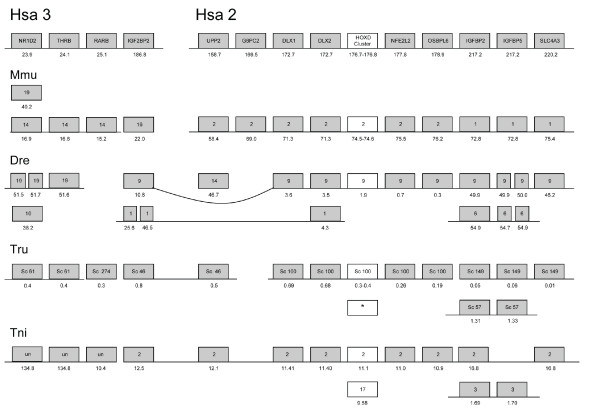
Conserved synteny between human chromosomes 2/3 and chromosomes of other vertebrate species. Gene order, gene name, position, local duplications and linkage of genes are indicated in the same way as in Fig. 2.
Figure 5
Figure 5
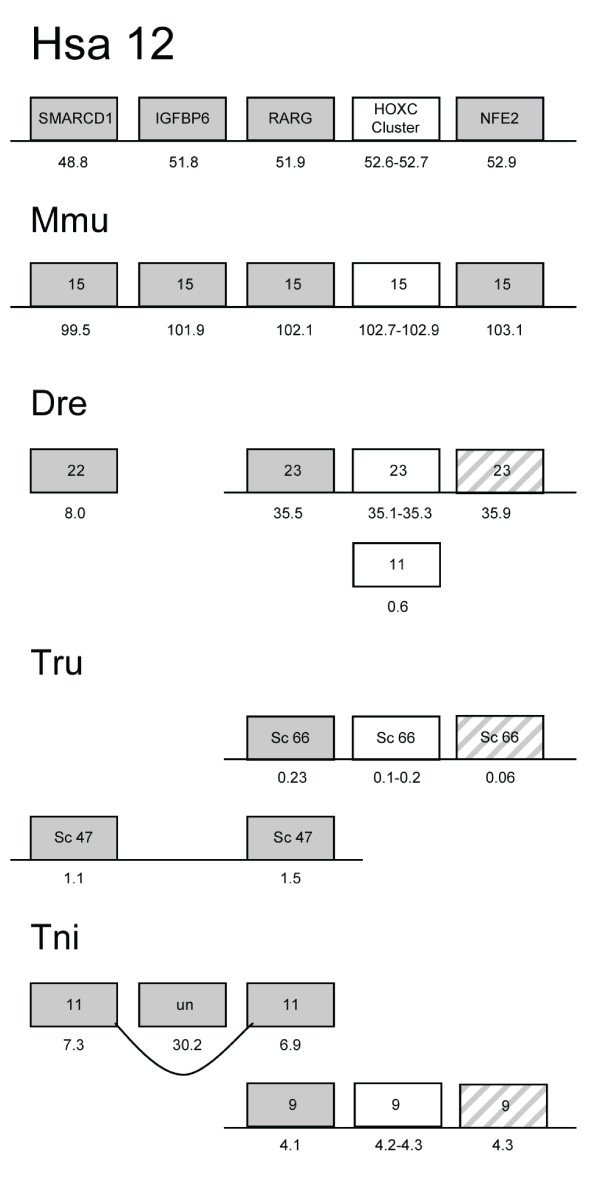
Conserved synteny between human chromosome 12 and chromosomes of other vertebrate species. Gene order, gene name, position, local duplications and linkage of genes are indicated in the same way as in Fig. 2.
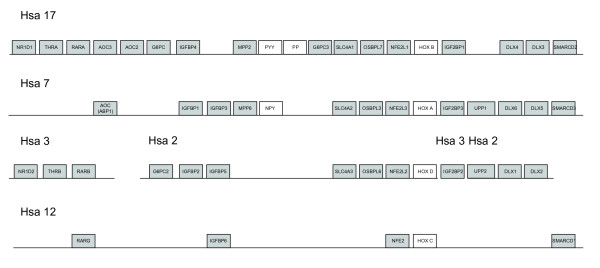
Figure 6
Figure 6
Schematic picture of human paralogs. Schematic picture illustrating the human paralogon analyzed in this study. Gene order as on chromosome 17. Observe that figure is not drawn to scale.

References

    1. Coulier F, Popovici C, Villet R, Birnbaum D. MetaHox gene clusters. J Exp Zool. 2000;8(4):345–351. doi: 10.1002/1097-010X(20001215)288:4<345::AID-JEZ7>3.0.CO;2-Y. - DOI - PubMed
    1. Lundin LG. Gene homologies with emphasis on paralogous genes and chromosomal regions. Life Sci Adv (Genet) 1989. pp. 89–104.
    1. Popovici C, Leveugle M, Birnbaum D, Coulier F. Homeobox gene clusters and the human paralogy map. FEBS Letters. 2001;8(3):237–242. doi: 10.1016/S0014-5793(01)02187-1. - DOI - PubMed
    1. Popovici C, Leveugle M, Birnbaum D, Coulier F. Coparalogy: physical and functional clusterings in the human genome. Biochem Biophys Res Commun. 2001;8(2):362–370. doi: 10.1006/bbrc.2001.5794. - DOI - PubMed
    1. Pebusque MJ, Coulier F, Birnbaum D, Pontarotti P. Ancient large-scale genome duplications: phylogenetic and linkage analyses shed light on chordate genome evolution. Mol Biol Evol. 1998;8(9):1145–1159. - PubMed

Publication types

LinkOut - more resources