


Survival of hereditary non-polyposis colorectal cancer patients compared with sporadic colorectal cancer patients
- PMID: 18803843
- PMCID: PMC2559820
- DOI: 10.1186/1756-9966-27-39
Survival of hereditary non-polyposis colorectal cancer patients compared with sporadic colorectal cancer patients
Abstract
Background: Patients with hereditary non-poliposys colorectal cancer (HNPCC) have better prognosis than sporadic colorectal cancer (CRC). Aim of our retrospective study was to compare the overall survival between sporadic CRC and HNPCC patients.
Methods: We analyzed a cohort of 40 (25 males and 15 females) HNPCC cases with a hospital consecutive series of 573 (312 males and 261 females) sporadic CRC observed during the period 1970-1993. In 15 HNPCC patients we performed mutational analysis for microsatellite instability. Survival rates were calculated by Kaplan-Meier method and compared with log rank test.
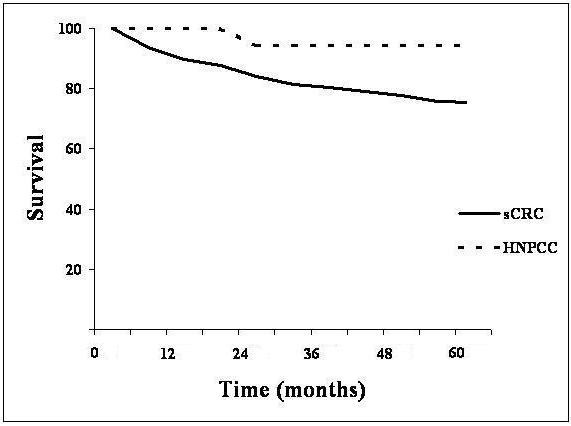
Results: The median age at diagnosis of the primary CRC was 46.8 years in the HNPCC series versus 61 years in sporadic CRC group. In HNPCC group 85% had a right cancer location, vs. 57% in the sporadic cancer group. In the sporadic cancer group 61.6% were early-stages cancer (Dukes' A and B) vs. 70% in the HNPCC group (p = ns). The crude 5-years cumulative survival after the primary CRC was 94.2% in HNPCC patients vs. 75.3% in sporadic cancer patients (p < 0.0001).
Conclusion: Our results show that overall survival of colorectal cancer in patients with HNPCC is better than sporadic CRC patients. The different outcome probably relates to the specific tumorigenesis involving DNA mismatch repair dysfunction.
Figures
References
-
- Parkin DM, Whelan SL, Flay J, Raymond L, Young J. Cancer incidence in five continents. Volume III. Vol. 143. IARC Sci Publ; 1997. pp. 1–1240. - PubMed
Publication types
MeSH terms
LinkOut - more resources
Full Text Sources
Medical
Miscellaneous
