


Lack of genomic evidence of AI-2 receptors suggests a non-quorum sensing role for luxS in most bacteria
- PMID: 18803868
- PMCID: PMC2561040
- DOI: 10.1186/1471-2180-8-154
Lack of genomic evidence of AI-2 receptors suggests a non-quorum sensing role for luxS in most bacteria
Abstract
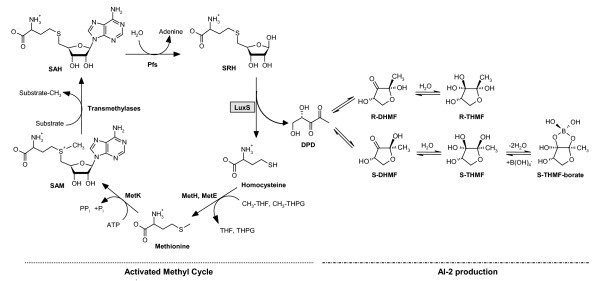
Background: Great excitement accompanied discoveries over the last decade in several Gram-negative and Gram-positive bacteria of the LuxS protein, which catalyzes production of the AI-2 autoinducer molecule for a second quorum sensing system (QS-2). Since the luxS gene was found to be widespread among the most diverse bacterial taxa, it was hypothesized that AI-2 may constitute the basis of a universal microbial language, a kind of bacterial Esperanto. Many of the studies published in this field have drawn a direct correlation between the occurrence of the luxS gene in a given organism and the presence and functionality of a QS-2 therein. However, rarely hathe existence of potential AI-2 receptors been examined. This is important, since it is now well recognized that LuxS also holds a central role as a metabolic enzyme in the activated methyl cycle which is responsible for the generation of S-adenosyl-L-methionine, the major methyl donor in the cell.
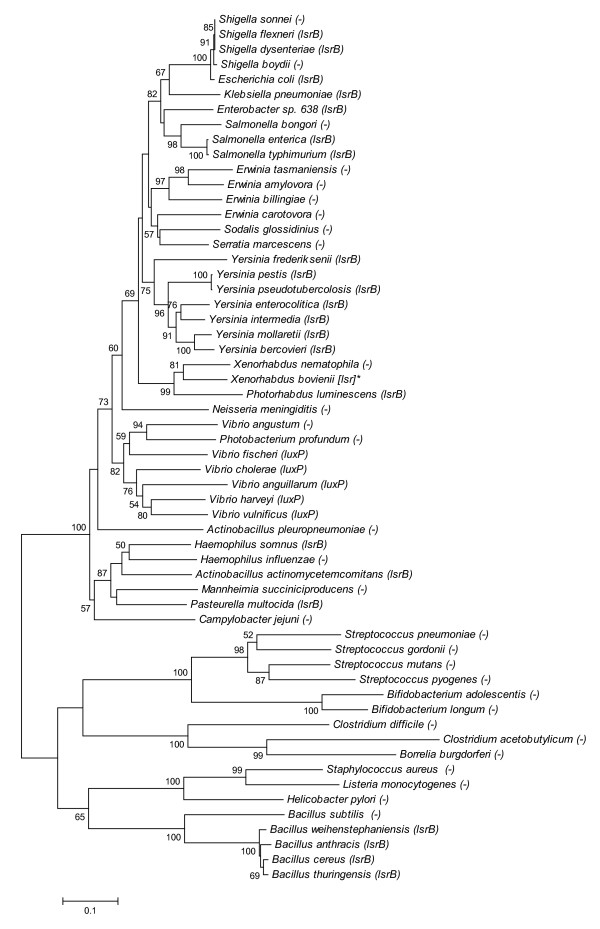
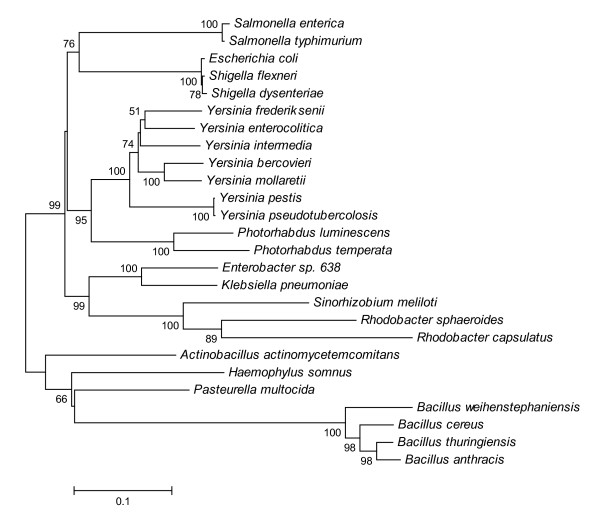
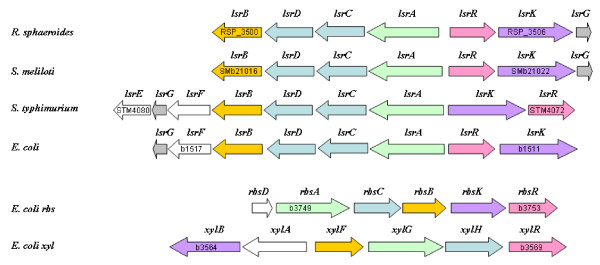
Results: In order to assess whether the role of LuxS in these bacteria is indeed related to AI-2 mediated quorum sensing we analyzed genomic databases searching for established AI-2 receptors (i.e., LuxPQ-receptor of Vibrio harveyi and Lsr ABC-transporter of Salmonella typhimurium) and other presumed QS-related proteins and compared the outcome with published results about the role of QS-2 in these organisms. An unequivocal AI-2 related behavior was restricted primarily to organisms bearing known AI-2 receptor genes, while phenotypes of luxS mutant bacteria lacking these genes could often be explained simply by assuming deficiencies in sulfur metabolism.
Conclusion: Genomic analysis shows that while LuxPQ is restricted to Vibrionales, the Lsr-receptor complex is mainly present in pathogenic bacteria associated with endotherms. This suggests that QS-2 may play an important role in interactions with animal hosts. In most other species, however, the role of LuxS appears to be limited to metabolism, although in a few cases the presence of yet unknown receptors or the adaptation of pre-existent effectors to QS-2 must be postulated.
Figures
References
-
- Whitehead NA, Barnard AM, Slater H, Simpson NJ, Salmond GP. Quorum-sensing in Gram-negative bacteria. FEMS Microbiol Rev. 2001;25:365–404. - PubMed
-
- Cao JG, Meighen EA. Purification and structural identification of an autoinducer for the luminescence system of Vibrio harveyi. J Biol Chem. 1989;264:21670–21676. - PubMed
-
- Engebrecht J, Nealson K, Silverman M. Bacterial bioluminescence: isolation and genetic analysis of functions from Vibrio fischeri. Cell. 1983;32:773–781. - PubMed
-
- Steidle A, Sigl K, Schuhegger R, Ihring A, Schmid M, Gantner S, Stoffels M, Riedel K, Givskov M, Hartmann A, Langebartels C, Eberl L. Visualization of N-acylhomoserine lactone-mediated cell-cell communication between bacteria colonizing the tomato rhizosphere. Appl Environ Microbiol. 2001;67:5761–5770. - PMC - PubMed
Publication types
MeSH terms
Substances
LinkOut - more resources
Full Text Sources
Molecular Biology Databases
