


Anopheles gambiae complex along The Gambia river, with particular reference to the molecular forms of An. gambiae s.s
- PMID: 18803885
- PMCID: PMC2569043
- DOI: 10.1186/1475-2875-7-182
Anopheles gambiae complex along The Gambia river, with particular reference to the molecular forms of An. gambiae s.s
Abstract
Background: The geographic and temporal distribution of M and S molecular forms of the major Afrotropical malaria vector species Anopheles gambiae s.s. at the western extreme of their range of distribution has never been investigated in detail.
Materials and methods: Collections of indoor-resting An. gambiae s.l. females were carried out along a ca. 400 km west to east transect following the River Gambia from the western coastal region of The Gambia to south-eastern Senegal during 2005 end of rainy season/early dry season and the 2006 rainy season. Specimens were identified to species and molecular forms by PCR-RFLP and the origin of blood-meal of fed females was determined by ELISA test.
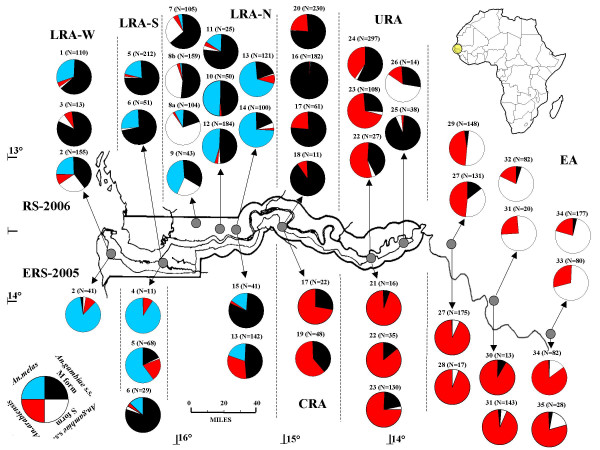
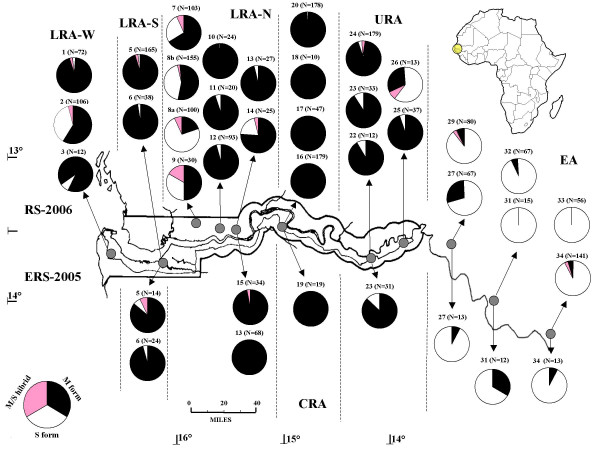
Results: Over 4,000 An. gambiae s.l. adult females were collected and identified, 1,041 and 3,038 in 2005 and 2006, respectively. M-form was mainly found in sympatry with Anopheles melas and S-form in the western part of the transect, and with Anopheles arabiensis in the central part. S-form was found to prevail in rural Sudan-Guinean savannah areas of Eastern Senegal, in sympatry with An. arabiensis. Anopheles melas and An. arabiensis relative frequencies were generally lower in the rainy season samples, when An. gambiae s.s. was prevailing. No large seasonal fluctuations were observed for M and S-forms. In areas where both M and S were recorded, the frequency of hybrids between them ranged from to 0.6% to 7%.
Discussion: The observed pattern of taxa distribution supports the hypothesis of a better adaptation of M-form to areas characterized by water-retaining alluvial deposits along the Gambia River, characterized by marshy vegetation, mangrove woods and rice cultivations. In contrast, the S-form seems to be better adapted to free-draining soil, covered with open woodland savannah or farmland, rich in temporary larval breeding sites characterizing mainly the eastern part of the transect, where the environmental impact of the Gambia River is much less profound and agricultural activities are mainly rain-dependent. Very interestingly, the observed frequency of hybridization between the molecular forms along the whole transect was much higher than has been reported so far for other areas.
Conclusion: The results support a bionomic divergence between the M and S-forms, and suggest that the western extreme of An. gambiae s.s. geographical distribution may represent an area of higher-than-expected hybridization between the two molecular forms.
Figures
References
-
- Bryan JH, Di Deco MA, Petrarca V, Coluzzi M. Inversion polymorphism and incipient speciation in Anopheles gambiae s.s. in Gambia, West Africa. Genetica. 1982;59:167–176. doi: 10.1007/BF00056539. - DOI
-
- Bryan JH, Petrarca V, Di Deco MA, Coluzzi M. Adult behaviour of members of the Anopheles gambiae complex in the Gambia with special reference to An. melas and its chromosomal variants. Parassitologia. 1987;29:221–249. - PubMed
-
- Fontenille D, Lochouarn L, Diatta M, Sokhna C, Dia I, Diagne N, Lemasson JJ, Ba K, Tall A, Rogier C, Trape JF. Four years' entomological study of the transmission of seasonal malaria in Senegal and the bionomics of Anopheles gambiae and A. arabiensis. Trans R Soc Trop Med Hyg. 1997;91:647–652. doi: 10.1016/S0035-9203(97)90506-X. - DOI - PubMed
-
- Lindsay SW, Wilkins HA, Zieler HA, Daly RJ, Petrarca V, Byass P. Ability of Anopheles gambiae mosquitoes to transmit malaria during the dry and wet seasons in an area of irrigated rice cultivation in The Gambia. J Trop Med Hyg. 1991;94:313–324. - PubMed
Publication types
MeSH terms
Substances
Grants and funding
LinkOut - more resources
Full Text Sources
