


Mechanism of 4-nitrophenol oxidation in Rhodococcus sp. Strain PN1: characterization of the two-component 4-nitrophenol hydroxylase and regulation of its expression
- PMID: 18805976
- PMCID: PMC2576653
- DOI: 10.1128/JB.00742-08
Mechanism of 4-nitrophenol oxidation in Rhodococcus sp. Strain PN1: characterization of the two-component 4-nitrophenol hydroxylase and regulation of its expression
Abstract
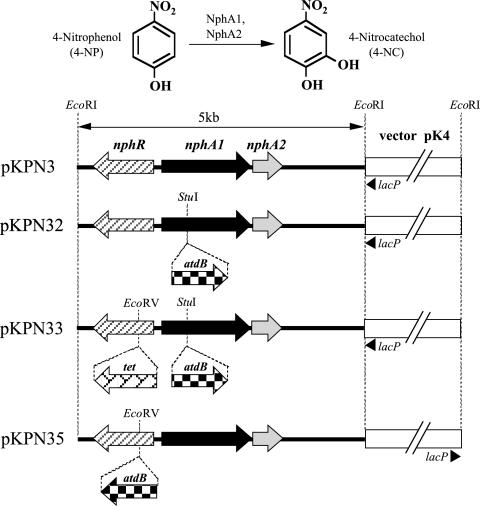
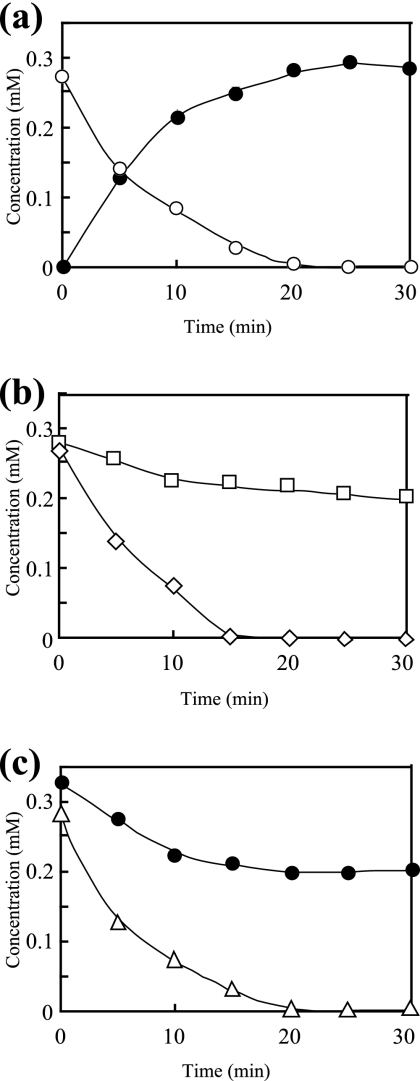
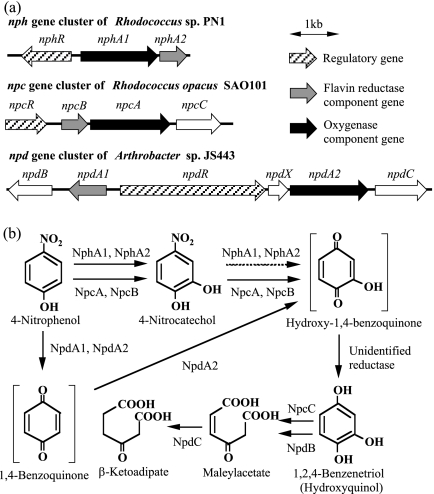
4-Nitrophenol (4-NP) is a toxic product of the hydrolysis of organophosphorus pesticides such as parathion in soil. Rhodococcus sp. strain PN1 degrades 4-NP via 4-nitrocatechol (4-NC) for use as the sole carbon, nitrogen, and energy source. A 5-kb EcoRI DNA fragment previously cloned from PN1 contained a gene cluster (nphRA1A2) involved in 4-NP oxidation. From sequence analysis, this gene cluster is expected to encode an AraC/XylS family regulatory protein (NphR) and a two-component 4-NP hydroxylase (NphA1 and NphA2). A transcriptional assay in a Rhodococcus strain revealed that the transcription of nphA1 is induced by only 4-NP (of several phenolic compounds tested) in the presence of nphR, which is constitutively expressed. Disruption of nphR abolished transcriptional activity, suggesting that nphR encodes a positive regulatory protein. The two proteins of the 4-NP hydroxylase, NphA1 and NphA2, were independently expressed in Escherichia coli and purified by ion-exchange chromatography or affinity chromatography. The purified NphA2 reduced flavin adenine dinucleotide (FAD) with the concomitant oxidation of NADH, while the purified NphA1 oxidized 4-NP into 4-NC almost quantitatively in the presence of FAD, NADH, and NphA2. This functional analysis, in addition to the sequence analysis, revealed that this enzyme system belongs to the two-component flavin-diffusible monooxygenase family. The 4-NP hydroxylase showed comparable oxidation activities for phenol and 4-chlorophenol to that for 4-NP and weaker activities for 3-NP and 4-NC.
Figures
References
-
- Abe, Y., M. Takeo, A. Sakakibara, and S. Negoro. 2003. Characterization of picric acid degradation by Rhodococcus sp. PN1. Jpn. J. Water Treat. Biol. 3925-31.
-
- Bolivar, F., R. L. Rodriguez, P. J. Greene, M. C. Betlach, H. L. Heyneker, and H. W. Boyer. 1977. Construction and characterization of new cloning vehicles. II. A multipurpose cloning system. Gene 295-113. - PubMed
-
- Chauhan, A., A. K. Chakraborti, and R. K. Jain. 2000. Plasmid-encoded degradation of p-nitrophenol and 4-nitrocatechol by Arthrobacter protophormiae. Biochem. Biophys. Res. Commun. 270733-740. - PubMed
Publication types
MeSH terms
Substances
Associated data
- Actions
LinkOut - more resources
Full Text Sources
Molecular Biology Databases
Miscellaneous
