. 2009 May;58(5):699-708.
doi: 10.1007/s00262-008-0592-4. Epub 2008 Sep 20.

Immunosensitization with a Bcl-2 small molecule inhibitor

Affiliations

Immunosensitization with a Bcl-2 small molecule inhibitor

Jonathan Begley et al. Cancer Immunol Immunother. 2009 May.

Abstract

Several tumor immunotherapy approaches result in a low percentage of durable responses in selected cancers. We hypothesized that the insensitivity of cancer cells to immunotherapy may be related to an anti-apoptotic cancer cell milieu, which could be pharmacologically reverted through the inhibition of antiapoptotic Bcl-2 family proteins in cancer cells. ABT-737, a small molecule inhibitor of the antiapoptotic proteins Bcl-2, Bcl-w and Bcl-x(L), was tested for the ability to increase antitumor immune responses in two tumor immunotherapy animal models. The addition of systemic therapy with ABT-737 to the immunization of BALB/c mice with tumor antigen peptide-pulsed dendritic cells (DC) resulted in a significant delay in CT26 murine colon carcinoma tumor growth and improvement in survival. However, the addition of ABT-737 to either a vaccine strategy involving priming with TRP-2 melanoma antigen peptide-pulsed DC and boosting with recombinant Listeria monocytogenes expressing the same melanoma antigen, or the adoptive transfer of TCR transgenic cells, did not result in superior antitumor activity against B16 murine melanoma. In vitro studies failed to demonstrate increased cytotoxic lytic activity when testing the combination of ABT-737 with lymphokine activated killer (LAK) cells, or the death receptor agonists Fas, TRAIL-ligand or TNF-alpha against the CT26 and B16 cell lines. In conclusion, the Bcl-2 inhibitor ABT-737 sensitized cancer cells to the antitumor effect of antigen-specific immunotherapy in a vaccine model for the CT26 colon carcinoma in vivo but not in two immunotherapy strategies against B16 melanoma.


Figures
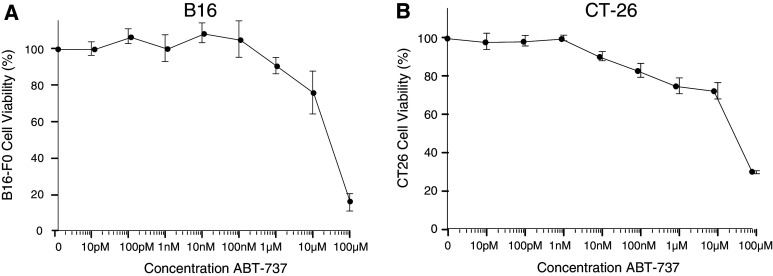
Fig. 1
Fig. 1
Dose–response curves for ABT-737 against B16-F0 and CT26 cells. B16-F0 (a) and CT26 (b) cells were incubated in 96-well plates with varying concentrations of ABT-737 for 24 h. Cells were then incubated in MTT for 1 h and cell viability was estimated by measuring optical density at 562 nm. Figures are representative of three independent experiments
Fig. 2
Fig. 2
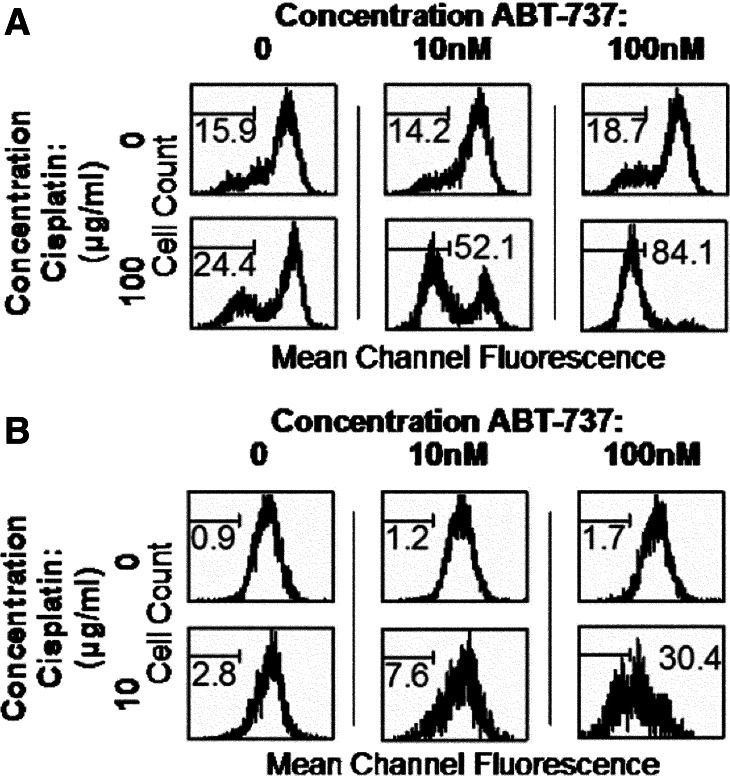
ABT-737 potentiated mitochondrial depolarization. B16-F0 (a) and CT26 (b) cells were incubated with a range of concentrations of ABT-737 (0, 10, 100 nM) and cisplatin (0, 1, 10, 100 μM). Cells were stained with DiOC6(3), and the peak shift to the left (representing mitochondrial membrane depolarization) was analyzed by flow cytometry. Results are representative of two independent experiments
Fig. 3
Fig. 3
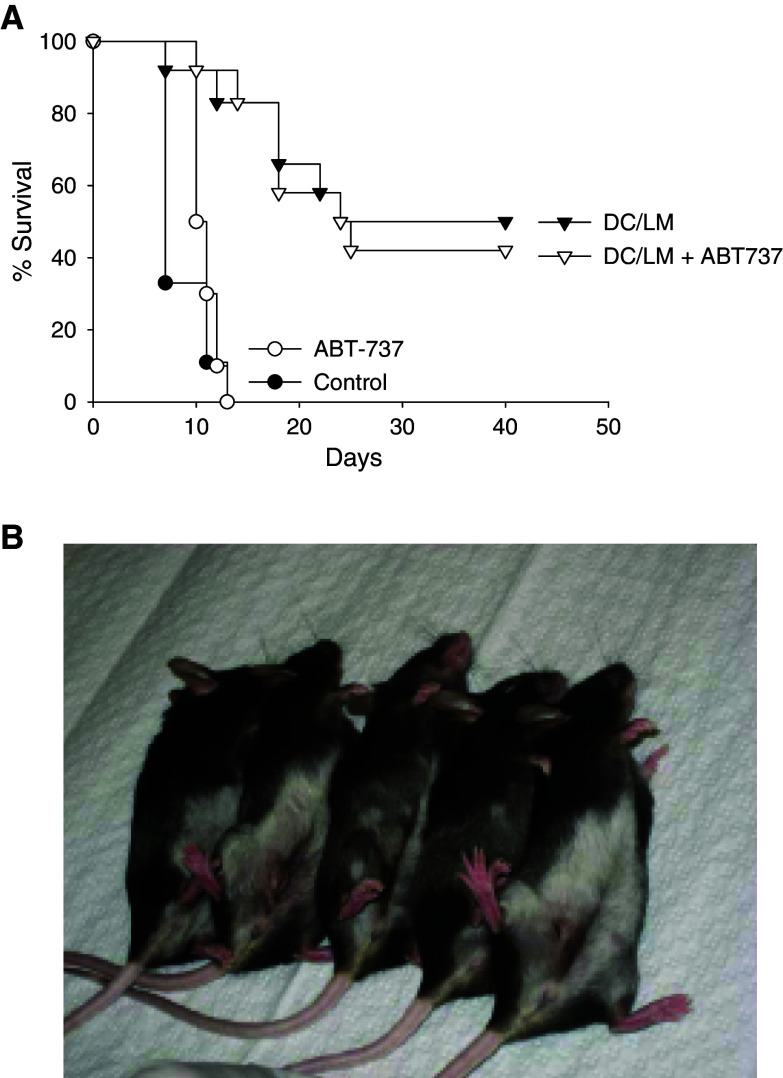
ABT-737 potentiated the anti-tumor activity of a DC vaccine-based immunotherapy against CT26 in vivo. BALB/c mice were randomized into four groups: (1) Untreated control, (2) ABT-737 treatment alone, (3) DC-vaccination treatment alone, and (4) ABT-737 and DC-vaccination combined therapy. Three AH1 and p320–333 peptide-pulsed DC vaccinations were given subcutaneously 2 weeks before, 1 week before and 1 week after tumor challenge. ABT-737 (50 mg/kg) was given intraperitoneally daily starting on day 8 after tumor challenge. Tumor volume curves are shown (a), representative of three independent experiments. Survival is shown (b), combined from three independent experiments
Fig. 4
Fig. 4
ABT-737 does not augment the in vivo antitumor effects of immunotherapy with TRP2-pulsed DC and recombinant Listeria monocytogenes-TRP2 (rLM-TRP2) vaccines. a C57BL/6 mice received a TRP2 peptide-pulsed DC prime followed 1 week later by an rLM-TRP2 boost. One week after the boost, mice were challenged with B16 melanoma in a flank. ABT-737 (50 mg/kg) was given intraperitoneally daily thereafter. There was no difference in the survival of mice receiving immunotherapy plus ABT-737 over immunotherapy alone. b Mice in the immunotherapy plus ABT-737 group that became long-term survivors after B16 tumor challenge rejection developed autoimmune vitiligo in the lower abdomen and flanks, the sites of prior B16 tumor challenge
Fig. 5
Fig. 5
ABT-737 did not sensitize B16 melanoma to the pmel-1 adoptive transfer in vivo therapy model. C57BL/6 mice received left flank subcutaneous implantation of 105 B16 melanoma cells on day 0. On day 12, groups of mice received total body irradiation (TBI) with a cesium irradiator of 500 cGy (lymphodepletion). The following day, mice were adoptively transferred 106 activated pmel-1 cells (ex vivo activation for 48 h with IL-2, IL-15, and gp10025–33). Mice treated with pmel-1 adoptive transfer received two subcutaneous injections of 5 × 105 gp10025–33 peptide-pulsed dendritic cells (DC) on the day of adoptive transfer and 1 week later. These mice also received IL-2, 250,000 IU, intraperitoneally for 3 days, starting with each DC injection (total of six doses IL-2). Groups of mice also received ABT-737 50 mg/kg, intraperitoneally, 5 days each week starting on the day of adoptive transfer
Fig. 6
Fig. 6
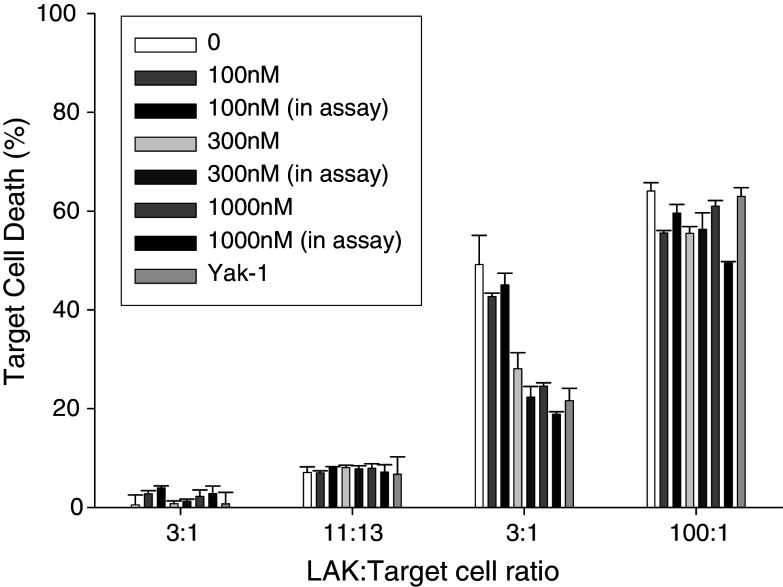
ABT-737 did not sensitize cells to perforin and granzyme-induced killing. CT26 and Yac-1 cells were incubated in ABT-737 at the specified concentrations, and chromium for 24 h. CT26 cells were incubated with LAK effector cells for 4 h, and CT26 cytolysis measured by chromium-release. Yac-1 cells were used as a positive control for killing (far right bar). ABT-737 was included in some assay samples (“in assay”), but not others
Fig. 7
Fig. 7
ABT-737 did not sensitize cells to Fas, TRAIL or TNF-α-induced apoptosis in CT26 cells. EL4, Jurkat and CCL-1 cells were incubated in low-serum medium for 24 h prior to incubation with agonistic Fas antibody (a), TRAIL-ligand (b) or TNF-α (c), respectively, as positive controls for killing. CT26 cells were incubated in low-serum medium for 24 h at 37°C with the specified concentrations of ABT-737 prior to incubation in the specified concentrations of agonistic Fas antibody (d), TRAIL-ligand (e) or TNF-α (f) for 48 h at 38.5°C. Cell viability was measured using a bioluminescent cell-viability assay. Note that parallel curves (df) represent that the effects of the Fas, TRAIL and TNF-α with ABT-737 were additive but not synergistic

References

    1. Dunn GP, Bruce AT, Ikeda H, Old LJ, Schreiber RD. Cancer immunoediting: from immunosurveillance to tumor escape. Nat Immunol. 2002;3:991–998. doi: 10.1038/ni1102-991. - DOI - PubMed
    1. Strasser A. The role of BH3-only proteins in the immune system. Nat Rev Immunol. 2005;5:189–200. doi: 10.1038/nri1568. - DOI - PubMed
    1. Begley J, Ribas A. Targeted therapies to improve tumor immunotherapy. Clin Cancer Res. 2008;14:4385–4391. doi: 10.1158/1078-0432.CCR-07-4804. - DOI - PubMed
    1. Oltersdorf T, Elmore SW, Shoemaker AR, Armstrong RC, Augeri DJ, Belli BA, Bruncko M, Deckwerth TL, Dinges J, Hajduk PJ, Joseph MK, Kitada S, Korsmeyer SJ, Kunzer AR, Letai A, Li C, Mitten MJ, Nettesheim DG, Ng S, Nimmer PM, O’Connor JM, Oleksijew A, Petros AM, Reed JC, Shen W, Tahir SK, Thompson CB, Tomaselli KJ, Wang B, Wendt MD, Zhang H, Fesik SW, Rosenberg SH. An inhibitor of Bcl-2 family proteins induces regression of solid tumours. Nature. 2005;435:677–681. doi: 10.1038/nature03579. - DOI - PubMed
    1. Kuroda J, Puthalakath H, Cragg MS, Kelly PN, Bouillet P, Huang DC, Kimura S, Ottmann OG, Druker BJ, Villunger A, Roberts AW, Strasser A. Bim and Bad mediate imatinib-induced killing of Bcr/Abl + leukemic cells, and resistance due to their loss is overcome by a BH3 mimetic. Proc Natl Acad Sci USA. 2006;103:14907–14912. doi: 10.1073/pnas.0606176103. - DOI - PMC - PubMed

Publication types

MeSH terms