


A within-subject assessment of the discriminative stimulus and reinforcing effects of self-administered cocaine in rhesus monkeys
- PMID: 18807249
- PMCID: PMC2738977
- DOI: 10.1007/s00213-008-1322-5
A within-subject assessment of the discriminative stimulus and reinforcing effects of self-administered cocaine in rhesus monkeys
Abstract
Rationale: Drug discrimination (DD) and drug self-administration (SA) are frequently used preclinical assays. All preclinical studies with cocaine have examined the discriminative stimulus (S(D)) and reinforcing (S(R)) effects in separate groups of subjects.
Objective: The objective of the study is to train drug-naïve rhesus macaques to discriminate self-administered cocaine from saline and to assess S(D) and S(R) effects using a within-subjects design.
Materials and methods: Adult male rhesus monkeys (n = 4) were trained to self-administer cocaine (0.1 mg/kg per injection) under a progressive-ratio (PR) reinforcement schedule. Next, they were trained to discriminate self-administered cocaine (0.45 or 0.56 mg/kg) or saline under a fixed-ratio (FR) 50 schedule of food presentation. The final schedule combined DD and SA into a multiple [chained FR 50 SA (cocaine or saline), food-reinforced DD] and PR SA schedule.
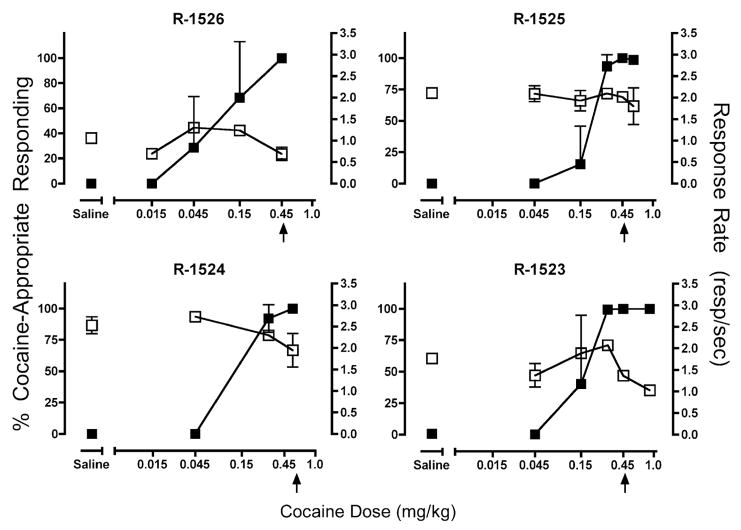
Results: Each subject acquired SA under a PR schedule with significant differences in breakpoint between saline and cocaine evident by session 5. Self-administered cocaine was established as an S(D), such that 80% of responding before delivery of the first reinforcer and 90% of all responding occurred on the injection-appropriate lever. In all monkeys, there was at least one cocaine dose that did not engender cocaine-appropriate responding during DD (i.e., <20% cocaine-appropriate responding) yet functioned as a reinforcer during PR SA, suggesting that cocaine-like S(D) effects are not necessary for cocaine reinforcement.
Conclusions: This within-subject model may provide new information related to the behavioral mechanisms of action leading to the high abuse potential of cocaine; such information may lead to novel pharmacological treatment strategies for addiction.
Figures




References
-
- Ator NA. Relation between discriminative and reinforcing effects of midazolam, pentobarbital, chlordiazepoxide, zolpidem, and imidazenil in baboons. Psychopharmacology. 2002;163:477–487. - PubMed
-
- Bigelow GE, Preston KL. Drug discrimination: methods for drug characterization and classification. NIDA Res Monogr. 1989;92:101–122. - PubMed
-
- Brady JV, Lukas SE. Testing drugs for physical dependence potential and abuse liability. NIDA Res Monogr. 1984:52. - PubMed
-
- Carroll ME. PCP and hallucinogens. Adv Alcohol Subst Abuse. 1990;9:167–190. - PubMed
-
- Colpaert FC. Drug discrimination in neurobiology. Pharmacol Biochem Behav. 1999;64:337–345. - PubMed
Publication types
MeSH terms
Substances
Grants and funding
LinkOut - more resources
Full Text Sources
Research Materials
